
Zepbound KwikPen: Doses, Step-by-Step Use, Needles, and Storage
The Zepbound KwikPen holds 4 fixed weekly doses in one of six strengths. How to attach the needle, prime, inject, store, and dispose of it, following its January 2026 Instructions for Use, plus how it compares with the single-dose pen and vials.


The Zepbound KwikPen is a multi-dose, single-patient-use prefilled pen that holds 4 fixed weekly doses of tirzepatide in one strength. Needles are not included: you attach a new pen needle and prime the pen before every weekly injection. You throw the pen away after 4 doses, 30 days after first use, or 30 days total at room temperature, whichever comes first.
The KwikPen holds the same medicine as the other Zepbound forms and shares the same FDA label and side-effect list. For the full list, see our page on Zepbound side effects.
Key takeaways:
- Approved: by the FDA on January 20, 2026; Lilly launched it in February 2026.
- Strengths: 2.5, 5, 7.5, 10, 12.5, or 15 mg per weekly dose, one strength per pen.
- Fixed dose: 0.6 mL. You turn the dose knob until it stops; you do not set the amount.
- Every week: new pen needle, then priming, then your dose.
- Leftover medicine: stays in the pen and goes out with it.
Table of Contents
- What is the Zepbound KwikPen?
- Zepbound KwikPen strengths and doses
- What you need before your first injection
- How to use the Zepbound KwikPen, step by step
- Priming the KwikPen every week
- Which pen needles fit the Zepbound KwikPen?
- Why medicine is left after 4 doses
- How to store the Zepbound KwikPen and when to throw it away
- Missed doses and the pen's 30-day limit
- How to dispose of the KwikPen and pen needles
- Zepbound KwikPen troubleshooting
- KwikPen vs single-dose pen vs vial
- How much does the Zepbound KwikPen cost?
- Plan a monthly routine around each pen
- Frequently asked questions
What Is the Zepbound KwikPen?
The Zepbound KwikPen is a disposable pen for one person that delivers 4 fixed weekly doses from a single device. Each dose is 0.6 mL, so one pen covers about a month of treatment.
The FDA approved it on January 20, 2026, as a supplement to the Zepbound application (NDA 217806/S-002). The approval letter added "six presentations of Zepbound KwikPen, each containing 4 doses of a fixed volume." Lilly announced availability on February 23, 2026.
What stays the same and what changes:
- Same medicine, same uses. The KwikPen is part of the same Zepbound label, so the approved uses match (section 1). One is weight reduction and long-term maintenance in adults with obesity, or with overweight and at least one weight-related condition, alongside a reduced-calorie diet and more physical activity. The other is moderate to severe obstructive sleep apnea in adults with obesity. For other GLP-1 options, see our GLP-1 medications list.
- Different inactive ingredients. Each KwikPen dose contains benzyl alcohol, glycerin, and phenol, which the single-dose pen and single-dose vial do not (label section 11). The label says not to use Zepbound if you have had a serious allergic reaction to tirzepatide or any of its ingredients (section 4), so tell your prescriber about any allergy to these.
- Tested for dose accuracy. The Instructions for Use (IFU) state that the pen meets the ISO 11608-1 dose accuracy standard.
Mounjaro, which contains the same medicine, also lists a single-patient-use KwikPen in its US label. Our Zepbound vs Mounjaro comparison covers how the two brands differ.
Zepbound KwikPen Strengths and Doses
The Zepbound KwikPen comes in six strengths: 2.5, 5, 7.5, 10, 12.5, and 15 mg per weekly dose. Each pen holds one strength, and every dose is the same 0.6 mL (label sections 3 and 11).
| Weekly dose | Total in the pen (2.4 mL) | Concentration | Doses per pen |
|---|---|---|---|
| 2.5 mg | 10 mg | 4.17 mg/mL | 4 |
| 5 mg | 20 mg | 8.33 mg/mL | 4 |
| 7.5 mg | 30 mg | 12.5 mg/mL | 4 |
| 10 mg | 40 mg | 16.7 mg/mL | 4 |
| 12.5 mg | 50 mg | 20.8 mg/mL | 4 |
| 15 mg | 60 mg | 25 mg/mL | 4 |
Source: Zepbound Prescribing Information, revised 08/2026, sections 3 and 16.1.
What this means for you:
- Same volume, stronger liquid. A 15 mg pen delivers the same 0.6 mL as a 2.5 mg pen; the liquid is six times as concentrated.
- A dose change means a new pen. You cannot set a different dose on a KwikPen. If your prescriber changes your dose, you get a pen of the new strength.
- The label sets the start. Treatment begins at 2.5 mg once weekly for 4 weeks, and 2.5 mg is not a maintenance dose. The label then moves to 5 mg, and your prescriber may raise the dose in 2.5 mg steps, at least 4 weeks apart, up to 15 mg (label sections 2.1 and 2.2). The full label schedule is in our tirzepatide dosage chart.
What You Need Before Your First Injection
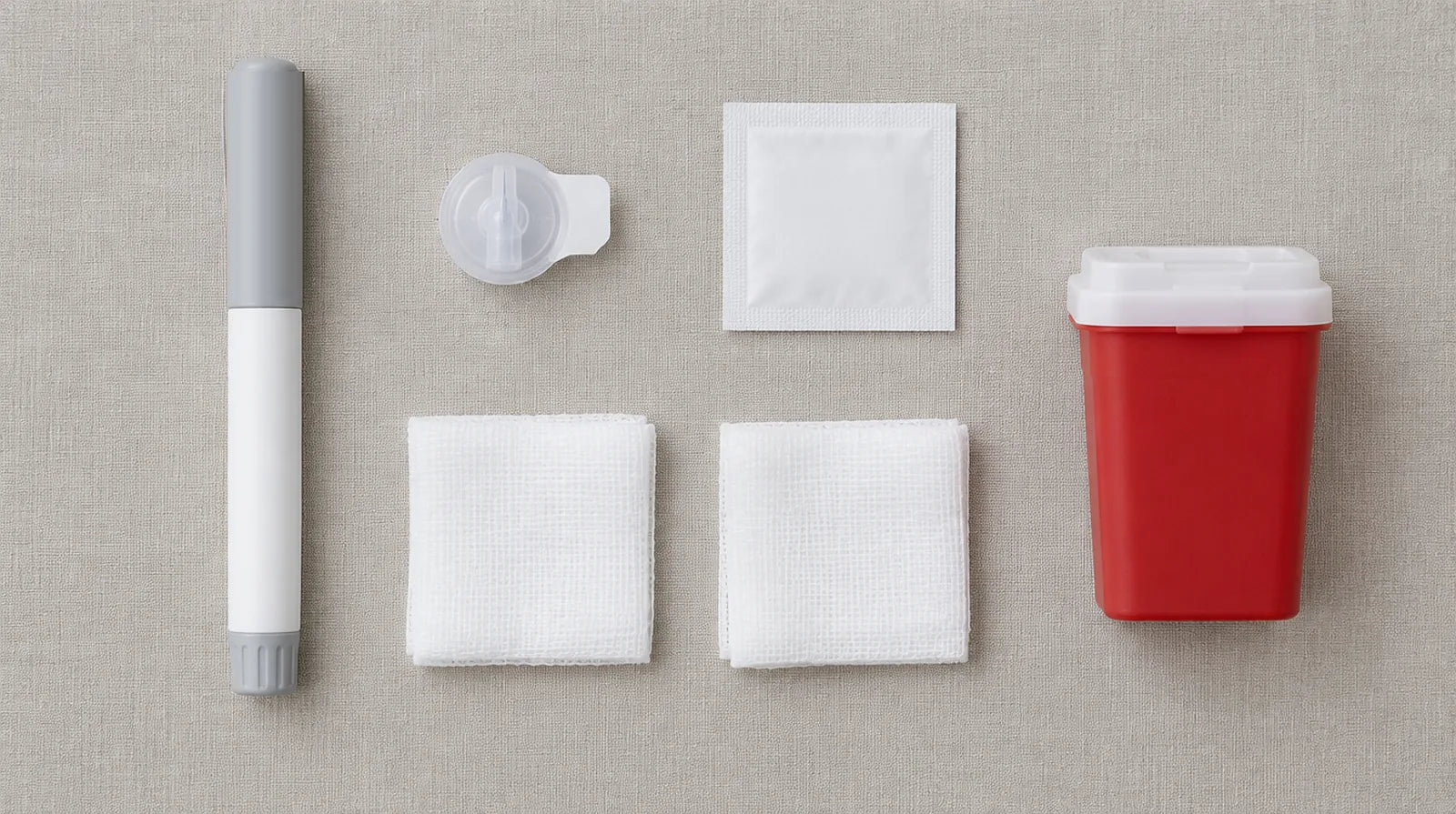
Before your first Zepbound KwikPen injection, gather five supplies listed in the IFU. The pen needle is the one item not in the box.
- Zepbound KwikPen
- KwikPen-compatible pen needle (not included)
- Alcohol swab
- Gauze or cotton ball
- FDA-cleared sharps disposal container, or a household container that meets the IFU criteria
Three rules apply before you start:
- Get device training. Label section 2.4 says patients should be trained on the specific presentation they receive. The IFU says to read it each time you get a new pen, since there may be new information.
- Vision problems need a helper. Label section 2.4 says the KwikPen is not recommended for self-injection by people who are visually impaired, and the Medication Guide says self-injection is not recommended for people who are visually impaired. The counseling section allows it only if a healthcare provider decides the person can inject properly (section 17). The IFU says people who are blind or have vision problems should not use the pen without help from a person trained to use it.
- Never share the pen. Section 5.10, added in January 2026, says never to share a Zepbound KwikPen, even if the needle is changed, because sharing can spread blood-borne infections.
How to Use the Zepbound KwikPen, Step by Step
The Zepbound KwikPen IFU has 17 steps in four groups: prepare, prime, inject, and finish. The order matters: the needle goes on first, then you prime, then you turn the knob to your dose.
Prepare the pen (steps 1 to 6)
- Wash your hands with soap and water.
- Pull the pen cap straight off. Check that the name and strength match your prescription and that the pen is not expired or damaged. The medicine should be colorless to slightly yellow; do not use it if it is frozen, cloudy, discolored, or has particles.
- Wipe the red inner seal with an alcohol swab.
- Take a new pen needle and pull off the paper tab.
- Push the capped needle straight onto the pen and twist it until it is tight.
- Pull off the outer needle shield and keep it for later. Pull off the inner needle shield and put it in your household trash.
Prime the pen (steps 7 to 9)
Set the prime position, tap air bubbles up with the needle pointing up, and push the knob in to release a drop into the air. The next section covers each move and what to do if no drop appears.
Inject your dose (steps 10 to 13)
- Step 10: choose your site. You or another person can inject into your stomach, at least 2 inches from the belly button, or your thigh. Only another person should use the back of your upper arm. Pick a new spot each week, and see our Zepbound injection sites guide for rotation and skin to avoid.
- Step 11: turn the dose knob all the way until it stops and the "1" icon shows in the dose window. This is your weekly dose. The IFU says, "Do not count clicks as you select the dose."
- Step 12: insert the needle. Push the dose knob in until it stops, then slowly count to 5 while holding it. The "0" icon must show in the dose window before you remove the needle.
- Step 13: pull the needle out and check the window. A drop of medicine on the needle tip is normal and does not affect your dose. If you see the "0" icon, you received the full dose.
If the "0" icon is not showing, put the needle back into your skin and finish the injection. Do not redial the dose. If you still think you did not get the full dose, the IFU says not to start over or repeat the injection.
Finish (steps 14 to 17)
- Step 14: if you see blood, press lightly with gauze or a cotton ball. Do not rub.
- Step 15: carefully put the outer needle shield back on.
- Step 16: unscrew the capped needle and put it in a sharps container. Never store the pen with a needle attached; the IFU says this can cause leaking, a blocked needle, and air in the pen.
- Step 17: put the pen cap back on.
The KwikPen IFU has no step for pinching or cleaning the skin, and none for warming the pen; the alcohol swab is for the red inner seal. Lilly shows each step in an official how-to-use video.
Priming the KwikPen Every Week
You prime the Zepbound KwikPen before every weekly injection, not only the first time. The IFU says priming removes air from the cartridge and makes sure the pen is working correctly.
Priming takes three moves, always with a new needle already attached:
- Set the prime position. Slowly turn the dose knob until you hear 2 clicks and the extended line shows in the dose window. If you pass it, turn the knob either way until the line meets the dose indicator.
- Move air to the top. Hold the pen with the needle pointing up and gently tap the cartridge holder.
- Release a drop. Push the dose knob in until it stops, then slowly count to 5 while holding it. The "0" icon must show. Do not inject this into your body.
Your pen is primed when a small drop of medicine comes out of the needle tip. If no drop appears, the IFU gives a fixed order:
- Repeat the three moves, no more than 2 additional times.
- If there is still no drop, change the pen needle and repeat them no more than 1 additional time.
- If there is still no drop, contact Lilly at 1-800-LillyRx (1-800-545-5979).
Priming does not come out of your 4 doses. The label says each KwikPen contains additional volume to allow for device priming (section 11).
Which Pen Needles Fit the Zepbound KwikPen?
The Zepbound KwikPen needs KwikPen-compatible pen needles, bought separately, with a new one for every injection. US labeling does not name a needle length or gauge.
What the sources say:
- A new needle every time. The IFU says to always use a new pen needle for each injection "to help prevent infections and blocked needles."
- Compatible needles. Lilly's US site says the pen is given with a KwikPen-compatible pen needle. Lilly Canada's needle page says Lilly does not make pen needles. It lists ISO 11608-2 compliant pen needles in lengths of 4, 5, 6, 8, or 12.7 mm and gauges of 29G to 34G as compatible. Not every combination is sold, and that page is Canadian information, not US labeling.
- Size is your provider's call. Lilly Canada tells patients to ask their healthcare provider. For insulin, the FITTER recommendations call the shortest needles (currently 4 mm for pens) safe, effective, and less painful, and suggest them first. That is insulin guidance, several authors worked for a needle maker, and it is not tirzepatide data.
Ask your pharmacist how to get pen needles with your prescription, and keep a few spares, since the priming steps may call for a fresh needle. Never share needles, and never leave one on the pen between doses.
Why Medicine Is Left After 4 Doses
A Zepbound KwikPen still holds some medicine after 4 doses, and the label says to throw the pen away with that medicine inside. The extra volume supports priming, and Lilly Medical says the leftover medicine "ensures the KwikPen operates correctly."
The IFU is direct:
- After 4 doses, throw away the pen, including the unused medicine.
- The pen will prevent you from dialing a full dose after 4 weekly doses.
- Do not inject the leftover medicine.
- Do not transfer Zepbound from your pen into a syringe.
Trying to inject leftover medicine "could result in an incomplete dose," the IFU warns. If the knob stops before the "1" icon, throw the pen away; there may not be enough medicine for a full dose. Our page on microdosing tirzepatide explains what the label and the evidence say about doses below 2.5 mg.
Never take 2 doses of Zepbound within 3 days (72 hours) of each other, the Medication Guide says. If you take too much, call your healthcare provider or Poison Help at 1-800-222-1222, or go to the nearest emergency room right away.
How to Store the Zepbound KwikPen and When to Throw It Away
Keep unused Zepbound KwikPens in the refrigerator at 36°F to 46°F. Once a pen is in use, keep it in the refrigerator or at room temperature up to 86°F. Throw it away after 30 days total at room temperature, 30 days after first use, or 4 weekly doses, whichever comes first (label section 16.2).
| Pen status | Where to keep it | When to throw it away |
|---|---|---|
| Unopened, refrigerated | Refrigerator, 36°F to 46°F, in the carton | At the expiration date on the label |
| Unopened, at room temperature | Up to 86°F | After 30 days |
| Opened (in use) | Refrigerator or room temperature up to 86°F, in the carton | After 30 days total at room temperature, 30 days after first use, or 4 doses, whichever comes first, even with medicine left |
| Frozen at any point | Not applicable | Do not use it; throw it away |
Source: Zepbound Prescribing Information, revised 08/2026, section 16.2, and the KwikPen Instructions for Use, January 2026.
More rules from the label documents:
- Heat and light. Protect the pen from both and keep it in its original carton.
- Cap on, needle off. Do not store the pen without its cap or with a needle attached.
- Children. Keep pens and needles out of their sight and reach.
The IFU is shorter than the label: it says to keep unused pens in the refrigerator and to throw a pen away 30 days after first use or after 4 doses. For contrast, single-dose pens and single-dose vials may stay unrefrigerated for up to 21 days total; the multi-dose vial follows the same 30-day rules as the KwikPen. For storage rules for every Zepbound form, read does Zepbound need refrigeration.
Missed Doses and the Pen's 30-Day Limit
A missed Zepbound KwikPen dose follows the same label rule as every Zepbound form: take it as soon as possible within 4 days (96 hours), and skip it if more than 4 days have passed. You can move your injection day if at least 3 days (72 hours) separate two doses (label section 2.3).
The pen adds one wrinkle. Its 30-day clock keeps running from first use, and the label does not say how to handle a skipped week inside that window. Do not use a pen past its discard point, and ask your pharmacist or prescriber how to time your next pen.
How to Dispose of the KwikPen and Pen Needles
Put each used pen needle in an FDA-cleared sharps container right after your Zepbound KwikPen injection. Once the needle is off, the IFU says the pen itself can go in household trash or a sharps container.
If you do not have an FDA-cleared container, the IFU allows a household container that is:
- made of heavy-duty plastic,
- closed with a tight-fitting, puncture-resistant lid,
- upright and stable during use,
- leak-resistant, and
- labeled to warn of hazardous waste inside.
Never throw loose needles in the trash. Do not put a full sharps container in household trash unless your community guidelines allow it, and never recycle it. State or local laws may apply; the FDA explains the options at fda.gov/safesharpsdisposal. The single-dose pen is different: its needle is built in, so the whole pen goes into a sharps container.
Zepbound KwikPen Troubleshooting
Most Zepbound KwikPen problems have a fixed answer in the IFU, either in its steps or in its troubleshooting section. For anything else, call your healthcare provider or 1-800-LillyRx (1-800-545-5979).
| Problem | What the IFU says |
|---|---|
| Pen cap will not come off | Gently twist the cap back and forth, then pull it straight off |
| Dose knob is hard to push | Push more slowly. The needle may be blocked: attach a new needle and prime. If dust, food, or liquid got inside, throw the pen away and use a new one |
| No drop after priming | Repeat priming up to 2 more times, then change the needle and try once more, then call Lilly (step 9) |
| Knob stops before the "1" icon | Throw the pen away with the unused medicine; there may not be enough for a full dose |
| No "0" icon after injecting | Put the needle back into your skin and finish. Do not redial. If you still think the dose was incomplete, do not start over or repeat it (step 13) |
| Drop of medicine on the needle tip | Normal; it does not affect your dose (step 13) |
| Blood at the injection spot | Press lightly with gauze or a cotton ball. Do not rub (step 14) |
| Medicine is cloudy, discolored, frozen, or has particles | Do not use the pen (step 2) |
KwikPen vs Single-Dose Pen vs Vial
The Zepbound KwikPen gives 4 doses from one device and needs a new needle and priming each week, while the single-dose pen gives one dose with a built-in needle and no priming. Vials need a separate syringe and needle for every dose. For vial steps, see how to inject tirzepatide.
| Feature | KwikPen | Single-dose pen | Single-dose vial | Multi-dose vial |
|---|---|---|---|---|
| Doses per device | 4 | 1 | 1 | 4 |
| Dose volume | 0.6 mL, fixed | 0.5 mL | 0.5 mL | 0.6 mL |
| Needle | Pen needle, not included, new each dose | Built in | Syringe and needle, separate | Syringe and needle, separate |
| Priming | Before each dose | None | None | None |
| How the dose is given | Knob to the stop and "1" icon, push, count to 5 | Press and hold up to 10 seconds, until the gray plunger shows | Needle in skin at least 5 seconds | Needle in skin at least 5 seconds |
| Room temperature (up to 86°F) | Unopened: 30 days. Opened: 30 days total, 30 days after first use, or 4 doses | Up to 21 days total | Up to 21 days total | Same as KwikPen |
| Benzyl alcohol, glycerin, phenol | Yes | No | No | Yes |
| Disposal | Needle in sharps; pen in trash or sharps | Whole pen in sharps | Syringe and needle in sharps | Syringe and needle in sharps |
| Medicare GLP-1 Bridge (from July 1, 2026) | Covered, $50 a month if eligible | Not covered | Not covered | Not covered |
Sources: Zepbound Prescribing Information sections 3, 11, and 16.2, the four Instructions for Use (2026 versions), and the Medicare GLP-1 Bridge fact sheet (June 2026).
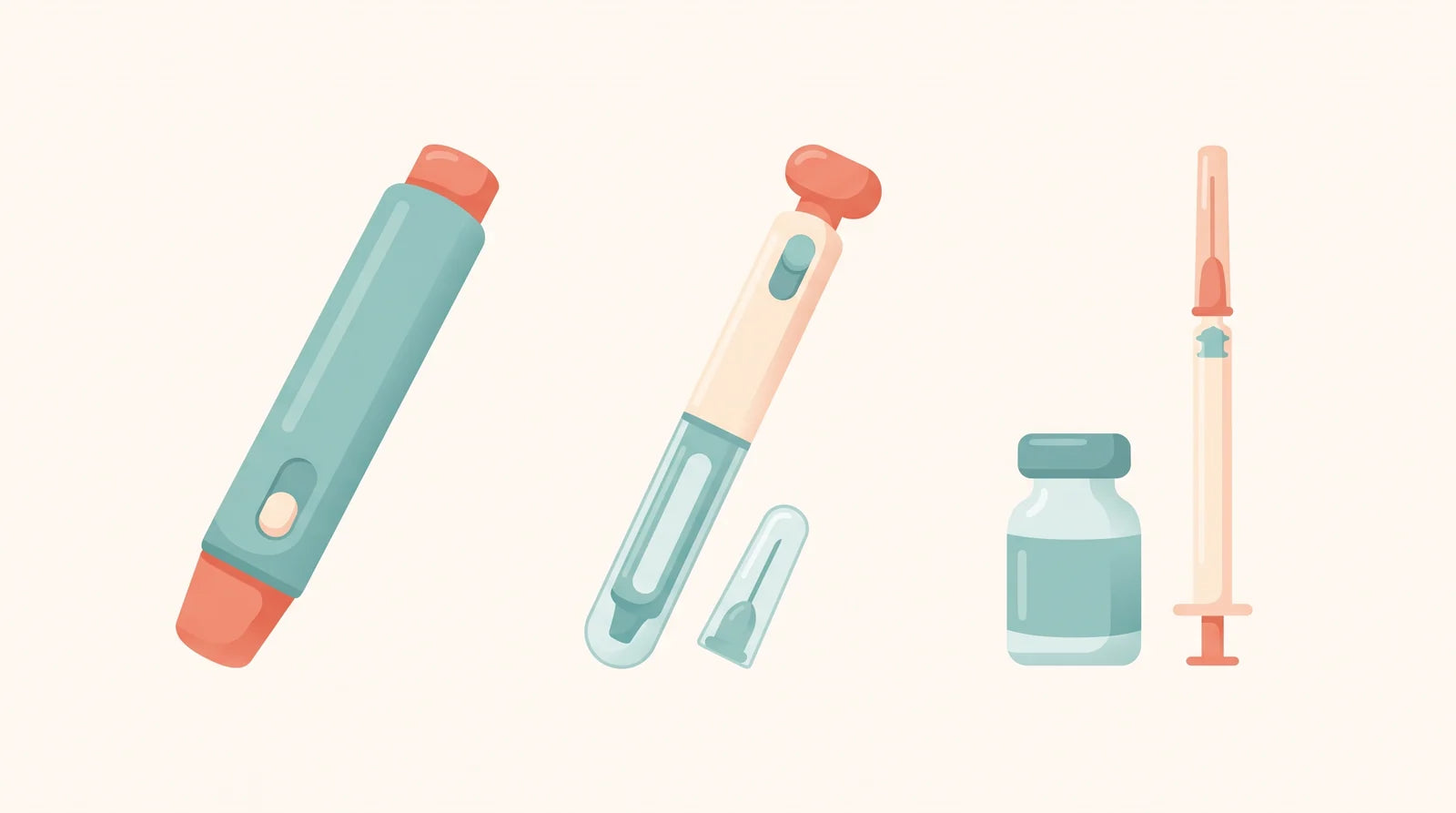
Which device fits you is a prescriber decision. We found no study comparing pain or ease of use between Zepbound devices. If your device changes, label section 2.4 says you should be trained on the new one and read its IFU.
How Much Does the Zepbound KwikPen Cost?
Lilly's self-pay price for the Zepbound KwikPen starts at $299 per month for the 2.5 mg strength. Lilly says the KwikPen and single-dose vials cost the same in its self-pay program.
| Strength | Monthly self-pay price |
|---|---|
| 2.5 mg | $299 |
| 5 mg | $399 |
| 7.5 mg | As low as $449 (regular $499) |
| 10, 12.5, and 15 mg | As low as $449 (regular $699) |
The lower prices require a refill within 45 days of the previous delivery. Lilly's savings card works differently for each device. Its "as little as $25" offer for commercial insurance that covers Zepbound applies to the single-dose pen only, with savings capped at $100 per 1-month fill and $1,300 per calendar year. For the KwikPen, there are two cards with the prices in the table above, starting at $299 per month. The savings card for commercial insurance applies only when your plan does not cover the KwikPen, and it is not for people in Medicare, Medicaid, or other government programs. A separate KwikPen Self-Pay Savings Card, added in March 2026, is for people who pay cash, including people without insurance; its terms say you may not seek reimbursement for these costs from any insurer or government program. If your plan does cover the KwikPen, your cost depends on your plan. Both cards end December 31, 2026. Our page on the Zepbound coupon and savings card compares every Lilly program by insurance type.
Medicare is a separate case. Since July 1, 2026, the Medicare GLP-1 Bridge covers the Zepbound KwikPen, but not the single-dose pen or vials, for $50 a month for eligible people with Part D drug coverage who meet its BMI and health criteria. That $50 does not count toward the Part D deductible or yearly out-of-pocket limit, and CMS runs the program through December 31, 2027. People with type 2 diabetes, moderate to severe sleep apnea, or fatty liver disease are told to contact their Medicare drug plan instead, since it may already cover a GLP-1 drug. Ask your prescriber whether you qualify, or call 1-800-MEDICARE (1-800-633-4227). Our page on what insurance covers Zepbound explains plan coverage.
Prices and programs change, so check Lilly's savings page and the Medicare GLP-1 Bridge fact sheet before you fill.
Plan a Monthly Routine Around Each Pen
A Zepbound KwikPen lasts 4 weekly doses, so it maps neatly onto a 4-week routine. Pen-change week is a good time to restock supplies, note the new pen's first-use date, and plan the month's meals.
A simple pen-change checklist:
- Write the first-use date on your calendar so you know the 30-day limit.
- Count pen needles for 4 doses, plus a spare in case the IFU tells you to change the needle during priming.
- Check that your sharps container has room.
- Plan the grocery list for the next 4 weeks.
The Zepbound label pairs the medicine with a reduced-calorie diet and physical activity (section 1). In a SURMOUNT-1 body composition substudy of 160 people, about a quarter of the weight lost was lean mass, the same share seen with placebo. Nutrition advisories stress protein and strength training for that reason. A 2025 joint advisory notes that 1.2 to 1.6 grams of protein per kilogram of body weight per day have been proposed during active weight loss, though which body weight to use is unsettled, and that strength training is also needed to protect muscle.
Many people find their appetite drops on tirzepatide, so smaller meals built around protein make those targets easier to reach. If you want high-protein recipes and meal ideas sized for a smaller appetite, see our GLP-1 meal plan and protein guide.
Frequently Asked Questions
How many doses are in a Zepbound KwikPen?
Each Zepbound KwikPen holds 4 fixed weekly doses of 0.6 mL, all in one strength. After the fourth dose you throw the pen away, even though some medicine is left inside.
Does the Zepbound KwikPen come with needles?
No. The Instructions for Use list a KwikPen-compatible pen needle as a supply that is not included, and you need a new one for every injection.
What size needle does the Zepbound KwikPen use?
US labeling does not name a needle length or gauge. Lilly Canada lists ISO 11608-2 compliant pen needles of 4, 5, 6, 8, or 12.7 mm and 29G to 34G as compatible, so ask your prescriber or pharmacist which one to use.
Do you have to prime the Zepbound KwikPen every time?
Yes. The Instructions for Use say to prime before each weekly injection, with a new needle attached, to remove air and check that the pen works.
Can you use the medicine left in the KwikPen after 4 doses?
No. The Instructions for Use say to throw the pen away with the unused medicine, not to inject it, and not to transfer it into a syringe.
How long can a Zepbound KwikPen stay out of the refrigerator?
An unopened KwikPen kept at room temperature up to 86°F is thrown away after 30 days. An opened pen is thrown away after 30 days total at room temperature, 30 days after first use, or 4 doses, whichever comes first.
Is the Zepbound KwikPen the same price as the vials?
Lilly says the KwikPen and single-dose vials cost the same in its self-pay program, starting at $299 per month for 2.5 mg. Prices change, so check Lilly's savings page.
What is the difference between the Zepbound pen and the KwikPen?
The single-dose pen holds one dose with a built-in needle and no priming. The KwikPen holds 4 weekly doses, needs a new pen needle and priming before each dose, and has different storage limits.
Can I switch from the single-dose pen to the KwikPen?
Switching is your prescriber's decision. The label says anyone whose Zepbound presentation changes should get training for the new device and read its Instructions for Use.
What should I do if the 0 does not show after my injection?
Put the needle back into your skin and finish the injection without redialing. If you still think you did not get the full dose, do not start over or repeat it; call your prescriber or 1-800-LillyRx.
The Bottom Line
The Zepbound KwikPen packs 4 fixed weekly doses into one pen, in six strengths. Attach a new needle and prime before every dose, turn the knob until it stops at the "1" icon, and confirm the "0" icon after you inject. Throw the pen away after 4 doses, 30 days after first use, or 30 days total at room temperature, whichever comes first, with any leftover medicine still inside. Bring questions about needles, storage, or switching devices to your pharmacist or prescriber.
References
- Zepbound (tirzepatide) Prescribing Information, revised 08/2026: Eli Lilly
- Zepbound Medication Guide, revised 08/2026: Eli Lilly
- Instructions for Use, Zepbound KwikPen, January 2026: Eli Lilly
- Instructions for Use, Zepbound single-dose pen, April 2026: Eli Lilly
- Instructions for Use, Zepbound single-dose vial, April 2026: Eli Lilly
- Instructions for Use, Zepbound multi-dose vial, January 2026: Eli Lilly
- Supplement approval letter, NDA 217806/S-002 (Zepbound KwikPen), January 2026: U.S. Food and Drug Administration
- Zepbound label on DailyMed: U.S. National Library of Medicine
- Mounjaro (tirzepatide) Prescribing Information, revised 08/2026: Eli Lilly
- Zepbound now available in multi-dose KwikPen, February 23, 2026: Eli Lilly (PR Newswire)
- Dosing, how to use, and how to inject Zepbound (official video): Eli Lilly
- Zepbound coverage, affordability, and savings, read September 24, 2026: Eli Lilly
- Can the remaining solution in the Zepbound KwikPen be kept for a future dose? Lilly Medical, reviewed January 20, 2026
- Zepbound KwikPen needles: compatibility and availability: Eli Lilly Canada
- Frid AH et al. New insulin delivery recommendations (FITTER). Mayo Clin Proc, 2016
- Safely using sharps (needles and syringes) at home, at work, and on travel: U.S. Food and Drug Administration
- Look M et al. Body composition changes during weight reduction with tirzepatide in the SURMOUNT-1 study of adults with obesity or overweight. Diabetes Obes Metab, 2025
- Nutritional priorities to support GLP-1 therapy for obesity: joint advisory from ACLM, ASN, OMA, and TOS, 2025
- Medicare GLP-1 Bridge: GLP-1 Drugs for $50 a Month, CMS Product No. 12234, June 2026: Medicare.gov
This article is for education only and is not medical advice. It summarizes the FDA label, the Instructions for Use, and published research and gives no personalized dosing advice. Talk to your prescriber about your device and your dose. Read our full medical disclaimer.