
Does Zepbound Need to Be Refrigerated? How Long Each Form Can Stay Out of the Fridge
Does Zepbound need to be refrigerated? Yes, but every form can spend limited time out of the fridge. How long each pen and vial can stay unrefrigerated, what to do if it gets warm or freezes, and how to travel with it.


Does Zepbound need to be refrigerated? Yes. The FDA label says to keep Zepbound in the refrigerator at 36°F to 46°F (2°C to 8°C), but every form may spend limited time at room temperature up to 86°F (30°C) [1]. Single-dose pens and vials allow up to a total of 21 days, the KwikPen and multi-dose vial allow up to 30 days, and no form may be frozen [1][2].
The rules below come from the Zepbound FDA label (revised August 2026) and each device's Instructions for Use [1][3][4][5][6].
On this page:
- Why the fridge is the default and room temperature is only an allowance
- How long each Zepbound form can be out of the fridge
- What to do if it got warm, froze, or sat out overnight
- How to travel with Zepbound, including TSA screening
- Whether you can inject it cold, and how Mounjaro compares
Table of Contents
- Does Zepbound Need to Be Refrigerated?
- How Long Can Zepbound Be Out of the Fridge? Every Form Compared
- Can You Put Zepbound Back in the Fridge After It Has Been Out?
- What to Do if Zepbound Got Too Warm, Froze, or Was Left Out
- How to Travel With Zepbound: Car Trips, Hotels, and TSA Rules
- Can You Inject Zepbound Cold, Straight From the Fridge?
- Do the Same Storage Rules Apply to Mounjaro?
- A Weekly Zepbound Storage and Meal-Prep Routine
- Frequently Asked Questions
- Key Takeaways
Does Zepbound Need to Be Refrigerated?
Yes. Zepbound belongs in the refrigerator at 36°F to 46°F (2°C to 8°C), in its original carton to protect it from light, and you should never freeze it [1][2]. Room temperature is an allowance with a day limit, not the default way to store it.
Some pages online claim Zepbound belongs at room temperature. The label says the opposite, with rules for every form [1]:
- Refrigerate it at 36°F to 46°F, in the carton.
- Never freeze it. The label says, "Do not use ZEPBOUND if frozen."
- Protect it from heat and light.
How long it lasts in the fridge depends on the form. The label says an unopened multi-dose vial or KwikPen kept in the refrigerator can go until the expiration date on the label [1]. For single-dose pens and vials, the Instructions for Use tell you to check that the medicine has not expired before you inject [3][4].
The label does not explain why Zepbound needs cold storage. It also sets no lower limit for room temperature, only the 86°F (30°C) maximum [1].
How Long Can Zepbound Be Out of the Fridge? Every Form Compared
Zepbound single-dose pens and vials can stay out of the fridge for up to a total of 21 days at up to 86°F. The KwikPen and multi-dose vial allow 30 days at room temperature, with extra limits once opened [1][2].
| Form | Fridge (36°F to 46°F) | Room temperature (up to 86°F) | What counts | Back in the fridge? | Throw it away |
|---|---|---|---|---|---|
| Single-dose pen | Check the expiration date before use [3] | A total of 21 days [1] | Days out | No, per Lilly [8] | After 21 days out [1] |
| Single-dose vial | Check the expiration date before use [4] | A total of 21 days [1] | Days out | No, per Lilly [8] | After 21 days out, or after one use [4] |
| Multi-dose vial | Unopened: until the expiration date [1] | Unopened: 30 days. Opened: 30 days total [1] | Days out, first use, doses | Opened: yes, per the label [1] | Opened: 30 days out, 30 days after first use, or 4 doses, whichever is first [1] |
| KwikPen | Unopened: until the expiration date [1] | Same as the multi-dose vial [1] | Same | Opened: yes, per the label [1] | Same as the multi-dose vial [1] |
Write the date on the carton the day it first leaves the fridge. For single-dose pens and vials, the label counts "a total of" 21 days [1], but Lilly's US page says not to return them to the fridge once at room temperature and to discard them within 21 days of removal [8]. So do not plan repeated trips in and out.
KwikPen and multi-dose vial: the 30-day clock
An opened Zepbound KwikPen or multi-dose vial runs three limits at once: a total of 30 days at room temperature, 30 days after first use, and 4 weekly doses. Whichever comes first ends it, even with medicine left [1][2]. The KwikPen's own Instructions for Use list only the last two limits, so the label is the fuller source [6]. For pen steps, see our page on the Zepbound KwikPen.
Can You Put Zepbound Back in the Fridge After It Has Been Out?
It depends on the form. For Zepbound single-dose pens and vials, Lilly says not to return them to the refrigerator once stored at room temperature, while the FDA label lets opened KwikPens and multi-dose vials go in either place [1][8].
- Single-dose pen or vial. The FDA label and Instructions for Use do not address this [1][3][4]. Lilly's US consumer page does: "If stored at room temperature, do not return it to the refrigerator." It adds that you should discard it if not used within 21 days after removal [8]. This is Lilly's instruction, not FDA labeling.
- Opened multi-dose vial or KwikPen. The label allows the original carton "in the refrigerator" or "at room temperature" [1]. Moving it back resets nothing: the 30-days-after-first-use and 4-dose limits keep running.
- Unopened multi-dose vial or KwikPen at room temperature. Throw it away after 30 days [1].
Many websites say Zepbound can never go back in the fridge. That is Lilly's rule for the single-dose forms only.
What to Do if Zepbound Got Too Warm, Froze, or Was Left Out
If Zepbound froze, do not use it, even after it thaws. If it got hotter than 86°F, or you do not know how warm it got, the label gives no rule, so call your pharmacist or Lilly at 1-800-545-5979 before you use it [1][3].
| Situation | What the source says | What to do |
|---|---|---|
| Frozen at any point | "Do not use ZEPBOUND if frozen" [1] | Do not use it, even after it thaws. The pen instructions say to throw the pen away and use a new one [3] |
| Above 86°F, a hot car, or an unknown temperature | The US label and Lilly's US instructions give no rule for this | Do not guess. Call your pharmacist or Lilly (1-800-545-5979) first [3] |
| Left out overnight at 86°F or below | Within the room-temperature allowance [1] | Count the time toward the 21 or 30 days. Single-dose forms: do not return to the fridge; use within 21 days of removal (Lilly) [8] |
| Shipped and arrived warm or with melted packs | FDA: do not use "any injectable GLP-1 drug that arrives warm or with insufficient refrigeration" [9] | Do not use it. Contact the pharmacy that shipped it |
Before every dose, check that the medicine looks clear and colorless to slightly yellow, with no cloudiness, discoloration, or particles [1][3]. Do not use a single-dose pen you dropped on a hard surface, since it has glass parts [3].
To report a quality problem, such as a warm delivery, use FDA's MedWatch program online [9]. The Medication Guide's 1-800-FDA-1088 number is for side effects [2].
How to Travel With Zepbound: Car Trips, Hotels, and TSA Rules
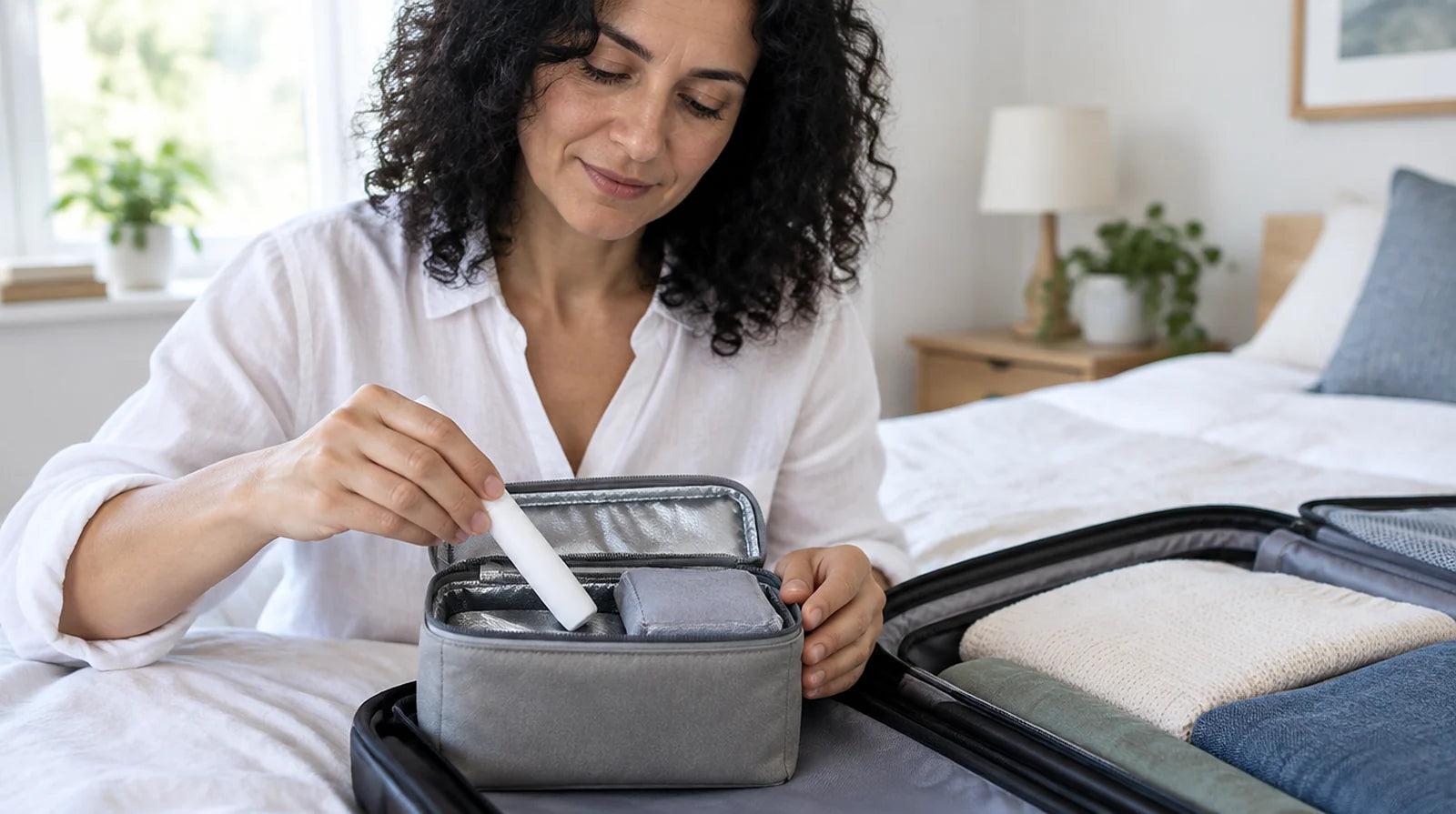
You can travel with Zepbound without a cooler if the trip fits inside its room-temperature limit and the medicine stays at or below 86°F [1]. For longer or hotter trips, use an insulated bag or cooler, and keep the medicine from touching ice packs so it cannot freeze.
The 86°F and no-freeze limits come from the label; the packing tips are general advice. Single-dose pens and vials should not go back in the fridge once at room temperature, per Lilly [8].
- Cars and hotels. Do not leave Zepbound in a parked car or trunk. Some hotel mini-fridges freeze items, so keep the carton away from the freezer section.
- Screening. Tell the TSA officer about your medically necessary liquids before screening, and put them in a separate bin with freezer packs and syringes [10]. TSA allows larger amounts of declared medical liquids in reasonable quantities [10][11].
- Cooling packs. TSA accepts ice, freezer, and gel packs that keep medical items cool in a frozen, partially frozen, or melted state [10].
- Syringes. Unused syringes may travel with injectable medicine; used ones go in a sharps or other hard-surface container [12][13]. TSA recommends, but does not require, labeled medicine, and the officer decides [12].
- Carry-on or checked. TSA allows liquid medicines in checked bags [11]. Carry-on is general advice, not a TSA rule.
These TSA points come from TSA's website, checked September 30, 2026. Abroad, the CDC advises checking with destination and layover embassies, carrying prescription copies, keeping medicines in original labeled containers, and packing extra for delays [14].
If travel moves your shot day, the Medication Guide says to take a missed dose as soon as possible within 4 days (96 hours); after that, skip it and take the next dose on your usual day [2]. The label allows changing your weekly day if doses stay at least 3 days (72 hours) apart [1]. See our tirzepatide dosage chart for the schedule, and our page on Zepbound side effects for nausea on travel days.
Can You Inject Zepbound Cold, Straight From the Fridge?
You can inject the Zepbound single-dose pen straight from the fridge. Its Instructions for Use say, "It is not necessary to warm the pen to room temperature" [3]. The single-dose vial, multi-dose vial, and KwikPen instructions say nothing about warming [4][5][6].
Never heat Zepbound to warm it up, since the label says to protect it from heat [1]. For where and how to inject, see our page on Zepbound injection sites.
Do the Same Storage Rules Apply to Mounjaro?
Yes. Mounjaro and Zepbound both contain tirzepatide, and Mounjaro's label sets the same storage rules for the same four device types: 21 days for single-dose pens and vials, 30 days for the KwikPen and multi-dose vial, and no freezing [7]. So tirzepatide needs refrigeration in both approved brands. Our page on Zepbound vs Mounjaro covers how the brands differ.
Compounded tirzepatide has no FDA label, so these rules do not transfer to it. FDA advises against using any injectable GLP-1 drug that arrives warm or with insufficient refrigeration [9]. Our page on compounded tirzepatide explains the wider risks.
A Weekly Zepbound Storage and Meal-Prep Routine
A weekly Zepbound routine works best when your shot day, a quick fridge check, and your grocery or meal-prep block fall on the same day. One habit then covers both your medicine and your meals.
- Check the carton. Look at the date you wrote, count the days out of the fridge, and check the expiration date [1][3].
- Pick a steady fridge spot. Use a middle shelf, away from the freezer vent and the back wall, where some fridges freeze food (general advice).
- Prep easy protein. Keep foods like Greek yogurt, eggs, cottage cheese, or cooked chicken ready for days when a full meal feels like too much.
Our page on the GLP-1 meal plan shows a sample week, and our page on how much protein to eat on a GLP-1 explains daily targets. If you want protein-focused recipes and meal ideas for a smaller appetite, see our guide with GLP-1 recipes and a meal plan.
Frequently Asked Questions
I left my Zepbound out overnight. Is it still good?
If the room stayed at 86°F or below, one night is within the room-temperature allowance. Count it toward the 21-day or 30-day limit for your form. Lilly says a single-dose pen or vial should not return to the fridge.
How long does Zepbound last in the fridge?
An unopened KwikPen or multi-dose vial stays usable until its expiration date if refrigerated. Check the date on single-dose pens and vials before each use. Opened KwikPens and multi-dose vials last at most 30 days after first use or 4 weekly doses.
What temperature is too hot for Zepbound?
The label sets 86°F (30°C) as the room-temperature maximum and gives no rule above it. If your Zepbound got hotter, or you are unsure, call your pharmacist or Lilly (1-800-545-5979) first.
How can I tell if my Zepbound was frozen?
The Instructions for Use tell you to check that the medicine is not frozen but give no test. If your Zepbound may have frozen, for example against an ice pack, do not use it and call your pharmacist or Lilly.
Can I keep Zepbound in a hotel mini-fridge?
Yes, if it holds 36°F to 46°F. Some mini-fridges freeze items, so keep the carton away from the freezer section and check it for ice (general advice).
Why does Zepbound need to be refrigerated?
The FDA label does not say why. It sets limits instead: 36°F to 46°F in the fridge, up to 86°F for 21 or 30 days depending on the form, and no freezing.
Can I bring ice packs for Zepbound through airport security?
Yes. TSA accepts ice, freezer, and gel packs that keep medical items cool, whether frozen, partially frozen, or melted. Declare your medicine and screen it in a separate bin with the packs.
Key Takeaways
- Fridge first. Store Zepbound at 36°F to 46°F in its carton; room temperature up to 86°F is an allowance.
- 21 or 30 days. Single-dose pens and vials allow a total of 21 days out. The KwikPen and multi-dose vial allow 30 days, plus first-use and 4-dose limits once opened.
- Back in the fridge. Lilly says no for single-dose forms; opened KwikPens and multi-dose vials may go in either place.
- Frozen means do not use it, even after it thaws.
- Unsure after heat exposure? Call your pharmacist or Lilly at 1-800-545-5979 before you use it.
This article is for education only and is not medical advice. Talk to your prescriber or pharmacist about your own medicine. Read our full medical disclaimer.
References
- Zepbound (tirzepatide) Prescribing Information, revised 08/2026: Eli Lilly
- Zepbound Medication Guide, revised 08/2026: Eli Lilly
- Zepbound Instructions for Use, single-dose pen, revised April 2026: Eli Lilly
- Zepbound Instructions for Use, single-dose vial, revised April 2026: Eli Lilly
- Zepbound Instructions for Use, multi-dose vial, revised January 2026: Eli Lilly
- Zepbound Instructions for Use, single-patient-use KwikPen, revised January 2026: Eli Lilly
- Mounjaro (tirzepatide) Prescribing Information, revised 08/2026: Eli Lilly
- Dosing, how to use and how to inject Zepbound (storage section), read September 30, 2026: Eli Lilly
- FDA's concerns with unapproved GLP-1 drugs used for weight loss, content current as of 09/01/2026: U.S. Food and Drug Administration
- TSA Cares: disabilities and medical conditions (medications), checked September 30, 2026: Transportation Security Administration
- What can I bring: medications (liquid), last updated October 9, 2024: Transportation Security Administration
- What can I bring: unused syringes, last updated November 16, 2017: Transportation Security Administration
- What can I bring: used syringes, last updated November 16, 2017: Transportation Security Administration
- Traveling abroad with medicine, page last reviewed August 18, 2022: Centers for Disease Control and Prevention