
Zepbound vs Mounjaro: Same Tirzepatide, Different Labels and Coverage
Zepbound vs Mounjaro compared from the 08/2026 FDA labels: the same tirzepatide in two brands, with different approved uses, dose rules, trials, side effect tables, cost, insurance coverage, and switching.


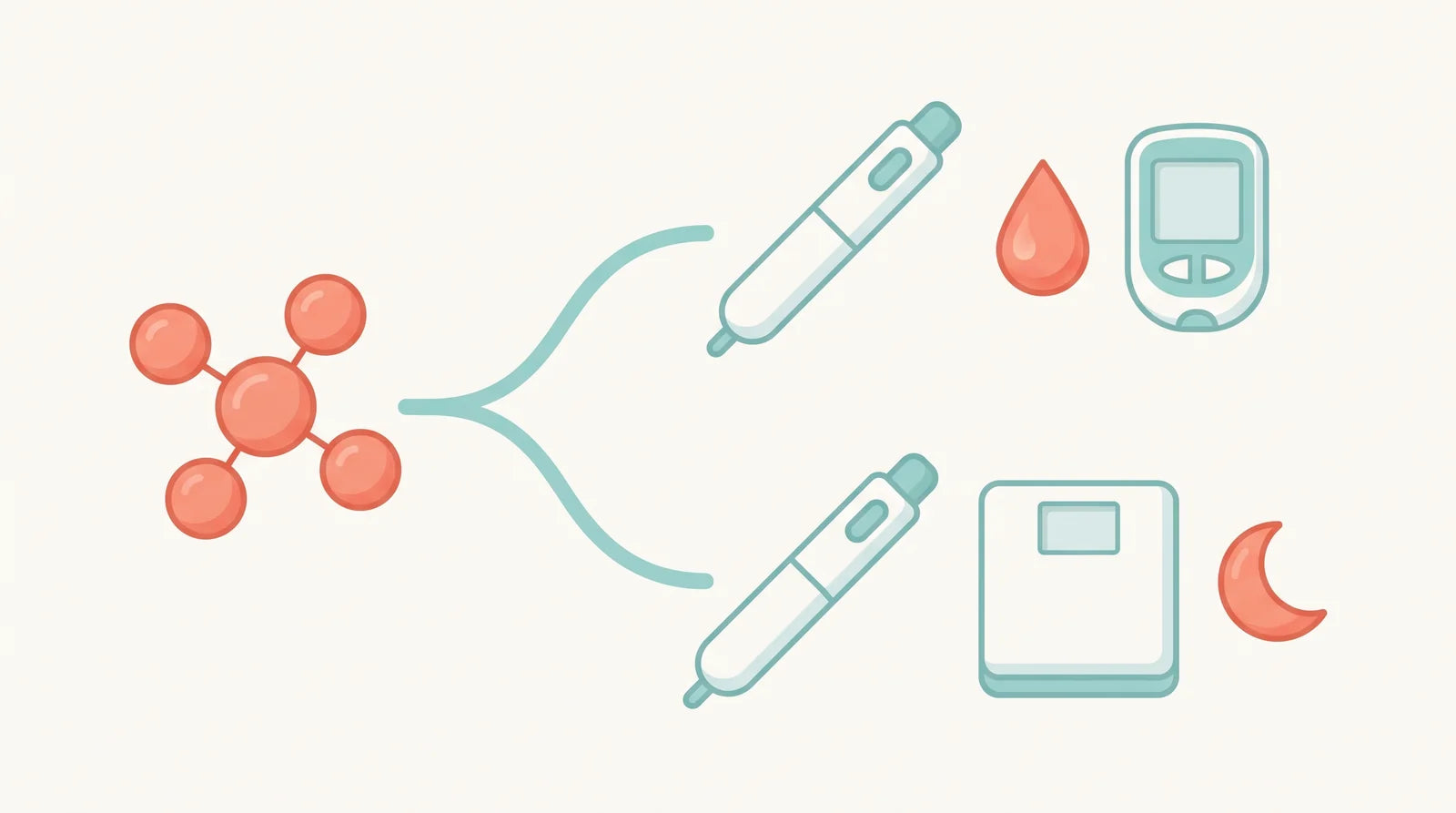
Zepbound vs Mounjaro is a comparison of two brands of one medicine. Both contain tirzepatide, both are made by Eli Lilly, and both come in the same six weekly strengths, from 2.5 mg to 15 mg. The real difference is the FDA label: Mounjaro is approved for type 2 diabetes, while Zepbound treats weight and sleep apnea.
That one difference shapes the dose rules, the trials behind each brand, and what your insurance covers. The side effects come from the same drug, and both labels carry the same boxed warning. For the full list, see our page on Zepbound side effects.
In this guide you will learn:
- What each brand is approved for, and who each one is for
- Which doses and devices match, and the dose rules that differ
- What the SURPASS and SURMOUNT trials showed for each brand
- Why the two labels print different side effect rates
- How cost and coverage differ, and whether you can switch brands
Table of Contents
- Zepbound vs Mounjaro at a glance
- Is Zepbound the same as Mounjaro?
- FDA-approved uses: who each brand is for
- Doses and devices: what matches and what differs
- Trial data behind each brand
- Does Zepbound work as well as Mounjaro for weight loss?
- Zepbound vs Mounjaro side effects
- Zepbound vs Mounjaro cost and insurance coverage
- Can you switch between Zepbound and Mounjaro?
- Which one is right for you?
- Eating well on either brand
- Frequently asked questions
- Key takeaways
Zepbound vs Mounjaro at a Glance
Zepbound and Mounjaro share the molecule, the maker, the six strengths, and the four devices listed in their labels. They differ in approved uses, dose rules, the trials behind each label, and how insurance reviews them. For every other approved option, see our GLP-1 medications list.
| Feature | Mounjaro | Zepbound |
|---|---|---|
| Active ingredient | Tirzepatide | Tirzepatide |
| Maker | Eli Lilly | Eli Lilly |
| First FDA approval | May 13, 2022 | November 8, 2023 |
| Approved uses | Blood sugar control in type 2 diabetes; lowering the risk of major cardiovascular events in adults with type 2 diabetes at high risk | Weight reduction and long-term maintenance; moderate to severe obstructive sleep apnea (OSA) in adults with obesity |
| Who | Adults and children 10 and older (diabetes); adults (heart risk) | Adults only |
| Strengths | 2.5, 5, 7.5, 10, 12.5, and 15 mg once weekly | Same six strengths |
| Maximum dose | 15 mg (adults), 10 mg (children) | 15 mg |
| Devices in the label | Single-dose pen, single-dose vial, multi-dose vial, KwikPen | Same four |
| Main trials | SURPASS program | SURMOUNT program |
| How coverage is reviewed | Against its approved uses, such as a type 2 diabetes diagnosis | For weight, in commercial plans, only where the plan sponsor covers weight-management drugs; for sleep apnea, against that diagnosis |
Sources: Mounjaro and Zepbound Prescribing Information, sections 1 to 3; Drugs@FDA; CVS Health, May 2026.
Is Zepbound the Same as Mounjaro?
Zepbound is the same medicine as Mounjaro, but not the same product. The FDA approved each brand for specific uses under separate applications, so the labels, dose rules, and coverage differ.
Both brands deliver tirzepatide. The Mounjaro label (section 12.1) says tirzepatide "selectively binds to and activates both the GIP and GLP-1 receptors." GIP and GLP-1 are gut hormones. Acting on both lowers blood sugar and reduces food intake, whichever name is on the box. Retatrutide, an experimental drug from the same company, adds a third target; see retatrutide vs tirzepatide.
Three facts clear up most confusion:
- Neither is a generic of the other. Mounjaro (NDA 215866) came first in 2022, and Zepbound (NDA 217806) followed in 2023. The Zepbound label even lists "Initial U.S. Approval: 2022", the year tirzepatide was first approved as Mounjaro.
- Same strengths, same devices. Every dose from 2.5 mg to 15 mg exists in both brands.
- Different indications. Your prescription names one brand, and your plan checks it against that brand's approved uses.
Compounded tirzepatide is neither brand, and neither label covers it. Our page on compounded tirzepatide explains why.
FDA-Approved Uses: Who Each Brand Is For
Mounjaro treats type 2 diabetes in adults and children 10 and older, and it lowers heart risk in adults with type 2 diabetes. Zepbound treats obesity, or overweight with a weight-related condition, and sleep apnea with obesity, in adults.
| Brand | Approved use | FDA approval |
|---|---|---|
| Mounjaro | With diet and exercise, to improve blood sugar control in adults with type 2 diabetes | May 13, 2022 |
| Mounjaro | The same use in children 10 and older with type 2 diabetes | December 19, 2025 |
| Mounjaro | To reduce the risk of major cardiovascular events (heart-related death, nonfatal heart attack, or nonfatal stroke) in adults with type 2 diabetes at high risk | August 27, 2026 |
| Zepbound | With a reduced-calorie diet and more activity, to reduce excess weight and keep it off long term in adults with obesity, or with overweight and at least one weight-related condition | November 8, 2023 |
| Zepbound | To treat moderate to severe obstructive sleep apnea in adults with obesity | December 20, 2024 |
Sources: Prescribing Information section 1 for each brand; FDA approval letters for NDA 215866 and NDA 217806.
Three points are easy to miss:
- Mounjaro is not approved for weight loss. Its trials report weight change as a secondary result, but weight management is not one of its indications.
- Zepbound is for adults only. Its Medication Guide says it is not known if Zepbound is safe and effective in children. Mounjaro is approved from age 10; its Medication Guide says safety and effectiveness under 10 are not known.
- The heart-risk indication is on the Mounjaro label only. The FDA added it in August 2026 based on SURPASS-CVOT, a trial in adults with type 2 diabetes and heart or blood vessel disease. Neither label lists heart failure as a use.
Doses and Devices: What Matches and What Differs
Zepbound and Mounjaro use the same six strengths, the same once-weekly schedule, and the same four devices. In the Zepbound vs Mounjaro dose rules, what differs is how you move between doses, because Mounjaro follows blood sugar and Zepbound follows weight.
| Dose rule | Mounjaro | Zepbound |
|---|---|---|
| Starting dose | 2.5 mg once weekly | 2.5 mg once weekly for 4 weeks |
| Staying on 2.5 mg | Allowed for ongoing blood sugar control (FDA, August 2026) | Not allowed; 2.5 mg is for starting treatment and is not a maintenance dose |
| When to increase | In 2.5 mg steps after at least 4 weeks, only if more blood sugar control is needed | To 5 mg after 4 weeks, then 2.5 mg steps after at least 4 weeks on the current dose |
| Maintenance | No fixed list; the dose rises only if blood sugar needs it | 5, 10, or 15 mg for weight; 10 or 15 mg for sleep apnea |
| Maximum | 15 mg weekly (adults); 10 mg weekly (children) | 15 mg weekly |
Sources: Mounjaro PI section 2.1 and FDA approval letter S-045 (August 27, 2026); Zepbound PI sections 2.1 and 2.2.
For every step in mg, see our tirzepatide dosage chart.
Much stays identical across the two labels:
- Missed dose. Take it within 4 days (96 hours); if more time has passed, skip it. You can change your injection day if doses stay at least 3 days (72 hours) apart.
- Injection sites. Use the stomach or thigh, or the back of the upper arm when someone else injects, and rotate each week. Our page on Zepbound injection sites covers rotation in detail.
- Timing. Any time of day, with or without meals.
- Storage. Single-dose pens and vials can stay unrefrigerated for up to 21 days at up to 86°F (30°C). Throw out multi-dose vials and KwikPens after 30 days at room temperature, 30 days after first use, or 4 weekly doses, whichever comes first. Our page on whether Zepbound needs to be refrigerated covers travel and what to do if a pen gets warm.
One rule appears only in the Mounjaro label (section 2.2). If you also use insulin, give Mounjaro and insulin as separate shots and never mix them. They can go in the same body area, but not right next to each other.
Devices
Both labels list a single-dose pen, a single-dose vial (2.5 to 15 mg in 0.5 mL), a multi-dose vial, and a KwikPen that holds 4 fixed doses of 0.6 mL. The FDA added the multi-dose vial on January 7, 2026 and the KwikPen on January 20, 2026 for both brands. Ask your pharmacy which presentations it carries. Lilly says Zepbound single-dose vials are sold only through LillyDirect self-pay, and KwikPen needles are bought separately. Our Zepbound KwikPen guide covers needles, priming, and storage.
Both labels say the KwikPen is not recommended for self-injection by people with vision problems, and both Medication Guides say self-injection is not recommended for people who are visually impaired. The Mounjaro Medication Guide adds that children should not inject themselves with the Mounjaro KwikPen; an adult caregiver should give the injection. Never share a KwikPen, even with a new needle. If your device changes, both labels call for training and the Instructions for Use for the new presentation.
Trial Data Behind Each Brand
Mounjaro rests on the SURPASS trials, which measured blood sugar first and weight second. Zepbound rests on the SURMOUNT trials, which measured weight loss first, plus two sleep apnea studies. That split explains most Zepbound vs Mounjaro differences in published results.
| Trial (brand) | Who and how long | Main result | Weight result |
|---|---|---|---|
| SURPASS-1 (Mounjaro) | 478 adults with type 2 diabetes, 40 weeks, vs placebo | HbA1c fell 1.7 to 1.8 points vs 0.1 | Lost 6.3 to 7.8 kg vs 1.0 kg |
| SURPASS-3 (Mounjaro) | 1,444 adults with type 2 diabetes, 52 weeks, vs insulin degludec | HbA1c fell 1.9 to 2.1 points vs 1.3 | Lost 7.0 to 11.3 kg vs a 1.9 kg gain |
| SURPASS-PEDS (Mounjaro) | 99 children aged 10 to 17, 30 weeks, vs placebo | HbA1c fell 1.9 (5 mg) and 2.2 (10 mg) points vs 0.2 | BMI fell 6.9% and 10.8% vs 0.5% |
| SURPASS-CVOT (Mounjaro) | 13,299 adults with type 2 diabetes and heart or blood vessel disease, median 210 weeks (about 4 years), vs dulaglutide 1.5 mg | Major cardiovascular events 12.1% vs 13.0% | Not a main result |
| SURMOUNT-1 (Zepbound) | 2,539 adults without diabetes, 72 weeks, vs placebo | Weight fell 15.0%, 19.5%, and 20.9% (5, 10, 15 mg) vs 3.1% | Main result |
| SURMOUNT-2 (Zepbound) | 938 adults with type 2 diabetes, 72 weeks, vs placebo | Weight fell 12.8% (10 mg) and 14.7% (15 mg) vs 3.2% | Main result |
| SURMOUNT-OSA (Zepbound) | 469 adults with moderate to severe sleep apnea and obesity, 52 weeks, vs placebo | Breathing events (AHI) fell 25.3 vs 5.3 per hour without PAP, and 29.3 vs 5.5 on PAP | Weight fell 17.7% vs 1.6%, and 19.6% vs 2.3% |
Sources: Mounjaro PI sections 14.2, 14.3, 14.5, and 14.6; Zepbound PI sections 14.1 and 14.2.
A few details change how you read this table:
- Different units. SURPASS reports weight in kilograms and SURMOUNT in percent, so the weight columns do not line up directly.
- The heart trial showed noninferiority, not superiority. In SURPASS-CVOT, the hazard ratio was 0.92 (95.3% confidence interval 0.83 to 1.01). The label calls tirzepatide noninferior to dulaglutide and states that superiority was not established.
- Lifestyle support. In SURMOUNT-1 and SURMOUNT-2, everyone got counseling on a diet about 500 calories a day below their needs and at least 150 minutes of activity a week (Zepbound PI section 14.1).
- Who took part. SURMOUNT-1 enrolled 68% women, SURMOUNT-2 enrolled 51% women, and SURPASS-PEDS enrolled 61% girls.
Does Zepbound Work as Well as Mounjaro for Weight Loss?
At the same dose, Zepbound and Mounjaro deliver the same medicine, so the labels give no reason to expect different weight loss. We found no trial that compared the two brands with each other.
The Zepbound vs Mounjaro weight loss question comes down to who was studied. In the Zepbound program, the separate trial in adults with type 2 diabetes showed smaller average weight loss than the trial in adults without it. The two trials were not compared head to head:
- SURMOUNT-1 (no diabetes): average weight loss of 15.0% to 20.9% over 72 weeks, depending on dose.
- SURMOUNT-2 (type 2 diabetes): 12.8% at 10 mg and 14.7% at 15 mg over the same 72 weeks. For when these results start to show, see how long it takes Zepbound to start working.
The Mounjaro diabetes trials tracked weight as a secondary result. In SURPASS-3, adults lost 7.0 to 11.3 kg over 52 weeks, while the insulin group gained 1.9 kg.
So if a friend on Mounjaro loses less than you do on Zepbound, look at diagnosis, dose, and time on treatment. The brand name does not change the drug.
Zepbound vs Mounjaro Side Effects
Zepbound and Mounjaro share the same boxed warning and nearly the same warnings, because they are the same drug. The main wording difference is low blood sugar (below). Their labels print different percentages because the trials behind each table enrolled different people, ran for different lengths of time, and used different reporting cutoffs.
| Side effect | Mounjaro (SURPASS-1 and -5 pool) | Zepbound (SURMOUNT-1 and -2 pool) |
|---|---|---|
| Nausea | 12%, 15%, 18% (4%) | 25%, 29%, 28% (8%) |
| Diarrhea | 12%, 13%, 17% (9%) | 19%, 21%, 23% (8%) |
| Vomiting | 5%, 5%, 9% (2%) | 8%, 11%, 13% (2%) |
| Constipation | 6%, 6%, 7% (1%) | 17%, 14%, 11% (5%) |
| Abdominal pain | 6%, 5%, 5% (4%) | 9%, 9%, 10% (5%) |
| Indigestion (dyspepsia) | 8%, 8%, 5% (3%) | 9%, 9%, 10% (4%) |
| Any digestive side effect | 37.1%, 39.6%, 43.6% (20.4%) | 56% at each dose (30%) |
| Stopped because of digestive side effects | 3.0%, 5.4%, 6.6% (0.4%) | 1.9%, 3.3%, 4.3% (0.5%) |
Sources: Mounjaro PI section 6.1, Table 1; Zepbound PI section 6.1, Table 1. The Zepbound table lists more reactions than shown here.
Why the numbers differ:
- Different people. The Mounjaro pool covered 718 adults with type 2 diabetes in two 40-week trials (mean exposure 36.6 weeks), 54% of them men. The Zepbound pool came from two 72-week trials and was 63% women.
- Different term grouping. Zepbound's diarrhea, constipation, and abdominal pain rows combine several related terms (for example, abdominal discomfort and upper or lower abdominal pain), which raises those numbers.
- Different cutoffs. Mounjaro's table lists reactions in at least 5% of patients, and Zepbound's lists those in at least 2%. Zepbound's table also shows injection site reactions (6% to 8%), fatigue (5% to 7%), and hair loss (4% to 5%). Our page on whether tirzepatide causes hair loss has the details.
- Different trial conditions. Both labels note that clinical trials are run under widely varying conditions. Their rates cannot be directly compared with rates from other trials and may not match real-world use.
In both labels, most nausea, vomiting, and diarrhea happened during dose increases and eased over time.
Warnings both labels share
Both labels carry the same boxed warning about thyroid C-cell tumors. Neither brand should be used by people with a personal or family history of medullary thyroid carcinoma (MTC), or by people with multiple endocrine neoplasia syndrome type 2 (MEN 2). The shared warnings also cover pancreatitis, serious allergic reactions, kidney injury from dehydration, severe digestive reactions, diabetic retinopathy complications in people with a history of retinopathy, gallbladder disease, and aspiration during anesthesia or deep sedation.
Low blood sugar appears on both labels. Mounjaro warns about hypoglycemia with insulin or with medicines that make the body release more insulin, such as sulfonylureas. In SURPASS-5, with basal insulin, blood sugar below 54 mg/dL occurred in 14% to 19% of people on Mounjaro vs 13% on placebo.
Zepbound's warning is broader. In SURMOUNT-2, hypoglycemia occurred in 4.2% of people on Zepbound vs 1.3% on placebo. It reached 10.3% among those also taking a sulfonylurea, vs 2.1% among those who were not. The label adds that low blood sugar has also occurred in adults without type 2 diabetes.
Children on Mounjaro. In SURPASS-PEDS, vomiting affected 16% and 12% of children on Mounjaro vs 3% on placebo, and abdominal pain 22% and 15% vs 9%. The label says these reactions and hypoglycemia were more common in children than in adults.
Points for women
Both labels say tirzepatide may make birth control pills less effective. They advise people who use the pill to switch to a non-pill method, or add a barrier method, for 4 weeks after starting and for 4 weeks after each dose increase. Ask your healthcare provider which method fits you. Birth control that is not taken by mouth is not expected to be affected.
The pregnancy wording differs by brand:
- Zepbound: the label advises stopping Zepbound when a pregnancy is recognized, because weight loss offers no benefit during pregnancy and may cause fetal harm. It lists a pregnancy registry at 1-844-524-0039.
- Mounjaro: the label says it should be used during pregnancy only if the potential benefit justifies the potential risk to the fetus. It also notes that poorly controlled diabetes carries its own pregnancy risks.
Both Medication Guides say to tell your healthcare provider if you are pregnant, plan to become pregnant, or become pregnant while using the medicine.
When to get help right away
Both Medication Guides say to stop using the medicine and get medical help right away if you have symptoms of a serious allergic reaction. These include swelling of the face, lips, tongue, or throat; problems breathing or swallowing; fainting or dizziness; severe rash or itching; or a very rapid heartbeat.
Both guides also list these urgent signs:
- Possible pancreatitis. Stop using the medicine and call your healthcare provider right away if you have severe pain in your stomach area that will not go away, with or without nausea or vomiting. The pain may spread to your back.
- Dehydration. Tell your healthcare provider right away if you have nausea, vomiting, or diarrhea that does not go away, because fluid loss can harm the kidneys.
- Gallbladder problems. Tell your healthcare provider right away about pain in the upper stomach, fever, yellowing of the skin or eyes, or clay-colored stools.
- Possible thyroid tumor. Tell your provider if you get a lump or swelling in your neck, hoarseness, trouble swallowing, or shortness of breath.
- Low blood sugar. Signs may include dizziness or light-headedness, sweating, confusion or drowsiness, headache, blurred vision, shakiness, fast heartbeat, hunger, and weakness. Both Medication Guides say to talk to your healthcare provider about low blood sugar and how to manage it before you start, and to tell them if you take insulin or a sulfonylurea.
For every side effect and when to call a doctor, see our Zepbound side effects guide.
Zepbound vs Mounjaro Cost and Insurance Coverage
Zepbound vs Mounjaro cost depends more on your diagnosis and your plan than on the drug. Coverage follows the approved use: a plan reviews Mounjaro against a type 2 diabetes diagnosis. In employer and other commercial plans, Zepbound for weight is covered only where the plan sponsor chooses to cover weight-management drugs; Zepbound for sleep apnea is reviewed against that diagnosis.
A plan may also require prior authorization for either brand, so check your own plan's rules. Our page on what insurance covers Zepbound goes plan by plan. In Medicare, people with type 2 diabetes or moderate to severe sleep apnea are told by CMS to contact their Part D plan, which may already cover a GLP-1 drug for them.
| Option | Mounjaro | Zepbound |
|---|---|---|
| Savings card, commercial plan covers the drug | As little as $25 for a 1-, 2-, or 3-month fill of the single-dose pen | As little as $25 for a 1-, 2-, or 3-month fill of the single-dose pen (savings up to $100 per 1-month fill and $1,300 per year) |
| Savings offer, commercial plan does not cover the drug | As low as $499 for a 1-month fill | As low as $299 for a 1-month fill of the 2.5 mg KwikPen (higher at larger doses), or as low as $499 for the single-dose pen |
| Self-pay through LillyDirect | Single-dose pen starting at $499 a month at every strength | Single-dose vial or KwikPen from $299 (2.5 mg) or $399 (5 mg) a month; 7.5 to 15 mg from $449 with on-time refills, otherwise $499 (7.5 mg) or $699 (10 to 15 mg) |
| Medicare drug plan (Part D) | People with type 2 diabetes should contact their plan, which may already cover a GLP-1 | People with moderate to severe sleep apnea should contact their plan, which may already cover a GLP-1 |
| Medicare GLP-1 Bridge | Not included | KwikPen only, $50 a month, for eligible people (see below) |
Sources: Lilly Mounjaro and Zepbound savings pages; LillyDirect Mounjaro and Zepbound pages; Medicare fact sheet 12234 (June 2026); CMS Medicare GLP-1 Bridge pages. Prices change; check the current terms.
Savings cards and self-pay
Both savings cards need a prescription for an FDA-approved use, exclude people with government insurance such as Medicare or Medicaid, and expire December 31, 2026. The $499 Mounjaro savings-card offer requires commercial drug insurance that does not cover Mounjaro. Separately, LillyDirect lists a self-pay price for the Mounjaro single-dose pen starting at $499 a month at every strength. Both cards are limited to people 18 and older, so they do not apply to children prescribed Mounjaro. For every Zepbound savings program by insurance type, see our Zepbound coupon guide.
The Zepbound self-pay price of $449 for 7.5 mg and up applies with Lilly's Zepbound Journey Program, which requires each refill within 45 days of the last delivery. If a refill is late, regular prices apply: $499 for 7.5 mg and $699 for 10, 12.5, or 15 mg.
So which is cheaper? At the lowest listed self-pay prices, Zepbound starts below the Mounjaro pen. Yet Zepbound at 10 mg or more without on-time refills costs more than the Mounjaro starting price. Price should not pick the brand on its own, because each brand is approved for different uses.
Medicare
The Medicare GLP-1 Bridge runs from July 1, 2026 to December 31, 2027 and costs $50 a month. It covers the Zepbound KwikPen, Wegovy, and Foundayo; the single-dose Zepbound pen, Zepbound vials, and Mounjaro are not on the list. For how Zepbound compares with the Foundayo pill, read Foundayo vs Zepbound. The $50 does not count toward your Part D deductible or out-of-pocket limit.
To qualify, you need Part D coverage and no access to a GLP-1 through your plan. People with type 2 diabetes, moderate to severe sleep apnea, or fatty liver disease are excluded and told to contact their drug plan instead. The other limits are age 18 or older and one of these:
- BMI of 35 or higher
- BMI of 30 or higher with certain heart failure, hard-to-control high blood pressure, or chronic kidney disease stage 3a or higher
- BMI of 27 or higher with prediabetes, or a past heart attack, stroke, or blocked arteries in the legs or arms
Your prescriber sends the prescription. After the pharmacy confirms you are eligible, your prescriber submits a form for Medicare approval.
Employer plans and formularies
Formularies change. In a May 28, 2026 announcement, CVS Caremark said it "will add Zepbound back to our commercial formularies as an additional preferred option October 1, 2026." It added that plan sponsors that use its template formularies can still customize coverage for their members. Check your own plan's drug list before you assume either brand is covered.
Can You Switch Between Zepbound and Mounjaro?
You can switch between Zepbound and Mounjaro only through your prescriber, who writes a new prescription for the other brand. We found no brand-to-brand switching instruction or Zepbound vs Mounjaro dose mapping in either label.
What the labels do say:
- Device training. If your presentation changes, both labels call for training and the new device's Instructions for Use.
- Not both at once. The Zepbound label says coadministration with other tirzepatide-containing products or with any GLP-1 receptor agonist is not recommended. That covers using Mounjaro and Zepbound together.
- No extra doses. Both Medication Guides say not to take 2 doses within 3 days of each other. If you take too much, call your healthcare provider or the Poison Help line at 1-800-222-1222, or go to the nearest emergency room right away.
- Same routine rules. The missed-dose rule, injection sites, and storage are identical, so your weekly routine carries over.
A switch can follow a change in diagnosis or coverage, such as a new type 2 diabetes diagnosis, a new job, or a formulary update. These questions help you plan it with your prescriber:
- Which dose will I take on the new brand, and why?
- Does my diagnosis match the new brand's FDA-approved use?
- Will my plan cover it, and does it need prior authorization?
- Which device will I get, and who will show me how to use it?
- When should I take the first dose of the new brand after my last dose of the old one?
- If I use birth control pills, do I need a backup method after the change?
Which One Is Right for You?
Choosing between Zepbound and Mounjaro comes down to which FDA label matches your diagnosis: Mounjaro for type 2 diabetes, Zepbound for weight management or sleep apnea with obesity. Your prescriber makes the final call based on your health history and your coverage.
| Your situation | Brand with the matching FDA-approved use |
|---|---|
| Adult with type 2 diabetes | Mounjaro |
| Child 10 or older with type 2 diabetes | Mounjaro (Zepbound is approved for adults only) |
| Adult with type 2 diabetes at high cardiovascular risk | Mounjaro (heart-risk indication) |
| Adult with obesity, or overweight with a weight-related condition, and no diabetes | Zepbound |
| Adult with moderate to severe sleep apnea and obesity | Zepbound |
| Adult with type 2 diabetes and obesity | Either label can apply; your prescriber and your coverage decide |
This table compares the two tirzepatide brands only.
If you are also weighing semaglutide, read our Wegovy vs Zepbound comparison.
Eating Well on Either Brand
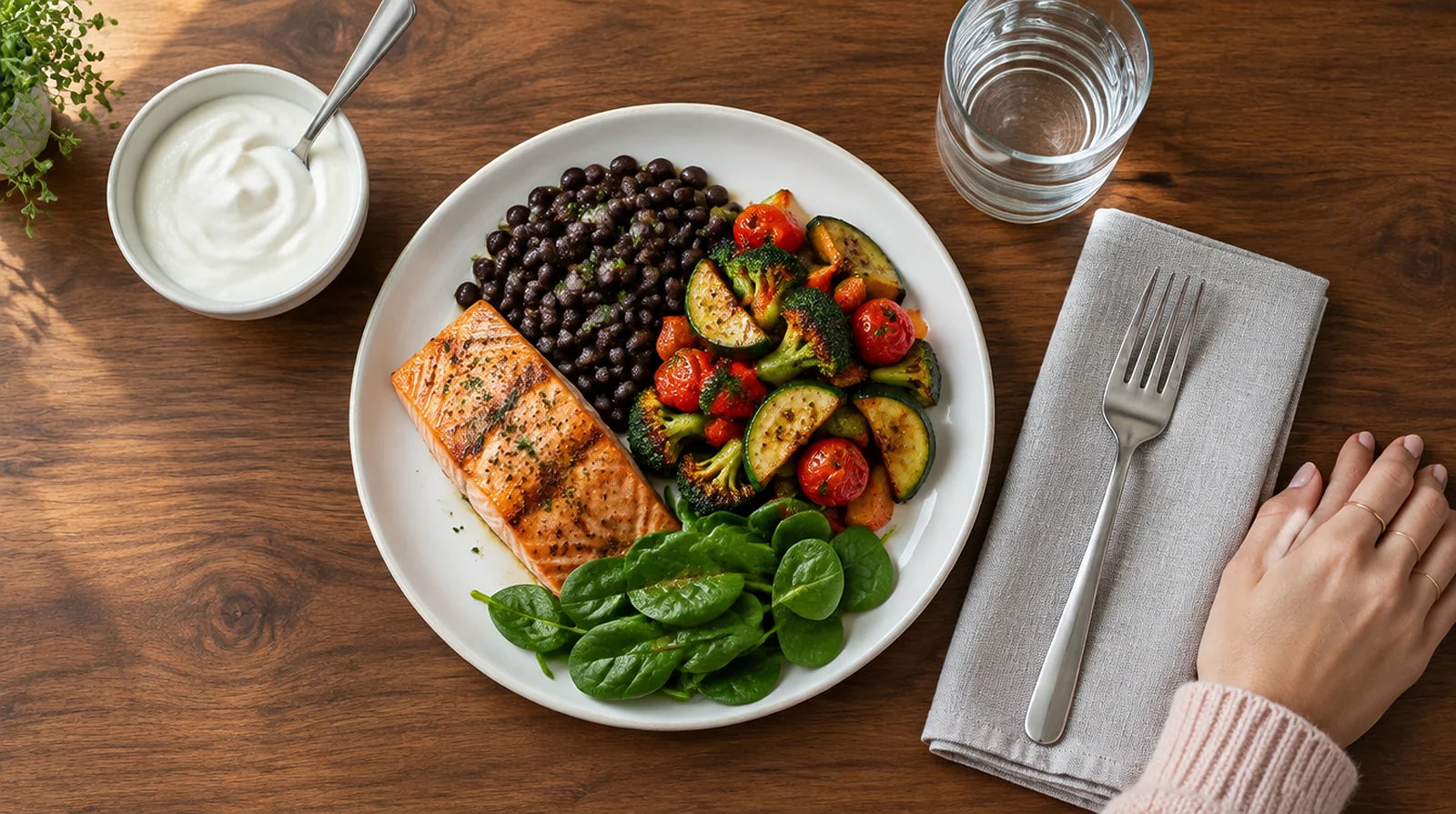
Mounjaro and Zepbound both reduce appetite, so each smaller meal needs to carry more protein and fiber. Both labels pair the drug with diet and exercise, and the tips below are general nutrition guidance, not label instructions.
Protein matters most during weight loss. In a SURMOUNT-1 body composition substudy, about a quarter of the weight lost was lean mass, the same share seen with placebo. A 2025 joint nutrition advisory notes that targets of 1.2 to 1.6 grams of protein per kilogram of body weight per day have been proposed during active weight loss. It also says the right body weight to use is unsettled and that strength training is needed to protect muscle.
Simple ways to put that into practice:
- Eat the protein first. Start each meal with eggs, Greek yogurt, fish, chicken, tofu, beans, or lentils.
- Add fiber at every meal. Vegetables, fruit, whole grains, and legumes fill the plate without much volume.
- Keep easy protein on hand. On days when your appetite is low, a yogurt, a boiled egg, or a protein shake is easier than a full meal.
- Pair meals with movement. The SURMOUNT trials counseled at least 150 minutes of activity a week.
If you want high-protein recipes and meal ideas sized for a smaller appetite, see our GLP-1 meal plan and protein guide.
Frequently Asked Questions
Is Zepbound a generic version of Mounjaro?
No. Both are brand-name tirzepatide products made by Eli Lilly, approved under separate FDA applications for different uses. Neither is a generic of the other.
Can I take Mounjaro for weight loss if I do not have diabetes?
Weight loss is not an FDA-approved use of Mounjaro; its label covers type 2 diabetes and heart-risk reduction in adults with type 2 diabetes. Zepbound is the tirzepatide brand approved for weight management, so ask your prescriber which brand matches your diagnosis.
Why would insurance cover Mounjaro but not Zepbound?
Coverage follows the approved use and your plan. A plan reviews Mounjaro against a type 2 diabetes diagnosis. In employer and other commercial plans, Zepbound for weight is covered only where the plan sponsor chooses to cover weight-management drugs; Zepbound for sleep apnea is reviewed against that diagnosis. Check your plan's drug list and any prior authorization rules.
Which is cheaper, Zepbound or Mounjaro?
It depends on your coverage. With a commercial plan that covers the drug, both savings cards can lower a single-dose pen fill to as little as $25. Without coverage, Lilly lists self-pay prices from $299 a month for Zepbound (vial or KwikPen) and from $499 a month for the Mounjaro single-dose pen (September 2026).
Are Zepbound and Mounjaro doses the same?
Both use the same six strengths, from 2.5 mg to 15 mg once weekly, and both start at 2.5 mg. Mounjaro allows 2.5 mg as an ongoing dose and caps children at 10 mg, while Zepbound uses 2.5 mg only to start.
Can you take Zepbound and Mounjaro together?
The Zepbound label says coadministration with other tirzepatide-containing products or with any GLP-1 receptor agonist is not recommended. That includes Mounjaro.
Who makes Zepbound and Mounjaro?
Eli Lilly makes both. Mounjaro was approved first, in May 2022, and Zepbound followed in November 2023.
Does Mounjaro have a heart benefit that Zepbound does not?
Since August 2026, the Mounjaro label includes reducing the risk of major cardiovascular events in adults with type 2 diabetes at high risk, based on SURPASS-CVOT. The difference is in the label, not the medicine: that trial enrolled adults with type 2 diabetes and showed tirzepatide was noninferior to dulaglutide. The Zepbound label has no cardiovascular indication.
Key Takeaways
The Zepbound vs Mounjaro choice is about the label and your coverage, not a stronger or weaker drug. These are the points to remember:
- Same medicine. Both brands are tirzepatide from Eli Lilly, with the same six strengths and four devices.
- Different labels. Mounjaro covers type 2 diabetes (adults and children 10 and older) and heart-risk reduction; Zepbound covers weight management and sleep apnea in adults.
- Different dose rules. Mounjaro can stay at 2.5 mg for blood sugar control; Zepbound uses 2.5 mg only to start. Neither label includes a dose below 2.5 mg; our page on microdosing tirzepatide explains what the evidence shows.
- Same warnings, different tables. The percentages differ because the trials differed. For signs of a serious allergic reaction, stop the medicine and get medical help right away.
- Coverage drives cost. Savings cards, self-pay prices, Medicare, and formularies treat the two brands differently.
- Switching is a prescriber decision. Neither label gives a brand-to-brand protocol.
Bring your diagnosis, your plan's drug list, and your dose history to your prescriber, and decide together.
References
- Mounjaro (tirzepatide) Prescribing Information, revised 08/2026: Eli Lilly
- Mounjaro Medication Guide, revised August 2026: Eli Lilly
- Zepbound (tirzepatide) Prescribing Information, revised 08/2026: Eli Lilly
- Zepbound Medication Guide, revised 08/2026: Eli Lilly
- Drugs@FDA: NDA 215866 (Mounjaro): U.S. Food and Drug Administration
- Drugs@FDA: NDA 217806 (Zepbound): U.S. Food and Drug Administration
- FDA approval letter, Mounjaro supplements S-044 and S-045, August 27, 2026
- FDA approval letter, Mounjaro supplement S-039 (pediatric), December 19, 2025
- FDA approval letter, Zepbound supplement S-013 (obstructive sleep apnea), December 20, 2024
- FDA approval letter, Mounjaro supplement S-041 (multi-dose vial), January 7, 2026
- FDA approval letter, Mounjaro supplement S-009 (KwikPen), January 20, 2026
- FDA approval letter, Zepbound supplement S-037 (multi-dose vial), January 7, 2026
- FDA approval letter, Zepbound KwikPen supplement S-002, January 20, 2026
- Nicholls SJ et al. Cardiovascular Outcomes with Tirzepatide versus Dulaglutide in Type 2 Diabetes. N Engl J Med, 2025;393:2409-2420
- Hannon TS et al. Efficacy and safety of tirzepatide in children and adolescents with type 2 diabetes (SURPASS-PEDS): a randomised, double-blind, placebo-controlled, phase 3 trial. Lancet, 2025;406:1484-1496
- Garvey WT et al. Tirzepatide once weekly for the treatment of obesity in people with type 2 diabetes (SURMOUNT-2): a double-blind, randomised, multicentre, placebo-controlled, phase 3 trial. Lancet, 2023;402:613-626
- Malhotra A et al. Tirzepatide for the Treatment of Obstructive Sleep Apnea and Obesity. N Engl J Med, 2024;391:1193-1205
- Zepbound coverage and savings: Eli Lilly
- Zepbound coverage and savings for healthcare providers: Eli Lilly
- Zepbound self-pay through LillyDirect: Eli Lilly
- Mounjaro savings and resources: Eli Lilly
- Mounjaro self-pay through LillyDirect: Eli Lilly
- Medicare GLP-1 Bridge: GLP-1 drugs for $50 a month, CMS Product No. 12234, June 2026
- Medicare GLP-1 Bridge: information for Part D plans: Centers for Medicare and Medicaid Services
- CVS Caremark delivers affordability and access to GLP-1 weight management medications with expanded coverage options, May 28, 2026: CVS Health
- Look M et al. Body composition changes during weight reduction with tirzepatide in the SURMOUNT-1 study of adults with obesity or overweight. Diabetes Obes Metab, 2025;27(5):2720-2729
- Nutritional priorities to support GLP-1 therapy for obesity: joint advisory from ACLM, ASN, OMA, and TOS, 2025
This article is for education only and is not medical advice. It summarizes the FDA labels and published research and gives no personalized dosing advice. Talk to your prescriber about which brand and dose fit you. Read our full medical disclaimer.