
Zepbound Injection Sites: Where to Inject, How to Rotate, and What Reactions Mean
Where to inject Zepbound according to the 08/2026 FDA label: stomach, thigh, or the back of the upper arm by a helper. Includes a rotation plan, steps for each device, and what injection site reactions mean.


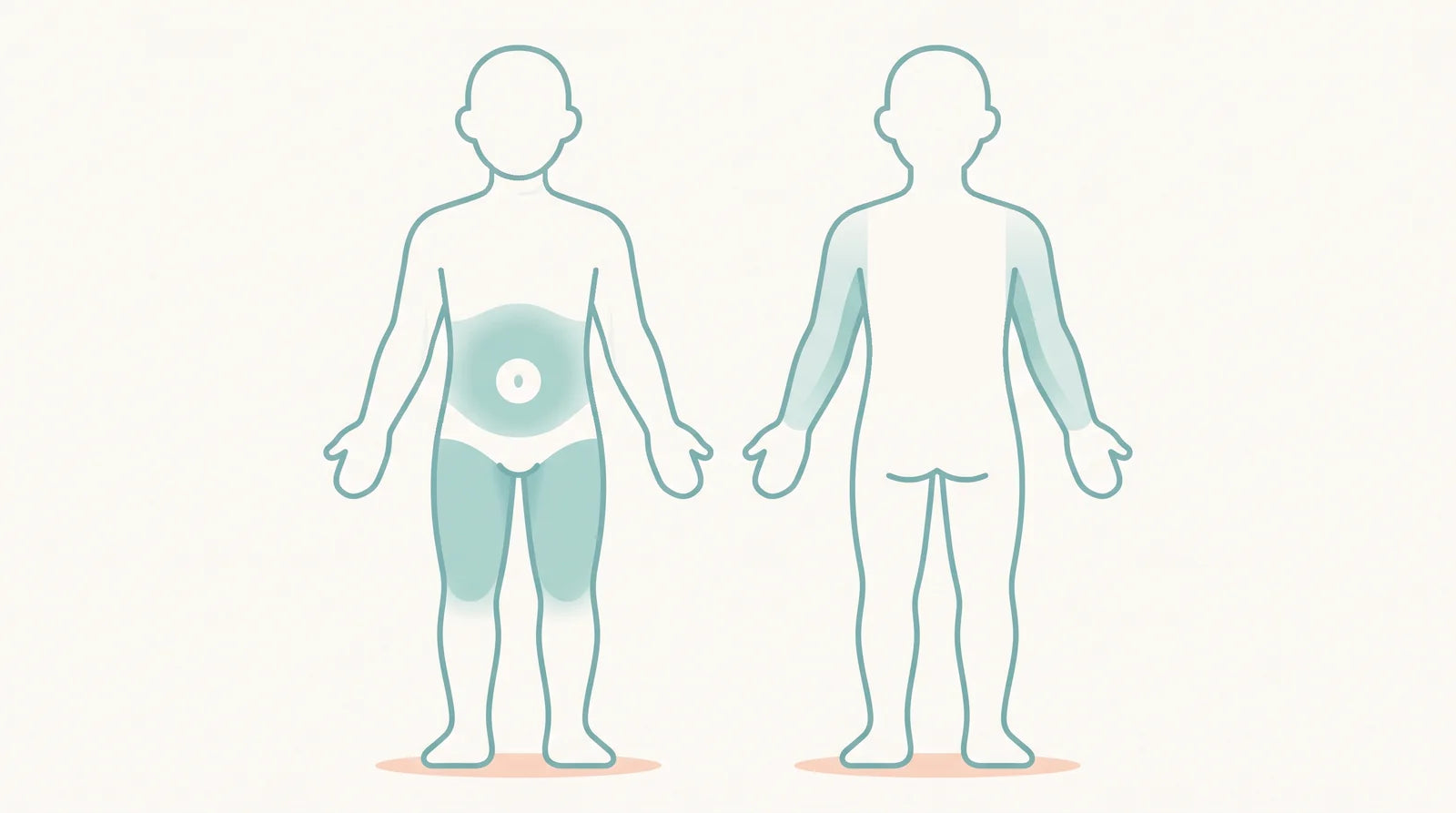
Zepbound injection sites are your stomach (abdomen), your thigh, or the back of your upper arm if someone else gives the shot. That is the whole list in the FDA label. Pick one of these areas each week and move to a new spot every time.
Zepbound (tirzepatide) is a once-weekly shot for weight management and for moderate to severe obstructive sleep apnea in adults with obesity. Injection site reactions such as redness, itching, and bruising are one of its common side effects, affecting 6% to 8% of people in the label trials. For the full list, see our page on Zepbound side effects.
In this guide you will learn:
- Where to inject Zepbound, and why the arm is for helpers only
- Whether the thigh, stomach, or arm works better, using the drug's own site study
- A simple 8-week rotation plan and the spots to avoid
- How each device works: pen, KwikPen, single-dose vial, and multi-dose vial
- What injection site reactions look like, why some people get them, and when to call your doctor
Table of Contents
- Where can you inject Zepbound?
- Thigh vs stomach vs arm: does the site matter?
- How to rotate Zepbound injection sites
- Where not to inject Zepbound
- How to inject Zepbound with each device
- When to inject: time of day, changing your day, and missed doses
- Zepbound injection site reactions
- Troubleshooting common injection problems
- When to call your doctor
- Frequently asked questions
Where Can You Inject Zepbound?
You can inject Zepbound under the skin of your stomach or thigh, and another person can inject it into the back of your upper arm. The FDA label (section 2.4) says exactly this, and every Instructions for Use repeats it.
| Area | Who can inject there | Label notes |
|---|---|---|
| Stomach (abdomen) | You or another person | KwikPen instructions add: at least 2 inches from the belly button |
| Thigh | You or another person | The label says "thigh" and does not limit it to one side |
| Back of the upper arm | Another person only | The label says another person should inject here |
A few details matter:
- Under the skin only. The Medication Guide says not to inject Zepbound into a muscle or a vein.
- Same area is fine, same spot is not. You may use the same body area each week, but choose a different spot within it.
- The 2-inch rule. Only the KwikPen instructions give a distance from the belly button. It is also standard advice for any shot under the skin, according to MedlinePlus, so it is a sensible habit with every device.
Mounjaro, which contains the same medicine, uses the same body areas. Our Zepbound vs Mounjaro comparison explains how the two brands differ.
Thigh vs Stomach vs Arm: Does the Site Matter?
No Zepbound injection site is better than another for how much medicine you absorb. The Zepbound label (section 12.3) states that similar exposure was achieved with injections in the abdomen, thigh, or upper arm.
That sentence rests on a dedicated study. In Lilly's phase 1 trial NCT04050670, 54 healthy adults (53 in the thigh analysis) each received three single 5 mg doses with the single-dose pen: one in the abdomen, one in the thigh, and one in the upper arm, at least 35 days apart. Researchers then compared blood levels.
| Site vs abdomen | Total exposure (AUC ratio) | Peak level (Cmax ratio) |
|---|---|---|
| Thigh | 0.95 | 0.86 |
| Upper arm | 0.99 | 0.92 |
Source: ClinicalTrials.gov NCT04050670 results. A ratio of 1.00 means identical to the abdomen.
What this means in plain terms:
- You get nearly the same total dose. Total exposure from the thigh was 95% of the abdomen, and the arm was 99%.
- The thigh peak was a bit lower. The highest blood level after a thigh shot was about 14% lower, but it stayed within the range regulators treat as equivalent, and the FDA said no dose change is needed by site.
- The FDA agreed. Its clinical pharmacology review concluded that tirzepatide may be given at any of the three sites tested.
Some claims you will see online have no data behind them:
- "The stomach absorbs faster." In the FDA review, the median time to peak was 24 hours at every site.
- "The thigh hurts less." We found no study comparing pain between Zepbound sites.
- "Arm or thigh shots cause less nausea." In the site study, nausea was reported by 20 of 54 people after abdominal doses, 12 of 54 after arm doses, and 11 of 53 after thigh doses. The study was open-label, used single doses in healthy volunteers, and ran no statistical test on side effects, so it cannot show that any site causes less nausea.
- "The site changes your weight loss." We found no trial that tested this.
The best place to inject Zepbound is the one you can reach comfortably, on healthy skin, that you rotate. Your prescriber can help you choose, as the pen instructions suggest.
How to Rotate Zepbound Injection Sites
Rotate Zepbound injection sites with every weekly dose. The label (section 2.4) says "Rotate injection sites with each dose," and the Medication Guide says not to use the same site for each injection.
The vial instructions explain why. Rotating within the area you choose lowers the risk of lipodystrophy (pits or thickened skin) and localized cutaneous amyloidosis (lumps under the skin). In insulin users, poor rotation is the strongest modifiable risk factor for thickened fatty lumps, according to a 2026 international consensus. We found no published tirzepatide-specific rates, but the same habit costs nothing.
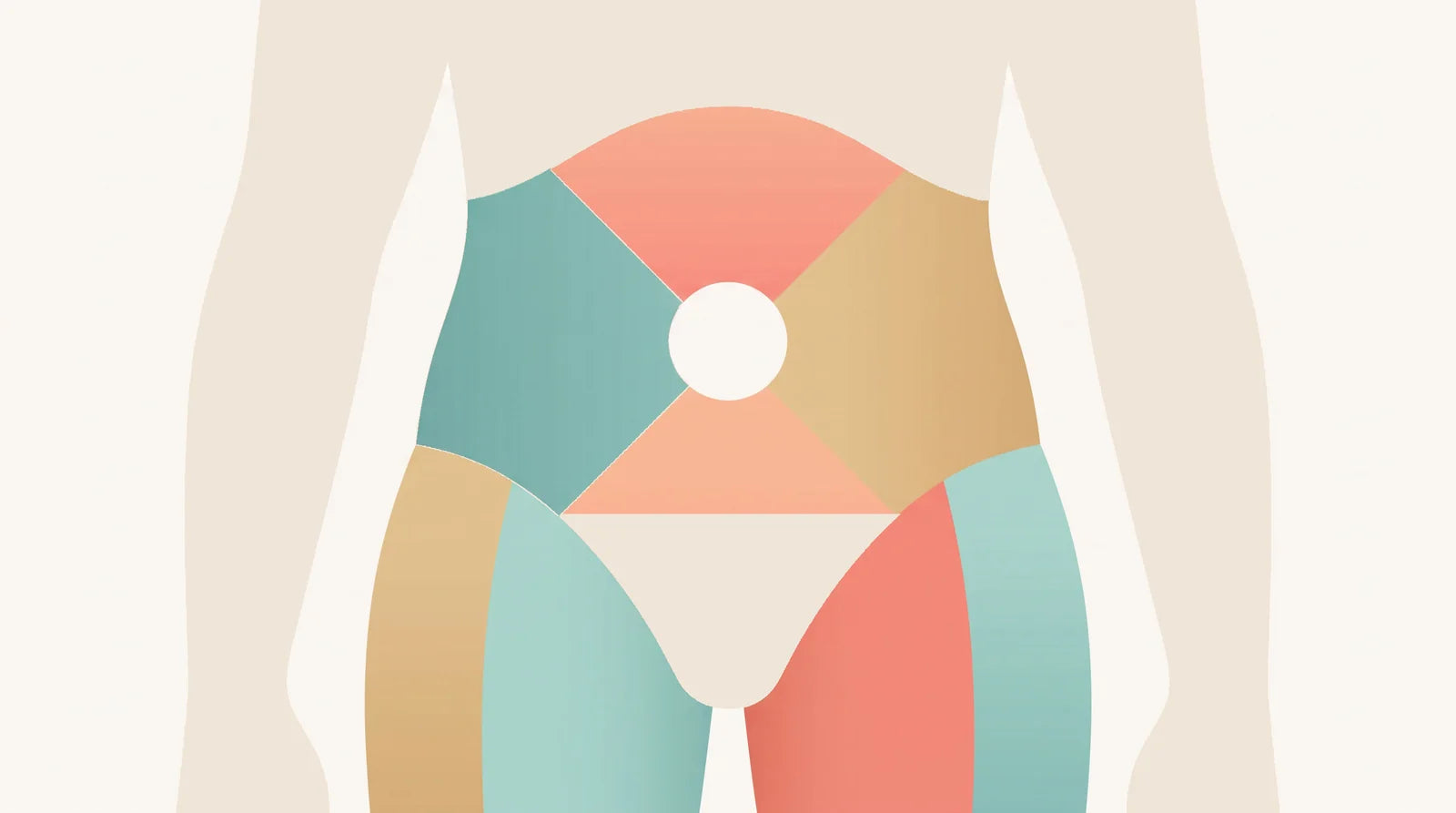
Here is one example plan that cycles through Zepbound injection sites over 8 weeks before you return to the first spot. Your prescriber may suggest a different pattern.
| Week | Area | Spot |
|---|---|---|
| 1 | Stomach | Upper left, 2 inches or more from the belly button |
| 2 | Stomach | Upper right |
| 3 | Stomach | Lower right |
| 4 | Stomach | Lower left |
| 5 | Left thigh | Upper front |
| 6 | Right thigh | Upper front |
| 7 | Left thigh | Upper outer |
| 8 | Right thigh | Upper outer |
Tips that make rotation easy:
- Log each shot. Write the date and spot in your phone or a calendar.
- Keep spots apart. MedlinePlus suggests at least 1 inch between one shot and the next.
- Add the arm if you have a helper. A partner can take weeks 9 and 10 on the back of each upper arm.
Where Not to Inject Zepbound
Do not inject Zepbound anywhere outside the stomach, thigh, or back of the upper arm, and never into a muscle or vein. The label lists only those three areas, so the buttocks, hips, lower back, and calves are not approved sites.
Within the approved Zepbound injection sites, the vial instructions list skin to skip:
- Skin that is tender, bruised, scaly, or hard
- Scars or damaged skin
- Skin with pits, thickening, or lumps
- The same spot you use for other injected medicines
Two more rules come from the label documents. Never mix Zepbound with another medicine in the same syringe. Stay clear of the belly button, as covered above.
If you also use insulin, ask your prescriber how to space the shots. The Zepbound vial instructions say not to use the same injection site as other medicines.
How to Inject Zepbound With Each Device
How you inject Zepbound depends on your device. Zepbound now comes in four presentations, and the label (section 2.4) says you should get training for the specific one you receive.
| Detail | Single-dose pen | KwikPen | Single-dose vial | Multi-dose vial |
|---|---|---|---|---|
| Doses per device | 1 | 4 | 1 | 4 |
| Needle | Built in | Pen needle, not included, new each dose | Syringe and needle, separate, new each dose | Syringe and needle, separate, new each dose |
| Dose volume | 0.5 mL | 0.6 mL (fixed; turn the dose knob until it stops) | 0.5 mL | 0.6 mL |
| Pinch the skin? | No pinch step; base flat on skin | No pinch step in the instructions | Your provider decides | Your provider decides |
| Hold time | Up to 10 seconds, until the gray plunger shows | Count slowly to 5 | At least 5 seconds | At least 5 seconds |
| Room temperature limit (up to 86°F) | 21 days total | Unopened: 30 days. Opened: 30 days total at room temperature, 30 days after first use, or 4 doses, whichever comes first | 21 days total | Unopened: 30 days. Opened: 30 days total at room temperature, 30 days after first use, or 4 doses, whichever comes first |
Sources: Zepbound Prescribing Information sections 2.4 and 16.2, and the four Instructions for Use (2026 versions).
For storage rules in more detail, read does Zepbound need refrigeration.
With every device, check the label for the right medicine, dose, and expiration date first. The medicine should be clear and colorless to slightly yellow, not frozen or cloudy, with no particles; if it is not, do not use it (label section 2.4). If you have vision problems, the Medication Guide says self-injection is not recommended, so ask your provider about help from a trained person.
Single-dose pen
- Take the pen out of the refrigerator and wash your hands. The pen instructions say it is not necessary to warm it to room temperature.
- Check the pen label and the medicine, and make sure the pen is locked.
- Choose and check your spot on the stomach, thigh, or (with a helper) the back of the arm.
- Pull off the gray base cap. Do not put it back on and do not touch the needle.
- Place the clear base flat against your skin, then turn the lock ring to unlock the pen.
- Press and hold the purple button for up to 10 seconds. The first click means the dose started; the second click means it finished.
- Keep the pen on your skin until the second click and the gray plunger is visible, then lift it off.
- Put the pen in an FDA-cleared sharps container.
KwikPen
The KwikPen holds 4 weekly doses. Before each dose, wipe the red inner seal with an alcohol swab, attach a new pen needle, and prime the pen, as the KwikPen instructions require. Then turn the dose knob all the way until it stops and the dose icon shows in the window; do not count clicks. Our page on microdosing tirzepatide explains why splitting these fixed doses is not part of the approved instructions. Inject at least 2 inches from the belly button, push the dose knob in until it stops, and count slowly to 5 before removing the needle. If the icon is not in the window afterward, the instructions say to put the needle back in and finish the injection; do not redial or repeat the dose. Never share a KwikPen, even with a new needle (label section 5.10). Our Zepbound KwikPen guide walks through each step.
Vials and syringes
With a vial, wipe the rubber stopper with an alcohol swab and use a new 1 mL syringe and needle for every dose. Draw up 0.5 mL from a single-dose vial or 0.6 mL from a multi-dose vial. These amounts apply only to FDA-approved Zepbound vials, not to compounded tirzepatide. Inject as your provider showed you, and keep the needle in for at least 5 seconds. For vials and syringes in more detail, see how to inject tirzepatide.
Do you need to clean your skin with alcohol first? None of the Zepbound instructions includes that step; the alcohol swab is for the vial stopper or the KwikPen seal. MedlinePlus does include skin cleaning in its general guide to shots under the skin, so follow what your provider taught you.
When to Inject: Time of Day, Changing Your Day, and Missed Doses
You can inject Zepbound once a week at any time of day, with or without meals. That is the exact instruction in the label (section 2.4), so morning versus night is your choice.
Build a weekly routine
Pick a day and time you can repeat, such as Sunday morning after breakfast. Keep your sharps container and your rotation log in the same place as your pens or vials.
Many people also plan the week's meals around injection day, since appetite often drops. In a SURMOUNT-1 body composition substudy, about a quarter of the weight lost was lean mass, the same share seen with placebo, which is why protein and strength training matter during weight loss. A 2025 joint nutrition advisory notes that targets of 1.2 to 1.6 grams of protein per kilogram of body weight per day have been proposed during active weight loss, though the right body weight to use is unsettled and strength training is also needed to protect muscle. If you want high-protein recipes and meal ideas sized for a smaller appetite, see our GLP-1 meal plan and protein guide.
Changing your injection day or missing a dose
The label (section 2.3) gives two clear rules:
- Changing your day: you can move your weekly injection day if at least 3 days (72 hours) pass between the two doses.
- Missing a dose: take it as soon as possible within 4 days (96 hours). If more than 4 days have passed, skip it and take the next dose on your usual day.
Never take two doses within 3 days of each other, the Medication Guide says. Our tirzepatide dosage chart lists every dose step and the full missed-dose rules.
Zepbound Injection Site Reactions
A Zepbound injection site reaction is redness, itching, bruising, pain, or a rash where you gave the shot. In the label's pooled weight-loss trials (section 6.1, Table 1), these reactions affected 6% to 8% of people on Zepbound, compared with 2% on placebo.
| Group | Injection site reactions |
|---|---|
| Placebo | 2% |
| Zepbound 5 mg | 6% |
| Zepbound 10 mg | 8% |
| Zepbound 15 mg | 8% |
Source: Zepbound Prescribing Information, revised 08/2026, Table 1 (SURMOUNT-1 and SURMOUNT-2 pooled, up to 72 weeks).
Why some people react and others do not
Antibodies are linked to much of the difference. Most people on Zepbound develop antibodies to tirzepatide: 64.5% in the weight-loss trials, according to label section 12.6. The label says no clinically significant effect of these antibodies on how the drug works or how the body handles it has been identified.
They did track with skin reactions. Injection site reactions occurred in 11.3% of people who developed antibodies, compared with 1% of those who did not (label section 6.1). A 2024 analysis of seven diabetes trials found the same pattern (4.6% vs 0.7%), and every injection site reaction in that analysis was nonserious and nonsevere. Most first appeared within 16 weeks of starting treatment and went away whether or not antibodies were present. The label itself does not say when reactions start or how long they last, so note the timing and size of any patch and share it with your prescriber.
Allergic reactions beyond the injection site
In the weight-loss trials, allergic (hypersensitivity) reactions were reported in 5% of people on Zepbound vs 3% on placebo, including reactions within one day of a dose in 2.1% vs 0.4%. Most were skin reactions such as rash or itching. Severe reactions affected 0.1% of people on Zepbound and no one on placebo, and serious reactions, including anaphylaxis and swelling of the face or throat (angioedema), have been reported since approval (label sections 5.6 and 6.1). Do not use Zepbound if you have had a serious allergic reaction to tirzepatide or its ingredients.
Reactions at the site are also covered in our Zepbound side effects guide, alongside the digestive side effects.
Troubleshooting Common Injection Problems
Most problems at Zepbound injection sites are minor. The table shows what the official instructions say and, where they are silent, general steps to take.
| Problem | What the instructions say | What to do |
|---|---|---|
| A drop of liquid or blood on the skin | The pen instructions call this normal | Press a cotton ball or gauze on the spot. Do not rub |
| A drop on the KwikPen needle tip | Normal, and it does not affect your dose | Nothing extra |
| Small bruise | The vial instructions say not to inject into bruised skin, and the label counts bruising as an injection site reaction | Skip that spot until it heals and rotate to a new one |
| Pen lifted before the second click | Do not remove the pen until the second loud click. The dose was delivered if the gray plunger is visible | Check for the gray plunger. If you do not see it, do not inject another dose on your own; call the support number in the pen instructions, your pharmacist, or your prescriber. The Medication Guide says not to take 2 doses within 3 days |
| Worried you hit a muscle | The Medication Guide says not to inject into a muscle | Do not repeat the dose. Tell your prescriber at your next contact |
| Itchy, red, or raised patch | Injection site reactions are a common side effect | Rotate spots. Mention it to your prescriber, especially if it grows with each dose |
| Lump, pit, or thick skin at a spot | Vial instructions warn against injecting into such skin | Avoid that area and show it to your provider |
| Air bubbles in the pen | Normal, per the pen instructions | Inject as usual |
When to Call Your Doctor
Most reactions at Zepbound injection sites are mild, but some signs need prompt care. The Zepbound Medication Guide says to stop using Zepbound and get medical help right away if you have symptoms of a serious allergic reaction.
| Sign | Action |
|---|---|
| Swelling of your face, lips, tongue, or throat | Stop Zepbound and get emergency help right away |
| Problems breathing or swallowing | Stop Zepbound and get emergency help right away |
| Severe rash or itching, fainting or feeling dizzy, very rapid heartbeat | Stop Zepbound and get medical help right away |
| Redness, swelling, red streaks, or fever | Call your provider; MedlinePlus lists these as signs of infection |
| You think you took too much Zepbound | Call your healthcare provider or Poison Help at 1-800-222-1222, or go to the nearest emergency room right away (Medication Guide) |
| A reaction that gets bigger or lasts longer with each dose | Call your prescriber before your next shot |
| Lumps or hard areas that do not go away | Show your provider at your next visit |
Mild soreness at the spot is expected with any shot under the skin, according to MedlinePlus.
Key Takeaways
- Three areas only. Inject into your stomach or thigh, and let someone else use the back of your upper arm.
- The site does not change the dose. The label and the site study show similar exposure at all three areas.
- Rotate every week. Use a new spot each time and skip damaged skin.
- Know your device. Pen, KwikPen, and vials differ in needles, hold times, and storage.
- Watch for patterns. Tell your prescriber about reactions that grow with each dose. For signs of a serious allergic reaction, such as swelling of the face, lips, tongue, or throat or trouble breathing or swallowing, stop Zepbound and get medical help right away.
Choosing among Zepbound injection sites is simple once you have a plan. Keep a log, rotate, and bring questions about technique to your prescriber or pharmacist.
Frequently Asked Questions
Do you pinch the skin for a Zepbound injection?
The single-dose pen instructions say to place the clear base flat against your skin, with no pinching step. The vial instructions say your healthcare provider should tell you whether to pinch.
Is it better to inject Zepbound in the thigh or stomach?
Either works. The FDA label says similar exposure was achieved in the abdomen, thigh, and upper arm, and no site is listed as better for weight loss or side effects.
Where is the least painful place to inject Zepbound?
We found no study comparing pain between Zepbound injection sites. Pick healthy skin away from scars and bruises, rotate spots, and ask your prescriber to watch your technique if shots hurt.
Can I inject Zepbound in my own arm?
The label says another person should inject into the back of your upper arm. If you inject yourself, use your stomach or thigh.
Is it better to inject Zepbound in the morning or at night?
Neither. The label says to take Zepbound once weekly at any time of day, with or without meals. Pick a time you will remember.
Do you need to warm Zepbound before injecting?
Not with the single-dose pen. Its instructions say it is not necessary to warm the pen to room temperature. The vial and KwikPen instructions do not mention warming.
Does Mounjaro use the same injection sites?
Yes. Mounjaro contains the same medicine, tirzepatide, and its label lists the abdomen and thigh, with the back of the upper arm injected by another person. Our GLP-1 medications list shows every approved brand and how each one is taken.
References
- Zepbound (tirzepatide) Prescribing Information, revised 08/2026: Eli Lilly
- Zepbound Medication Guide, revised 08/2026: Eli Lilly
- Instructions for Use, Zepbound single-dose pen, April 2026: Eli Lilly
- Instructions for Use, Zepbound single-dose vial, April 2026: Eli Lilly
- Instructions for Use, Zepbound multi-dose vial, January 2026: Eli Lilly
- Instructions for Use, Zepbound KwikPen, January 2026: Eli Lilly
- Zepbound label on DailyMed: U.S. National Library of Medicine
- Relative bioavailability of tirzepatide by injection site, study NCT04050670: ClinicalTrials.gov
- Clinical pharmacology review, NDA 215866 (tirzepatide), 2022: U.S. Food and Drug Administration
- Mullins GR et al. Tirzepatide immunogenicity on pharmacokinetics, efficacy, and safety. J Clin Endocrinol Metab, 2024
- Mounjaro (tirzepatide) Prescribing Information, revised 08/2026: Eli Lilly
- Subcutaneous (SQ) injections: MedlinePlus Medical Encyclopedia
- Guo L et al. Consensus recommendations on lipohypertrophy. Diabetes Res Clin Pract, 2026
- Look M et al. Body composition changes during weight reduction with tirzepatide in the SURMOUNT-1 study of adults with obesity or overweight. Diabetes Obes Metab, 2025
- Nutritional priorities to support GLP-1 therapy for obesity: joint advisory from ACLM, ASN, OMA, and TOS, 2025
This article is for education only and is not medical advice. It summarizes the FDA label and published research and gives no personalized dosing advice. Talk to your prescriber about your injections and your dose. Read our full medical disclaimer.