
Microdosing Tirzepatide: What the Evidence Actually Shows
Microdosing tirzepatide has no FDA-approved dose. What trials show about doses below 2.5 mg, what the Zepbound label allows instead (a lower maintenance dose), the risks of splitting pens and compounded products, and what to ask your prescriber.


Microdosing tirzepatide usually means taking less than the label dose of tirzepatide (Zepbound or Mounjaro), or taking it less often than once a week. There is no FDA-approved microdose. The Zepbound label starts everyone at 2.5 mg once weekly, and we found no randomized trial of doses below 2.5 mg in people using tirzepatide for weight management.
Many people try it to avoid Zepbound side effects or to stretch a costly supply. The label already offers an approved alternative: if a maintenance dose is not tolerated, your prescriber can consider a lower maintenance dose.
Quick answers:
- No official microdose. The lowest approved tirzepatide dose is 2.5 mg, and the Zepbound label limits it to the first 4 weeks.
- Lower doses gave less weight loss in randomized trials. In a trial in adults with type 2 diabetes, a 1 mg arm lost about 1 kg in 26 weeks, close to placebo.
- Lower doses still cause side effects. Nausea affected 25% of people even at 5 mg in the label trials.
- Splitting pens is not part of the approved instructions, which call for one full fixed dose each week, and compounded products are not FDA approved.
This guide covers what people mean by the term, the trial data on low doses, what the label allows, the risks, and the questions to bring to your prescriber. It gives no microdose amounts or schedules, because none are approved or backed by randomized trials we found.
Table of Contents
- What does microdosing tirzepatide mean?
- Is there an FDA-approved microdose of tirzepatide?
- What trials show about low tirzepatide doses
- Does a lower tirzepatide dose mean fewer side effects?
- What the label allows instead: a lower maintenance dose
- Eating for results at any tirzepatide dose
- Microdosing tirzepatide claims vs the evidence
- Risks of microdosing tirzepatide
- Questions to ask your prescriber before changing your dose
- Frequently asked questions
What Does Microdosing Tirzepatide Mean?
Microdosing tirzepatide has no standard medical definition. People use the term for at least five different practices, and the Zepbound label and the research treat each one differently.
Jody Dushay, MD, of Harvard Medical School and Beth Israel Deaconess, made the same point in a May 2026 STAT essay that "there isn't even a single definition of microdosing for weight loss or any other condition." Before you read any claim about microdosing tirzepatide, check which of these five practices it means. For semaglutide medicines such as Wegovy and Ozempic, see our page on microdosing GLP-1.
| What people mean | What the Zepbound label says | Evidence we found |
|---|---|---|
| A dose below 2.5 mg | No dose below 2.5 mg is approved | Longest randomized data we found: a 1 mg arm in a 26-week 2018 type 2 diabetes trial; short phase 1 safety studies also used lower doses |
| Staying on 2.5 mg long term | 2.5 mg is for starting treatment and is not approved as a maintenance dose | One non-randomized Japanese cohort (2026) |
| Slower or smaller dose steps | 2.5 mg to 5 mg after 4 weeks; above 5 mg, 2.5 mg steps after at least 4 weeks | A 2020 study of faster-than-label plans to 12 or 15 mg linked lower starting doses and smaller steps to fewer side effects; it did not test microdoses |
| Stretching the time between doses | Once weekly; a missed dose may be taken within 4 days | No randomized trial found; one small case series |
| Splitting a pen or vial | Multi-dose devices hold 4 fixed weekly doses; single-dose pens and single-dose vials are for one injection each | The KwikPen instructions forbid counting clicks and moving medicine from the pen into a syringe; the multi-dose vial instructions say to throw the vial away after 4 doses or 30 days, even if medicine is left |
Two details stand out. First, the label moves everyone from 2.5 mg to 5 mg after 4 weeks; above 5 mg, it says a dose may be increased after at least 4 weeks on the current dose, which is a minimum, not a deadline (label section 2.1). Second, none of these five practices is part of the label. What the label does offer is a lower maintenance dose at the approved strengths, covered below.
Is There an FDA-Approved Microdose of Tirzepatide?
No. The lowest approved tirzepatide dose is 2.5 mg once weekly, and the Zepbound label says: "The 2.5 mg dosage is for treatment initiation and is not approved as a maintenance dosage."
The label (sections 2.1 and 2.2) sets these limits:
- Start: 2.5 mg once weekly for 4 weeks, for every indication.
- Why the steps exist: the label says to follow the dose escalation "to reduce the risk of gastrointestinal adverse reactions."
- Maintenance: 5 mg, 10 mg, or 15 mg once weekly for weight reduction and long-term maintenance; 10 mg or 15 mg for obstructive sleep apnea.
- Maximum: The maximum dose is 15 mg once a week. See every label step in our tirzepatide dosage chart.
Every approved step is 2.5 mg or higher, and the full label schedule is a topic of its own. Mounjaro contains the same medicine but is approved for type 2 diabetes. See how the two brands differ in our Zepbound vs Mounjaro comparison. Its label also starts at 2.5 mg and allows 2.5 mg increases if more blood sugar control is needed, and the current Mounjaro label (revised 08/2026) does not contain the Zepbound sentence that limits 2.5 mg to initiation. That label is for type 2 diabetes (blood sugar control and lowering heart risk), not weight management.
Why there is no microdosing tirzepatide chart
Searches for a "microdosing tirzepatide chart" have no official answer. Neither the FDA label nor the manufacturer lists any dose below 2.5 mg, so any chart you find comes from sellers or personal reports, not from randomized trials. In a statement reported by TODAY.com in November 2025, before the multi-dose KwikPen launched, Eli Lilly said microdosing is not contemplated by the FDA label and may increase the risk of contamination. For that reason this page has no microdose chart.
What Trials Show About Low Tirzepatide Doses
In randomized trials, lower tirzepatide doses produced less weight loss than higher doses. The longest randomized data below 2.5 mg we found come from a 1 mg arm in adults with type 2 diabetes, and that group lost about 1 kg in 26 weeks, close to placebo. Earlier phase 1 studies (single doses and 4-week courses) also tested doses below 2.5 mg in healthy volunteers and people with type 2 diabetes, but they were built to test safety and blood levels, not weight management.
| Study | Design | Dose | Weight change | Main limits |
|---|---|---|---|---|
| Phase 2 (Frias, Lancet 2018) | Randomized, 318 adults with type 2 diabetes, 26 weeks | 1 mg | -0.9 kg (placebo -0.4 kg) | Diabetes population; weight was a secondary outcome |
| Phase 2 (same trial) | Same | 5 mg | -4.8 kg | Short trial; started at 5 mg with no 2.5 mg step |
| Phase 2 (same trial) | Same | 10 mg / 15 mg | -8.7 kg / -11.3 kg | These arms escalated faster than today's label |
| SURMOUNT-1 (Zepbound label, Study 1) | Randomized, adults with obesity or overweight, 72 weeks | 5 / 10 / 15 mg | -15.0% / -19.5% / -20.9% (placebo -3.1%) | Tested approved maintenance doses only |
| Japanese cohort (Amioka, 2026) | Non-randomized, 112 adults without diabetes, 6 months | 2.5 mg vs 5 mg | -15.3% vs -16.1% | Not randomized, one country, short, lower starting BMI (30.8), very high diet adherence |
Sources: Frias 2018 and ClinicalTrials.gov NCT03131687 posted results; Zepbound Prescribing Information Table 2; Amioka, Diabetes Obes Metab 2026.
The phase 2 trial is the closest thing to a microdose trial we found. At 26 weeks, 13.5% of people on 1 mg lost at least 5% of their body weight, compared with 0% on placebo, 47.3% on 5 mg, 70.6% on 10 mg, and 62.3% on 15 mg (ClinicalTrials.gov results). Blood sugar still improved at 1 mg, which matters for diabetes but says little about weight management.
The Japanese cohort is the only 2.5 mg maintenance data we found. After 4 weeks, patients and clinicians chose together whether to stay on 2.5 mg (58 people) or move to 5 mg (54 people). Weight loss at 6 months was similar, and adverse events affected 35% vs 50%.
Because people chose their own group, those who stayed on 2.5 mg may simply have been early responders, and the authors reported 96.4% adherence to the diet plan. In the US, 2.5 mg remains a starting dose, not an approved Zepbound maintenance dose.
Does a Lower Tirzepatide Dose Mean Fewer Side Effects?
Partly, but less than many people expect. In the Zepbound label trials, any digestive side effect affected 56% of people at every maintenance dose (vs 30% on placebo), and even the 1 mg arm of the phase 2 trial had digestive events in 23.1% of people, compared with 9.8% on placebo.
| Side effect | Placebo | 5 mg | 10 mg | 15 mg |
|---|---|---|---|---|
| Nausea | 8% | 25% | 29% | 28% |
| Diarrhea | 8% | 19% | 21% | 23% |
| Vomiting | 2% | 8% | 11% | 13% |
| Constipation | 5% | 17% | 14% | 11% |
| Stopped because of digestive effects | 0.5% | 1.9% | 3.3% | 4.3% |
Source: Zepbound Prescribing Information, revised 08/2026, section 6.1 (SURMOUNT-1 and SURMOUNT-2 pooled; the 5 mg column is from SURMOUNT-1 only, because SURMOUNT-2 did not test 5 mg).
What the numbers show:
- Nausea and diarrhea changed little between 5 mg and 15 mg. Vomiting rose from 8% to 13%.
- Constipation went the other way. It fell from 17% at 5 mg to 11% at 15 mg.
- Stopping for side effects rose with dose, from 1.9% to 4.3%.
- Timing matters more than you might think. The label says most nausea, vomiting, and diarrhea happened during dose escalation and decreased over time.
The pace of dose increases also seems to matter. In a 12-week 2020 study of 111 adults with type 2 diabetes, three escalation plans all reached 12 or 15 mg within 8 weeks. Nausea ranged from 24.1% to 39.3%, vs 7.7% on placebo. Compared with the faster earlier trial, the authors linked lower starting doses and smaller dose steps to a more favorable side effect profile. The study did not test low or micro doses.
Still, we found no trial that compared a microdose schedule with the label schedule. In the phase 2 trial, digestive events rose from 23.1% at 1 mg to 66.0% at 15 mg, but those high-dose arms escalated faster than today's label allows. For practical ways to handle nausea and other digestive effects, see our page on Zepbound side effects.
What the Label Allows Instead: A Lower Maintenance Dose
The Zepbound label lets your prescriber choose a lower maintenance dose when a higher one is not tolerated. Section 2.1 says: "If patients do not tolerate a maintenance dosage, consider a lower maintenance dosage."
The approved maintenance choices are 5 mg, 10 mg, and 15 mg. That is the legitimate version of what many people hope microdosing tirzepatide will do: a smaller dose that still works, chosen with your prescriber.
SURMOUNT-MAINTAIN: what stepping down to 5 mg did
SURMOUNT-MAINTAIN is the only randomized trial of a lower tirzepatide maintenance dose we found (Lancet, May 2026). Adults first completed a 60-week open-label period on tirzepatide, reaching their maximum tolerated dose (10 or 15 mg). Then 378 people continued that dose, stepped down to 5 mg, or switched to placebo for 52 more weeks.
| Group | Weight change from start of trial | Needed rescue treatment for regain |
|---|---|---|
| Stayed on maximum tolerated dose | -21.9% | 8% |
| Stepped down to 5 mg | -16.6% | 25% |
| Switched to placebo | -9.9% | 67% |
Source: Horn et al., Lancet 2026. Rescue tirzepatide was allowed from week 84 for people who regained more than half of the weight they had lost.
The authors suggested that 5 mg may be an alternative to stopping, while noting that individual responses vary. The trial was funded by Lilly, and 65% of the enrolled participants were women. It tested 5 mg, an approved dose, not a microdose. Our page on the Zepbound maintenance dose covers the trial and its limits in more detail.
Stopping completely carries a clearer cost. In SURMOUNT-4, people switched to placebo after 36 weeks saw their weight rise by 14.0% between week 36 and week 88, while those who stayed on tirzepatide lost another 5.5% (label section 14.1).
Eating for Results at Any Tirzepatide Dose
Your tirzepatide dose is only part of your result. Zepbound is approved for use with a reduced-calorie diet and more physical activity, and a 2025 joint advisory from four nutrition and obesity societies lists protecting muscle and bone through resistance training and an appropriate diet as a priority.
The same advisory notes that GLP-1 medicines reduce body weight by 5% to 18% in trials, with somewhat lower results in real-world use. General habits that help (from the joint advisory, not the drug label):
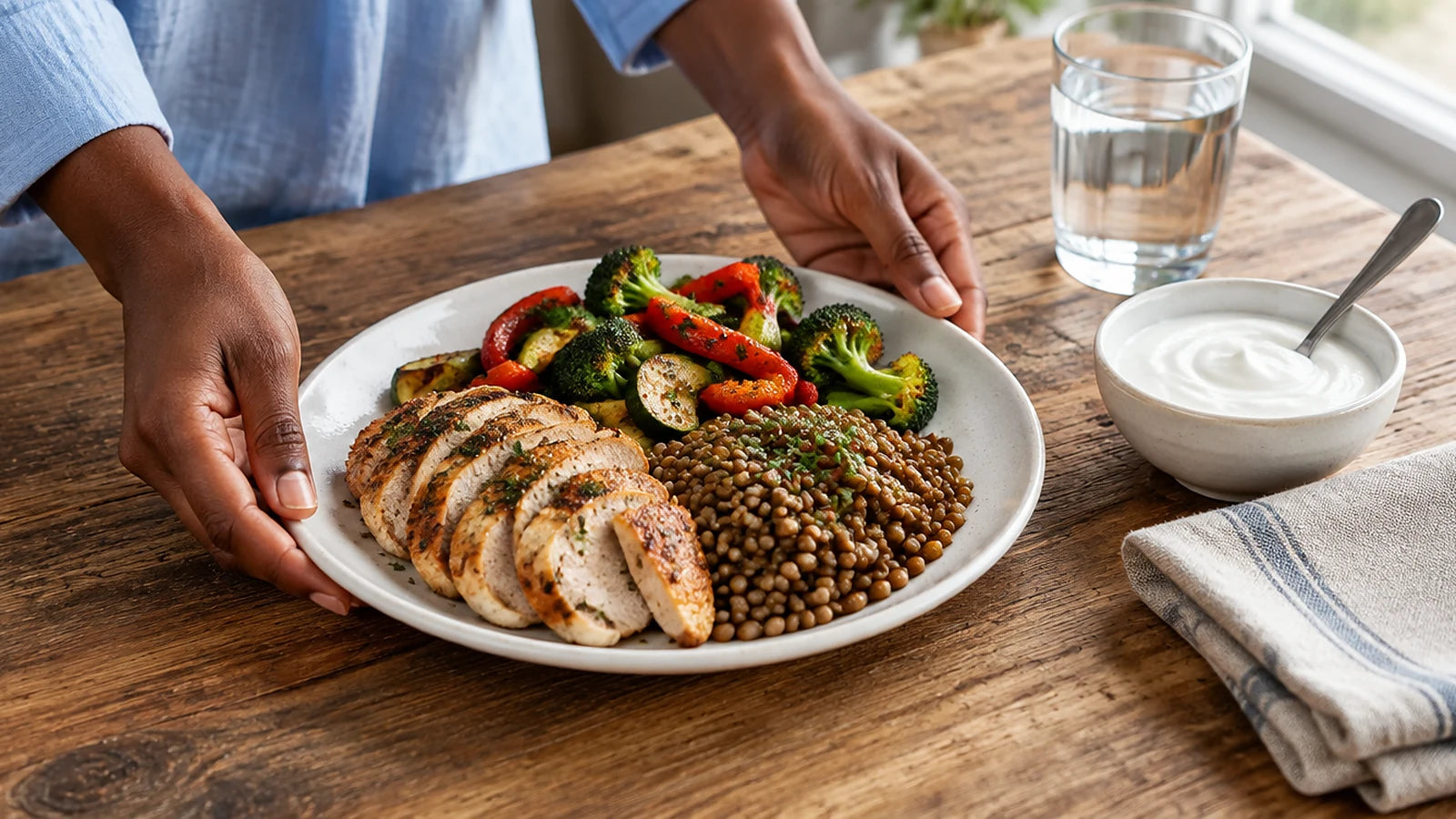
- Build each meal around protein, such as eggs, Greek yogurt, fish, chicken, tofu, or lentils, to help protect muscle while you lose weight.
- Eat regular, smaller meals while your appetite is low, and avoid large meals.
- Add strength training on a regular schedule, in a form your clinician agrees suits you.
- Keep fluids up, especially on days when your appetite is low.
If you want help building protein-first meals around a smaller appetite, our guide includes a weekly meal plan made for GLP-1 users: see our GLP-1 meal plan and protein guide.
Microdosing Tirzepatide Claims vs the Evidence
For most popular claims about microdosing tirzepatide, we found no tirzepatide microdosing trial. The table below compares common claims with what we found in trials and the label.
| Claim | What we found |
|---|---|
| "Fewer side effects" | A 2020 study of faster-than-label plans to 12 or 15 mg linked lower starting doses and smaller steps to fewer side effects; it did not test microdoses, and we found no trial comparing a microdose schedule with the label schedule |
| "Same weight loss at a lower dose" | Randomized trials show less weight loss at lower doses; the 1 mg arm lost about 1 kg in 26 weeks |
| "Reduces inflammation" | We found no tirzepatide microdosing trial that measured this |
| "Longevity or anti-aging" | We found no tirzepatide microdosing trial that measured this |
| "Balances hormones or eases menopause" | We found no tirzepatide microdosing trial that measured this |
| "Cheaper" | The device instructions call for one full fixed dose a week and say to throw pens and multi-dose vials away after 4 doses, so extra doses are not part of approved use |
| "Best for maintenance" | SURMOUNT-MAINTAIN tested 5 mg, not microdoses; 25% on 5 mg needed rescue treatment |
The honest summary: lower doses are a fair question for research, and a 2026 commentary and a separate letter in the journal Obesity show the debate is active. Until trials report, claims beyond the table above are opinions. Claims that a small dose "quiets food noise" are in the same place; see what studies show about food noise.
Risks of Microdosing Tirzepatide
The main risks of microdosing tirzepatide are dosing errors, splitting devices that were not designed for it, unapproved compounded products, and less weight loss than you expect. Each one is covered below with what the official instructions say.
Splitting pens and vials
The Zepbound KwikPen instructions (January 2026) say: "Each pen contains 4 fixed doses, one dose taken weekly." You turn the dose knob all the way until it stops, and Step 11 says: "Do not count clicks as you select the dose."
The same instructions say not to inject leftover medicine and not to move Zepbound from the pen into a syringe. They warn that trying to inject leftover medicine could give an incomplete dose. Other device rules:
- KwikPen: throw it away 30 days after first use or after 4 weekly doses.
- Single-dose pen or single-dose vial: each holds one dose for one injection.
- Multi-dose vial: it holds 4 weekly doses; discard it after 30 days or 4 doses, even if medicine is left.
- Sharing: the label says never to share a KwikPen between patients, even if the needle is changed. Our Zepbound KwikPen guide walks through each step.
A 2026 commentary in the journal Obesity (Lodrigues and colleagues) noted that microdosing the multi-dose pen is not endorsed by the manufacturer or approved by any regulatory agency. The authors flagged contamination, reduced product integrity if a pen is used after its beyond-use date, and a higher chance of dosing errors for people with poor vision or dexterity. They also called microdosing a reasonable approach to individualizing care, while stressing how few pharmacokinetic, safety, and efficacy studies exist. The label already says the KwikPen is not recommended for self-injection by people who are visually impaired.
For where and how to inject each device, see our page on Zepbound injection sites.
Compounded tirzepatide
The FDA states that compounded drugs are not FDA approved, so the agency does not review them for safety, effectiveness, or quality before sale. It has received adverse event reports that may be linked to compounded semaglutide or tirzepatide prescribed in doses beyond the approved label, and more than 730 adverse event reports associated with compounded tirzepatide as of May 31, 2026.
The FDA declared the national tirzepatide shortage resolved on October 2, 2024, confirmed that decision on December 19, 2024, and ended its temporary enforcement flexibility for compounders in early 2025. Our page on compounded tirzepatide covers the full legal timeline and 2026 FDA actions.
Stretching the time between doses
Tirzepatide has a half-life of about 5 to 6 days, and blood levels reach a steady state after 4 weeks of weekly doses (label section 12.3). We found no randomized trial of tirzepatide taken less often than once a week.
One retrospective case series described 30 adults on semaglutide or tirzepatide who moved to less frequent doses after a weight plateau, with no control group. The authors reported that average weight did not rebound and fell slightly, from 74.1 kg at the plateau to 72.4 kg later, but a small uncontrolled series cannot show that the lower frequency caused this. A small randomized pilot trial is registered but not yet recruiting. Neither gives a basis for a schedule, and the label keeps the weekly rhythm: take a missed dose within 4 days, or skip it.
Taking too much by mistake
Measuring unusual amounts raises the chance of a dosing error. The Zepbound Medication Guide says: "If you take too much ZEPBOUND, call your healthcare provider or Poison Help line at 1-800-222-1222 or go to the nearest hospital emergency room right away."
The prescribing information adds that observation and treatment may be needed for some time, since tirzepatide has a half-life of about 5 days (section 10).
Label rules that still apply at any dose
- Birth control pills: the label advises switching to a non-oral method, or adding a barrier method, for 4 weeks after starting and after each dose increase.
- No doubling up: the label does not recommend using Zepbound with other tirzepatide products or any other GLP-1 medicine. Our GLP-1 medications list shows which medicines those are.
- Dehydration: the Medication Guide says drinking fluids helps reduce your chance of dehydration, and to tell your healthcare provider right away if you have nausea, vomiting, or diarrhea that does not go away.
- Serious symptoms: the Medication Guide says to stop Zepbound and call your healthcare provider right away for severe pain in your stomach area that will not go away, with or without nausea or vomiting, and to stop Zepbound and get medical help right away for signs of a serious allergic reaction.
Questions to Ask Your Prescriber Before Changing Your Dose
Bring any wish to lower your tirzepatide dose to your prescriber rather than adjusting it yourself. The Zepbound Medication Guide says to use it "exactly as your healthcare provider tells you to."
Useful questions:
- Is a lower maintenance dose, such as 5 mg, right for me, and how would we decide?
- Would a slower pace between dose increases suit me?
- Which presentation (single-dose pen, KwikPen, or vial) fits my needs and my eyesight?
- What should I do if nausea, vomiting, or constipation makes a dose hard to tolerate?
- How will we judge whether my dose is working, and after how long?
- If cost is the reason, what approved lower-cost options or coverage routes exist?
- What should I expect, and plan for, if I stop tirzepatide?

A dose change is a shared decision based on your response, side effects, and health history. Read our medical disclaimer for how to use this guide.
Key Takeaways
- No approved microdose. The lowest tirzepatide dose is 2.5 mg, and Zepbound's label limits it to the first 4 weeks.
- Less medicine, less weight loss. Randomized trials show a clear dose-response, and the 1 mg arm lost about 1 kg in 26 weeks.
- Side effects still happen at low doses. Digestive events affected 23.1% of people even at 1 mg (vs 9.8% on placebo).
- The label has an approved lever. Ask about a lower maintenance dose, and do not split pens or vials, which hold fixed doses.
Microdosing tirzepatide is a popular idea with very little trial data behind it. The approved options, more time between dose increases above 5 mg, a lower maintenance dose, and good nutrition, give you and your prescriber real room to adjust.
Frequently Asked Questions
What is considered a microdose of tirzepatide?
There is no official definition. People usually mean any amount below the 2.5 mg starting dose, or taking tirzepatide less often than weekly. No dose below 2.5 mg is FDA approved.
Can you microdose Zepbound with the KwikPen?
Not within the approved instructions. The KwikPen instructions say each pen holds 4 fixed weekly doses, tell you not to count clicks, and say not to inject leftover medicine or move it into a syringe. Splitting doses is not part of the approved use.
Is 2.5 mg of tirzepatide a microdose, and can I stay on it?
No, 2.5 mg is the approved starting dose. The Zepbound label says it is for starting treatment and is not approved as a maintenance dose, so ask your prescriber before staying on it.
How long does tirzepatide take to work at a low dose?
We found no randomized data on doses below 2.5 mg for weight management, so there is no evidence-based answer for a microdose. At approved doses, blood levels reach a steady state after about 4 weeks of weekly doses, and the label trials measured weight results at 72 weeks. For the full timeline at approved doses, read how long it takes Zepbound to start working.
Does microdosing tirzepatide help with maintenance?
The trial we found on lower maintenance doses, SURMOUNT-MAINTAIN, tested 5 mg, not microdoses. People who stepped down to 5 mg kept off more weight than placebo but less than those who stayed on their full dose.
Is microdosing tirzepatide cheaper?
Not in any approved way. The device instructions call for one full fixed dose a week and say to throw pens and multi-dose vials away after 4 doses, so extra doses are not part of approved use. If cost is the issue, ask your prescriber about approved lower-cost options and your insurance coverage.
Does microdosing tirzepatide reduce inflammation?
We found no clinical trial of tirzepatide microdosing that tested inflammation, longevity, or hormone benefits.
References
- Zepbound (tirzepatide) Prescribing Information, revised 08/2026: Eli Lilly
- Zepbound Medication Guide, revised 08/2026: Eli Lilly
- Instructions for Use, Zepbound KwikPen, January 2026: Eli Lilly
- Instructions for Use, Zepbound single-dose pen, April 2026: Eli Lilly
- Instructions for Use, Zepbound multi-dose vial, January 2026: Eli Lilly
- Mounjaro (tirzepatide) Prescribing Information, revised 08/2026: Eli Lilly
- Zepbound label on DailyMed: U.S. National Library of Medicine
- Frias JP et al. Efficacy and safety of LY3298176, a novel dual GIP and GLP-1 receptor agonist, in patients with type 2 diabetes: a randomised, placebo-controlled and active comparator-controlled phase 2 trial. Lancet, 2018
- Phase 2 tirzepatide trial NCT03131687, posted results: ClinicalTrials.gov
- Coskun T et al. LY3298176, a novel dual GIP and GLP-1 receptor agonist for the treatment of type 2 diabetes mellitus: from discovery to clinical proof of concept. Mol Metab, 2018
- Frias JP et al. Efficacy and tolerability of tirzepatide, a dual glucose-dependent insulinotropic peptide and glucagon-like peptide-1 receptor agonist in patients with type 2 diabetes: a 12-week, randomized, double-blind, placebo-controlled study to evaluate different dose-escalation regimens. Diabetes Obes Metab, 2020
- Amioka M et al. Low-dose tirzepatide for obesity: comparative efficacy of 2.5 mg versus 5 mg in non-diabetic Japanese adults. Diabetes Obes Metab, 2026
- Horn DB et al. Tirzepatide for maintenance of bodyweight reduction in people with obesity in the USA (SURMOUNT-MAINTAIN): a multicentre, double-blind, randomised, placebo-controlled trial. Lancet, 2026, with its published erratum (Lancet 2026;407:2290)
- Lodrigues AB et al. Micro doses, macro potential? Considerations for microdosing tirzepatide in multi-dose pens. Obesity, 2026
- Vidal-Ostos De Lara F. Microdosing tirzepatide in multi-dose pens: clinical individualization, safety, and evidence gaps (letter). Obesity, 2026
- Wong M et al. Reduced-frequency GLP1 therapy maintains weight, body composition, and metabolic syndrome improvements: a case series. Obesity, 2026
- OFF-RAMP pilot trial NCT07832084: ClinicalTrials.gov
- FDA's concerns with unapproved GLP-1 drugs used for weight loss, content current as of 09/01/2026: U.S. Food and Drug Administration
- FDA clarifies policies for compounders as national GLP-1 supply begins to stabilize: U.S. Food and Drug Administration
- Mozaffarian D et al. Nutritional priorities to support GLP-1 therapy for obesity: joint advisory from ACLM, ASN, OMA, and TOS. Obesity, 2025
- Dushay J. First Opinion essay on GLP-1 microdosing. STAT, May 29, 2026
- Eli Lilly statement on GLP-1 microdosing, reported by TODAY.com, November 2025
This article is for education only and is not medical advice. It summarizes the FDA label and published research and gives no personalized dosing advice or microdose amounts. Talk to your prescriber before you change your dose. Read our full medical disclaimer.