
Microdosing GLP-1: What the Evidence Says About Semaglutide and Ozempic
Microdosing GLP-1 explained: there is no FDA-approved microdose of semaglutide. The label starting doses, what low-dose studies show, why the Ozempic pen instructions say not to count clicks, and compounded dose risks.


Microdosing GLP-1 medicines means taking less than the label dose, or taking it less often, of a drug such as semaglutide (Wegovy, Ozempic). There is no FDA-approved microdose. The lowest approved doses are the label starting doses [1][2]. We found no randomized trial of microdosing GLP-1 medicines in PubMed and ClinicalTrials.gov searches on September 30, 2026.
People usually try it to cut costs or side effects. For approved options, see our GLP-1 medications list.
Quick answers:
- No approved microdose. Wegovy injections start at 0.25 mg a week, the Wegovy pill at 1.5 mg a day, and Ozempic at 0.25 mg a week [1][2].
- Lower doses did less in trials. Older dose-finding trials showed smaller effects [3][4].
- Side effects still occurred at low doses. Some people had nausea even at one trial's lowest dose [5].
- No click counting. The Ozempic pen instructions rule it out [2].
This page gives no microdose amounts or schedules, because none are approved.
Table of Contents
- What is microdosing a GLP-1?
- Is there an FDA-approved microdose of semaglutide?
- What studies show about low GLP-1 doses
- Do lower GLP-1 doses cause fewer side effects?
- Microdosing Ozempic: why the pen instructions say not to count clicks
- Compounded semaglutide and other off-label risks
- Does the same apply to tirzepatide (Zepbound and Mounjaro)?
- Why people try microdosing GLP-1s, and what the evidence says
- Eating well on Wegovy or Ozempic at any dose
- Questions to ask before changing a Wegovy or Ozempic dose
- Key takeaways
- Frequently asked questions
What Is Microdosing a GLP-1?
Microdosing a GLP-1 has no standard medical definition. Commentaries describe it as a fraction of the starting dose, or longer gaps between doses, of a medicine such as semaglutide [6].
The usual reasons are better tolerability, lower cost, and access during shortages [6]. In practice, microdosing GLP-1 medicines covers at least five different practices.
| Practice | What the labels say | Evidence we found |
|---|---|---|
| Taking less than the starting dose | No approved dose is lower than the label starting dose | No randomized trial of microdosing; the lowest dose in an old trial barely differed from placebo |
| Staying on the starting dose | Used only at the start, then doses step up | Not tested as a long-term plan in any randomized trial we found |
| Slower dose steps | Wegovy labels: a step can be delayed if a dose is not tolerated | The approved route, decided with a prescriber |
| Stretching the time between doses | Injections are once weekly; Wegovy tablets are once daily | One uncontrolled case series of 30 adults; taper trials have no results yet |
| Counting pen clicks or splitting doses | Ozempic instructions: do not count clicks; Wegovy tablets: do not split | A 2025 journal letter calls click microdosing off-label; no randomized trial |
Even registered trials use the word loosely: one calls an approved Ozempic maintenance strength "microdosing" [7]. When you read a claim about microdosing GLP-1 drugs, check which practice it means.
Is There an FDA-Approved Microdose of Semaglutide?
No, there is no FDA-approved microdose of semaglutide. The lowest approved doses are the label starting doses, and the labels step doses up "to reduce the risk of gastrointestinal adverse reactions" [1][2].
The starting doses are:
- Wegovy injection: 0.25 mg once weekly, stepping up every 4 weeks [1].
- Wegovy pill: 1.5 mg once daily [1].
- Ozempic: 0.25 mg once weekly for 4 weeks. The label lists 0.25 mg as the "Initiation" strength [2].
What the labels allow instead:
- A slower step-up. If a Wegovy injection dose is not tolerated, the label says to "consider delaying dosage escalation for 4 weeks." The pill label also allows a delay [1].
- A lower maintenance dose. The Wegovy maintenance dose for weight reduction is "either 1.7 mg or 2.4 mg (recommended)," chosen with response and tolerability in mind [1].
- A switch from pill to shot. If the 25 mg pill is not tolerated, the label says to consider Wegovy injection 1.7 mg once weekly [1].
- Whole tablets only. The label says: "Swallow tablets whole. Do not split, crush, chew or dissolve in any solution." [1]
Ozempic is a type 2 diabetes medicine. Its maintenance doses are 0.5 mg, 1 mg, or 2 mg once weekly, based on blood sugar control, and it is not approved for weight management [2].
There is no approved microdosing chart for any GLP-1. The full label schedules are on our pages on how to take the Wegovy pill and Wegovy pill vs injection.
What Studies Show About Low GLP-1 Doses
We found no randomized trial of microdosing GLP-1 medicines in our PubMed and ClinicalTrials.gov searches. The closest data come from older semaglutide dose-finding trials, and they show smaller effects at lower doses [3][4].
| Trial | Design | What the lower doses showed | Limits |
|---|---|---|---|
| Phase 2 dose-finding trial (Nauck 2016) | 12 weeks, 415 adults with type 2 diabetes, weekly doses, most arms without a step-up | Lowest weekly dose tested, below today's starting dose: HbA1c fell 0.6% vs 0.5% on placebo; nausea in 4 of 47 vs 2 of 46 | Type 2 diabetes only, short, weight not posted for the lowest arm, run in 2008 to 2009 |
| Phase 2 obesity trial (O'Neil 2018) | 52 weeks, 957 adults without diabetes, once-daily injections | Weight loss rose with dose overall: 6.0% on the lowest daily dose to 13.8% on the highest, vs 2.3% on placebo | Daily schedule, so not a test of weekly microdosing |
| STEP 6 (Wegovy label Study 6) | 68 weeks, 401 East Asian adults | Weight loss of 9.6% on 1.7 mg and 13.2% on 2.4 mg, vs 2.1% on placebo | Both are labeled maintenance doses; adults in Japan and South Korea only |
Sources: Nauck 2016 and its posted results, O'Neil 2018, Wegovy Prescribing Information [1][3][4][5]. Five registered studies involve low, tapered, or "microdosed" semaglutide, and none had posted results as of September 30, 2026. They are a gradual dose-reduction trial, a tapering trial, a trial in people with HIV, a company-sponsored trial, and a company-sponsored observational study [8][9][7][10][11].
A September 2026 commentary on microdosing GLP-1 drugs by Beck and Clements concluded that "high-quality evidence is essentially absent." The same authors note that early reports suggest possible benefits, including less nausea, better adherence, and modest weight loss, while high-quality clinical evidence remains limited [6].
Do Lower GLP-1 Doses Cause Fewer Side Effects?
Partly. GLP-1 side effects such as nausea rise with dose and cluster during dose increases, but some people had nausea even at the lowest trial dose, and we found no trial comparing microdosing GLP-1 medicines with the label plan [2][5].
- Ozempic: stomach and gut side effects affected 15.3% of people on placebo, 32.7% on 0.5 mg, and 36.4% on 1 mg. The label adds: "The majority of reports of nausea, vomiting, and/or diarrhea occurred during dose escalation." [2]
- Wegovy: nausea affected 44% of people on 2.4 mg vs 16% on placebo, and 6.8% vs 3.2% stopped treatment because of side effects [1].
- The lowest trial dose: nausea affected 4 of 47 people vs 2 of 46 on placebo. At the highest dose given without a step-up, it affected 25 of 42 [5].
The label routes for side effects are a slower Wegovy step-up or a lower labeled maintenance dose, decided with your prescriber [1][2].
Microdosing Ozempic: Why the Pen Instructions Say Not to Count Clicks
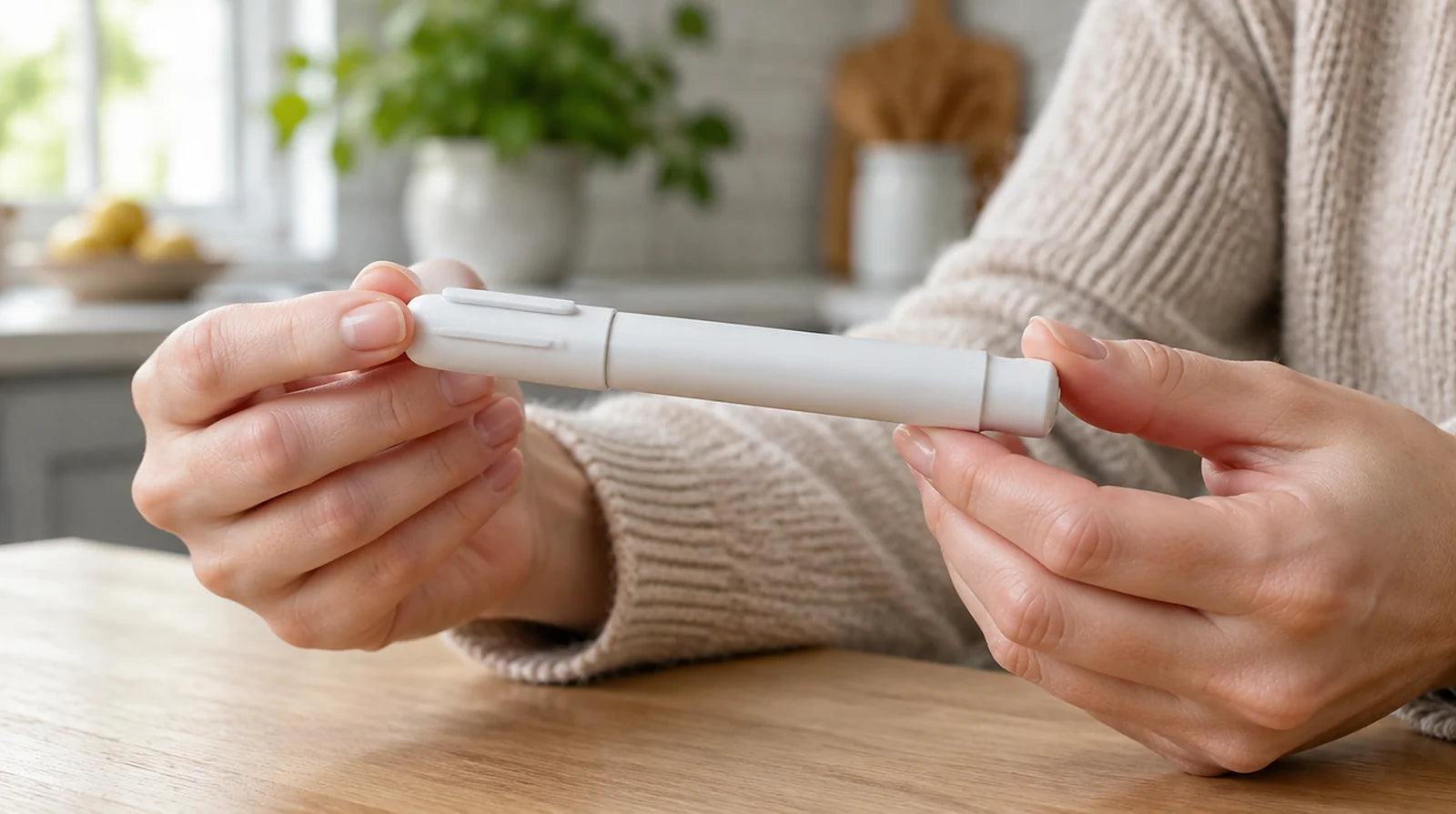
Microdosing Ozempic is not part of the approved instructions. The Ozempic pen can select only its labeled doses, and its June 2026 Instructions for Use say not to set a dose by counting clicks [2].
The instructions say:
- "You will hear a 'click' every time you turn the dose selector. Do not set the dose by counting the number of clicks you hear."
- "The dose selector clicks differently when turned forward or backward. Do not count the pen clicks."
- "If there is not enough OZEMPIC left in your pen for a full dose, do not use it." [2]
A 2025 Diabetes Care letter by University of North Carolina pharmacists and endocrinologists says click microdosing of the Ozempic pen "is considered off-label and is not endorsed by the manufacturer" and "lacks extensive evidence-based support." The same authors call its practical benefits encouraging and describe clinicians using it in diabetes care [12].
Other devices follow the same logic:
- Wegovy single-dose pens hold one dose and are thrown away after use [1].
- Wegovy FlexTouch: "Each pen contains 4 fixed doses, one dose taken weekly." [1]
- Never share a pen, "even if the needle is changed" [2][1].
- Wegovy tablets are swallowed whole, never split [1].
If you are asking how to microdose Ozempic or semaglutide, there is no approved method or amount; ask your prescriber about the label options above.
Compounded Semaglutide and Other Off-Label Risks
Compounded semaglutide is not FDA approved, and FDA has linked compounded vials to dosing errors of five to 20 times the intended dose [13][14]. The FDA pages cited here do not mention microdosing GLP-1 drugs by that name; their warnings cover compounded and unapproved GLP-1 products.
- Units confusion. Mix-ups between milliliters, milligrams, and "units" may have contributed, and some patients were hospitalized [14].
- Adverse event reports. FDA had received 990 reports for compounded semaglutide as of May 31, 2026. FDA says events are likely underreported, and a report does not always prove cause [13].
- Salt forms. Semaglutide sodium and acetate are different active ingredients, and FDA knows of no lawful basis for compounding with them [13].
- Vials and shipping. Throw away a multi-dose vial 28 days after first use, and do not use an injectable GLP-1 that arrives warm [13].
- Shortage and rules. FDA resolved the semaglutide shortage on February 21, 2025 [15]. On April 30, 2026, it proposed excluding semaglutide from the 503B bulks list, and no final decision was published as of September 30, 2026 [16][17].
The FDA alert lists acute pancreatitis among effects reported after dosing errors [14]. The Wegovy Medication Guide says to stop using the medicine and call your healthcare provider right away if you have severe pain in your stomach area that will not go away, with or without nausea or vomiting. The pain can spread from your abdomen to your back [1].
If you take too much, the Wegovy and Ozempic Medication Guides say to "call your healthcare provider or Poison Help line at 1-800-222-1222 or go to the nearest hospital emergency room right away" [1][2]. For the 503A and 503B rules, see our page on compounded tirzepatide.
Does the Same Apply to Tirzepatide (Zepbound and Mounjaro)?
Yes, the same picture holds for tirzepatide. The Zepbound label says "The 2.5 mg dosage is for treatment initiation and is not approved as a maintenance dosage," so no lower dose is approved either [18].
Our page on microdosing tirzepatide covers the trial data and the KwikPen instructions. For what stepping down to 5 mg did in SURMOUNT-MAINTAIN, see our page on the Zepbound maintenance dose. Our page on Zepbound vs Wegovy compares the two brands.
Why People Try Microdosing GLP-1s, and What the Evidence Says
People try microdosing GLP-1s for cost, side effects, keeping weight off, and "longevity." Only the first three have any related data, and none of it comes from a randomized trial of microdosing GLP-1 medicines.
Cost. As of September 30, 2026, NovoCare lists Wegovy pen self-pay at $349 a month for every strength from 0.25 mg to 2.4 mg, and $399 for the Wegovy HD 7.2 mg pen [19]. That applies after the new-patient offer of $199 a month for 2 fills of 0.25 mg or 0.5 mg, which runs through December 31, 2026. The Wegovy pill's 1.5 mg starting strength costs $149 a month. Single-dose pens hold one dose each, so a lower dose does not lower the pen price [1][19]. Prices change.
Side effects. Lower doses are not reliably gentler (see the side effects section above).
Keeping weight off. In STEP 4, people who switched to placebo after 20 weeks on semaglutide gained 6.9% of body weight, while those who stayed on it lost a further 7.9% [20]. In the STEP 1 extension, people regained, on average, two-thirds of their lost weight a year after stopping [21]. In a case series of 30 adults who moved to less frequent doses after a plateau, average weight held steady for about 36 weeks, but the study was retrospective with no control group [22]. Two taper trials are registered but have no results yet [8][9].
Longevity, inflammation, and mood. We found no published trial results for microdosing GLP-1 drugs for these goals. A company-sponsored trial is registered but has posted no results [10].
Eating Well on Wegovy or Ozempic at Any Dose
At any dose of Wegovy or Ozempic, a smaller appetite makes protein and regular meals matter more. A 2025 joint advisory from four medical and nutrition societies notes that targets of 1.2 to 1.6 grams of protein per kilogram of body weight per day have been proposed during active weight loss [23].
The right body weight to use is unsettled, and strength training also helps protect muscle. When you feel full fast:
- Eat the protein part of each meal first [23].
- Plan smaller meals and snacks built around protein foods.
- Add strength training, as your clinician advises.
Our page on how much protein to eat on a GLP-1 explains the targets, and our GLP-1 meal plan page shows a full week.
For high-protein recipes and meal ideas sized for a smaller appetite, see our guide.
Questions to Ask Before Changing a Wegovy or Ozempic Dose
Before changing a Wegovy or Ozempic dose, or trying microdosing GLP-1 medicines, talk with your prescriber rather than adjusting it yourself. The labels give prescribers options, such as a slower step-up or the lower 1.7 mg Wegovy maintenance dose [1].
Questions worth asking:
- Is a slower step-up or the lower labeled maintenance dose right for me?
- What should I do about nausea or other side effects?
- What does my plan cover, and which manufacturer programs apply to me?
- What is likely to happen to my weight if I stop?
- If I use a compounded product, what is in it, and which pharmacy made it?
Bring your current dose, your side effects, and your cost questions to the visit so you can plan the next step together.
Key Takeaways
- No approved microdose. The lowest approved GLP-1 doses are the label starting doses.
- Evidence is thin. We found no randomized trial of microdosing GLP-1 medicines, and lower doses did less in older trials.
- Label routes exist. A slower Wegovy step-up or a lower labeled maintenance dose is decided with your prescriber.
- No click counting or tablet splitting. The Ozempic and Wegovy instructions rule both out.
- Too much medicine is urgent. Call your healthcare provider or Poison Help line at 1-800-222-1222 or go to the nearest hospital emergency room right away.
This page reflects labels, FDA pages, and studies as of September 30, 2026. Read our medical disclaimer.
Frequently Asked Questions
What is considered a microdose of semaglutide?
There is no official definition, and no microdose of semaglutide is FDA approved. The lowest approved doses are the label starting doses: 0.25 mg once weekly for Wegovy and Ozempic injections and 1.5 mg once daily for the Wegovy pill.
Can you lose weight on a microdose of Ozempic?
Ozempic is not approved for weight loss, and we found no trial of Ozempic microdoses. In older semaglutide dose-finding trials, lower doses gave smaller effects than higher doses.
Is GLP-1 microdosing worth it?
The evidence is not there yet: we found no randomized trial of microdosing GLP-1 medicines. Approved options exist instead, such as a slower Wegovy step-up or a lower labeled maintenance dose, chosen with your prescriber.
Is microdosing a GLP-1 cheaper?
Not in any approved way. Pens hold fixed doses, and the Wegovy self-pay pen price is the same $349 for every strength from 0.25 mg to 2.4 mg after the introductory offer ($399 for 7.2 mg). Ask about coverage and manufacturer programs. FDA-approved generic liraglutide that references Saxenda, a daily weight-loss shot, is another option to ask about [24]. Our page on Saxenda vs Wegovy compares the two.
What happens when you stop microdosing Ozempic?
We found no study of stopping microdoses. After people stopped full-dose semaglutide 2.4 mg in the STEP 1 extension, they had regained about two-thirds of the weight they lost one year later.
Does microdosing a GLP-1 cause hair loss?
We found no study of hair loss on microdoses. Hair loss is listed at label doses: in one Wegovy table, it affected 3% of people on 2.4 mg vs 1% on placebo. Our page on whether Zepbound causes hair loss explains why fast weight loss can trigger shedding.
Is there a GLP-1 microdosing chart?
No approved microdosing chart exists. The labels give only their own dose schedules, and the Ozempic pen instructions say not to set a dose by counting clicks.
References
- Wegovy (semaglutide) injection and Wegovy (semaglutide) tablets Prescribing Information and Medication Guide, revised 06/2026, with Instructions for Use: Novo Nordisk
- Ozempic (semaglutide) injection Prescribing Information (revised 05/2026), Medication Guide (revised 01/2025) and Instructions for Use (revised June 2026): Novo Nordisk
- Nauck MA et al. A Phase 2, Randomized, Dose-Finding Study of the Novel Once-Weekly Human GLP-1 Analog, Semaglutide, Compared With Placebo and Open-Label Liraglutide in Patients With Type 2 Diabetes. Diabetes Care, 2016
- O'Neil PM et al. Efficacy and safety of semaglutide compared with liraglutide and placebo for weight loss in patients with obesity: a randomised, double-blind, placebo and active controlled, dose-ranging, phase 2 trial. Lancet, 2018
- ClinicalTrials.gov NCT00696657, posted results (read September 30, 2026): U.S. National Library of Medicine
- Beck H, Clements JN. Considerations and challenges in microdosing of GLP-1-based receptor agonists. Expert Opin Pharmacother, online September 25, 2026
- ClinicalTrials.gov NCT07325500, incretin microdosing in people with HIV (recruiting, no results): U.S. National Library of Medicine
- ClinicalTrials.gov NCT07294950, gradual semaglutide dose reduction vs stopping (recruiting, no results): U.S. National Library of Medicine
- ClinicalTrials.gov NCT07783854, semaglutide tapering vs maintenance dose (not yet recruiting, no results): U.S. National Library of Medicine
- ClinicalTrials.gov NCT07092605, microdosed GLP-1 and longevity measures (no results posted): U.S. National Library of Medicine
- ClinicalTrials.gov NCT07588984, observational cohort (not yet recruiting): U.S. National Library of Medicine
- Kome AM et al. One Size Does Not Fit All: Understanding Microdosing Semaglutide for Diabetes in Multidose Pens. Diabetes Care, 2025
- FDA's concerns with unapproved GLP-1 drugs used for weight loss, content current as of 09/01/2026: U.S. Food and Drug Administration
- FDA alerts health care providers, compounders and patients of dosing errors associated with compounded injectable semaglutide products, content current as of 07/26/2024: U.S. Food and Drug Administration
- FDA clarifies policies for compounders as national GLP-1 supply begins to stabilize, content current as of 04/01/2026: U.S. Food and Drug Administration
- FDA proposes to exclude semaglutide, tirzepatide, and liraglutide on 503B bulks list, April 30, 2026: U.S. Food and Drug Administration
- Extension of comment period, 91 FR 38719, June 26, 2026: Federal Register
- Zepbound (tirzepatide) Prescribing Information, revised 08/2026: Eli Lilly
- Wegovy cost, coverage, and savings, read September 30, 2026: NovoCare
- Rubino D et al. Effect of Continued Weekly Subcutaneous Semaglutide vs Placebo on Weight Loss Maintenance in Adults With Overweight or Obesity: The STEP 4 Randomized Clinical Trial. JAMA, 2021
- Wilding JPH et al. Weight regain and cardiometabolic effects after withdrawal of semaglutide: The STEP 1 trial extension. Diabetes Obes Metab, 2022
- Wong M et al. Reduced-Frequency GLP1 Therapy Maintains Weight, Body Composition, and Metabolic Syndrome Improvements: A Case Series. Obesity, 2026
- Nutritional priorities to support GLP-1 therapy for obesity: joint advisory from ACLM, ASN, OMA, and TOS, 2025
- Drugs@FDA data for liraglutide, openFDA (data updated September 29, 2026): U.S. Food and Drug Administration
This article is for education only and is not medical advice. It summarizes FDA labels, FDA pages, and published research, and it gives no microdose amounts, schedules, or personalized dosing advice. Talk to your prescriber about your treatment and your dose. Read our full medical disclaimer.