
GLP-1 Supplements and OTC GLP-1: Do They Work? What the Evidence Shows
Do GLP-1 supplements work, and is there an over-the-counter GLP-1? What human studies show for fiber, berberine, probiotics, and botanicals, how the FDA and FTC regulate these products, the safety risks, and how to read a label.


A GLP-1 supplement is a dietary supplement, such as fiber, berberine, a probiotic, or a plant extract, sold to support the body's own GLP-1 hormone. None contains a GLP-1 drug, and there is no over-the-counter GLP-1 medicine in the US. Human studies show small or no effects on weight, and little direct evidence of higher GLP-1 levels.
Real GLP-1 medicines need a prescription; see every FDA-approved GLP-1 medicine.
In this guide you will learn:
- What GLP-1 supplements contain
- Why there is no OTC GLP-1
- What human trials show for each ingredient
- FDA and FTC rules, and safety risks
- Supplements on a GLP-1 medication, and how to read a label
This page reviews the evidence. It does not rank, recommend, or name products.
Table of Contents
- What are GLP-1 supplements?
- Is there an over-the-counter GLP-1?
- GLP-1 supplements vs GLP-1 medications
- What studies show for common GLP-1 supplement ingredients
- How the FDA and FTC regulate GLP-1 supplements
- Are GLP-1 supplements safe?
- Supplements people ask about while taking a GLP-1 medication
- Food first: meals that support fullness on or off a GLP-1
- How to read a GLP-1 supplement label
- Frequently asked questions
- Key takeaways
What Are GLP-1 Supplements?
GLP-1 supplements are dietary supplements sold to "boost" or "support" GLP-1, a gut hormone the body releases after meals. They contain food or plant ingredients, not semaglutide or tirzepatide, and FDA does not permit supplements to contain pharmaceutical ingredients [2].
They come as capsules, tablets, fiber powders, probiotics (some with Akkermansia muciniphila), gummies, drops, and skin patches. A 2026 pharmacy journal editorial notes that the supplement law covers swallowed products and concludes that transdermal "GLP-1" supplements are illegal [24]; see do GLP-1 patches work.
"GLP-1 booster" and "GLP-1 support" are marketing terms, not a drug class, and do not mean FDA has reviewed the product.
Is There an Over-the-Counter GLP-1?
No. Every FDA-approved GLP-1 medicine in the US needs a prescription, including the two GLP-1 pills for weight management, the Wegovy pill and Foundayo. We checked every GLP-1 receptor agonist in Drugs@FDA on September 29, 2026, and no product had over-the-counter status [1].
| Molecule | Brand names in Drugs@FDA | Form | Drugs@FDA status |
|---|---|---|---|
| Semaglutide | Ozempic, Rybelsus, Wegovy, Wegovy tablets | Injection, tablet | Prescription (one Ozempic product discontinued) |
| Tirzepatide | Mounjaro, Zepbound | Injection | Prescription (all 48 products) |
| Liraglutide | Victoza, Saxenda, Xultophy, generics | Injection | Prescription |
| Dulaglutide | Trulicity | Injection | Prescription |
| Exenatide | Byetta, generic, Bydureon | Injection | Prescription or discontinued |
| Lixisenatide | Adlyxin, Soliqua | Injection | Prescription |
| Orforglipron | Foundayo | Tablet | Prescription |
| Albiglutide | Tanzeum | Injection | Discontinued |
"Prescription" (one openFDA query per active ingredient) is FDA's record of the approval, not proof that a product is on pharmacy shelves today. Our GLP-1 drugs list covers each medicine.
The Wegovy pill is oral semaglutide with strict timing rules (how to take the Wegovy pill). Foundayo is orforglipron (Foundayo vs Zepbound, orforglipron price).
Products sold online as "OTC GLP-1" are either supplements with no drug in them or, if they contain a drug ingredient, unapproved drugs, per NIH's Office of Dietary Supplements [2]. Compounded and "research use only" products are a separate category; see compounded tirzepatide.
GLP-1 Supplements vs GLP-1 Medications
A GLP-1 supplement tries to nudge the body's own short-lived hormone, while a GLP-1 medication is a long-acting drug that activates the GLP-1 receptor directly. Semaglutide shares 94% of its sequence with human GLP-1 and has a half-life of about 1 week [11]; tirzepatide activates both the GIP and GLP-1 receptors and has a half-life of about 5 days [12].
| Feature | GLP-1 supplements | GLP-1 medications |
|---|---|---|
| What it contains | Fiber, berberine, probiotics, plant extracts | Semaglutide, tirzepatide, other drugs |
| FDA review before sale | None; the maker is responsible for safety | Required; FDA approves each drug |
| Evidence required | Maker's substantiation for claims | Clinical trials reviewed by FDA |
| How long it acts | Natural GLP-1 is inactivated "extremely rapidly" | Half-life about 1 week (semaglutide) or 5 days (tirzepatide) |
| Weight results in trials | Viscous fiber -0.81 kg, berberine -2.07 kg vs control (pooled trials) | Wegovy -14.9% vs -2.4% placebo at 68 weeks; Zepbound 15 mg -20.9% vs -3.1% placebo at 72 weeks (change from baseline, label) |
| Side effect information | Makers must forward serious adverse event reports to FDA | Labels list side effects seen in trials |
Sources: [2][3][4][10][11][12][16][17]. The weight row is not head-to-head: labels report percent of body weight, and the supplement meta-analyses report kilograms from different trials.
What Studies Show for Common GLP-1 Supplement Ingredients
Human trials of common GLP-1 supplement ingredients show small or no weight effects, and in the few that measured GLP-1, psyllium and pasteurized Akkermansia did not raise it [14][15][21].
| Ingredient | GLP-1 in people | Weight in people | Main limit |
|---|---|---|---|
| Psyllium | No change (10 people); lower after a psyllium plus protein meal (16 people) | Not measured | Single-meal studies |
| Viscous fiber, with calorie cutting | Not measured | -0.81 kg vs control (15 RCTs, 1,347 people) | Calorie-restricted diets only |
| Glucomannan | Not reported | No significant effect (2 reviews) | Tablets linked to esophageal blockage |
| Berberine | No human randomized trial found | -2.07 kg vs control (12 RCTs) | High risk of bias in many studies (NCCIH) |
| Akkermansia, pasteurized | No significant change | -2.27 kg vs placebo, not significant (32 people) | Small 3-month pilot |
| Probiotic blend with Akkermansia | Not measured | No effect | All authors worked for the maker |
| Probiotics overall | Not summarized | -0.6 kg (15 RCTs), small | Strains and doses vary |
| Yerba mate | Not reported | Less body fat vs placebo (30 people) | One small 12-week trial |
Sources: [2][14][15][16][17][18][21][22][23].
Fiber: Psyllium and Glucomannan
Human data do not show that fiber raises GLP-1: 1.7 g of psyllium added to pasta had "no significant effect" on the GLP-1 response in 10 people [14], and GLP-1 was significantly lower after a meal rich in psyllium and protein in 16 adults [15].
For glucomannan, a konjac root fiber, ODS reports no significant weight effect in 2014 and 2015 reviews. ODS also warns that glucomannan tablets were linked to 7 cases of esophageal obstruction in Australia in 1984 and 1985; it did not link powders or capsules to the problem [2].
Berberine
Berberine's weight effect is small: a 2020 meta-analysis of 12 randomized trials found 2.07 kg more weight loss than control [17]. NCCIH says many studies in a 2022 review of berberine and weight had a high risk of bias, most berberine studies took place in Asian countries, and most participants had health problems such as diabetes or fatty liver disease [18].
We found no human randomized trial on PubMed that measured berberine's effect on GLP-1 (search on September 29, 2026); the GLP-1 findings we retrieved came from cell and animal studies. Patches are a different product; see berberine patches.
Probiotics and Akkermansia
The human probiotic trials we found show no GLP-1 rise or meaningful weight loss. In a 2019 pilot in 32 adults with overweight or obesity, researchers "did not find any significant changes in plasma GLP-1 levels," and the 2.27 kg weight difference between pasteurized Akkermansia and placebo was not statistically significant [21].
A 2020 trial in 76 adults with type 2 diabetes found better after-meal glucose with a 5-strain blend containing Akkermansia, but GLP-1 levels "were not directly measured," body weight did not change, and all authors were employees and shareholders of the probiotic's maker [22]. Across probiotics, ODS reports a 0.6 kg weight loss that was "small and of questionable clinical significance" [2].
Yerba Mate, Caffeine, and Other Botanicals
Plant extracts have even thinner evidence. Yerba mate lowered body fat versus placebo in one 12-week trial of 30 adults, with no GLP-1 data in the abstract [23], and it contains caffeine, which some supplement labels do not quantify [2]. According to NCCIH, cinnamon did not change body weight in a 2020 review, and research on bitter melon, fenugreek, ginseng, and milk thistle for diabetes has not proven any of them effective [19].
How the FDA and FTC Regulate GLP-1 Supplements
GLP-1 supplements reach store shelves without FDA approval: the maker, not FDA, is responsible for their safety and for truthful labels. Under the Dietary Supplement Health and Education Act (DSHEA), FDA "does not have the authority to approve dietary supplements before they are marketed" [3].
FDA still regulates supplements, but mostly after sale:
- No testing before sale. "FDA does not test dietary supplements before they are sold to consumers" [3], but it can act against an adulterated or misbranded supplement on the market [4].
- Structure/function claims. A label may describe an effect on the body, such as "fiber maintains bowel regularity," if the maker has substantiation and notifies FDA within 30 days after marketing [5]. It needs this bold disclaimer: "This statement has not been evaluated by the Food and Drug Administration. This product is not intended to diagnose, treat, cure, or prevent any disease" [6].
- No disease claims. A supplement sold to treat, prevent, or cure a disease "meets the definition of a drug" [3]. Under 21 CFR 101.93, that includes claiming a product is "a substitute for a product that is a therapy for a disease" or "augments a particular therapy or drug action," even through its name [6].
Whether a label crosses the line is FDA's call; this page makes no finding about any product. The FTC, which oversees advertising, says health claims generally need "randomized, controlled human clinical testing" [7].
In December 2024, FDA warned an online seller of oral "GLP-1" products, one of which claimed to be approved by FDA, that the products were unapproved and misbranded [8]. FDA's tainted weight-loss product list (updated September 4, 2026) warns that such products are "sometimes falsely advertised as dietary supplements" and covers only a small fraction of contaminated products, so a product missing from it is not proven safe [9].
Are GLP-1 Supplements Safe?
Most ingredients in GLP-1 supplements cause mainly stomach and bowel side effects, but some interact with medicines, and ODS reports that weight-loss products sold as supplements are "sometimes adulterated or tainted with prescription-drug ingredients" [2].
- Berberine. Side effects are mainly digestive: nausea, stomach pain, bloating, constipation, or diarrhea. It interacts with cyclosporine, and NCCIH says it should not be used during pregnancy or while breastfeeding, and should not be given to infants [18][19]. A 2026 narrative review lists possible added effects with other drugs on low blood sugar, low blood pressure, and heart rhythm (QT prolongation), and a 34.5% rise in cyclosporine exposure in kidney transplant recipients [20].
- Herbal supplements with diabetes drugs. NCCIH says the combination can cause unwanted side effects, and people who take diabetes drugs should tell their health care providers about any herbal supplements [19].
- Glucomannan and guar gum. ODS says these fibers "might decrease the absorption of many drugs that are taken orally," and glucomannan could interact with diabetes medicines [2].
- Caffeine and stimulants. Labels may not declare the caffeine amount, and caffeine or bitter orange can add to the effects of other stimulants [2].
If you think a supplement has harmed you, FDA's advice is clear. First, contact or see your health care provider immediately. Then you or your provider can report the problem through FDA's Safety Reporting Portal, even if you are unsure the product caused it [3].
Tell your prescriber and pharmacist about every supplement you take. FDA advises talking to a doctor, pharmacist, or other health care professional before starting one, and notes that some supplements might interact with medicines [3].
Supplements People Ask About While Taking a GLP-1 Medication
People on a GLP-1 medication may need a few specific supplements based on their diet and lab results, not "GLP-1 boosters." A 2025 joint advisory from four medical and nutrition societies says vitamin D, calcium, and B12 supplements can be "proactively considered" [26].
The advisory notes that the risk of nutrient shortfalls rises for women who eat fewer than 1,200 calories a day. For constipation it lists fluids, food fiber, magnesium citrate or PEG 3350; for diarrhea, fiber capsules or powders [26].
In a 2025 claims study of 461,382 people taking GLP-1 medicines, 22.4% had a new nutritional deficiency diagnosis within 12 months, including vitamin D deficiency in 13.6% [27]. Most (80.5%) had type 2 diabetes, coded diagnoses can reflect more testing, and several authors worked for a nutrition products company. More in Zepbound side effects.
Timing with oral medicines matters too:
- Zepbound. The label says Zepbound delays gastric emptying and "has the potential to impact the absorption" of oral medicines taken with it [12].
- Birth control pills. The Zepbound Medication Guide says birth control pills taken by mouth may not work as well. If you take them, your healthcare provider may recommend another type of birth control for 4 weeks after you start Zepbound and for 4 weeks after each dose increase [13].
- The Wegovy pill. The label says to wait at least 30 minutes after the tablet before eating, drinking, or taking other oral medicines [11]. Our Wegovy pill guide covers the routine.
A top-ranking review on this topic was written by supplement-retailer employees; it notes that no intervention study has tested multivitamin use during GLP-1 treatment [25]. Ask your prescriber before adding any supplement; this page gives no doses.
Food First: Meals That Support Fullness on or off a GLP-1
Protein, fiber-rich foods, and regular meals are the best-supported everyday way to support fullness, with or without a GLP-1 medication. The 2025 advisory notes proposed protein targets of 1.2 to 1.6 grams per kilogram of body weight per day during active weight loss, above the 0.8 g/kg recommended dietary allowance [26].
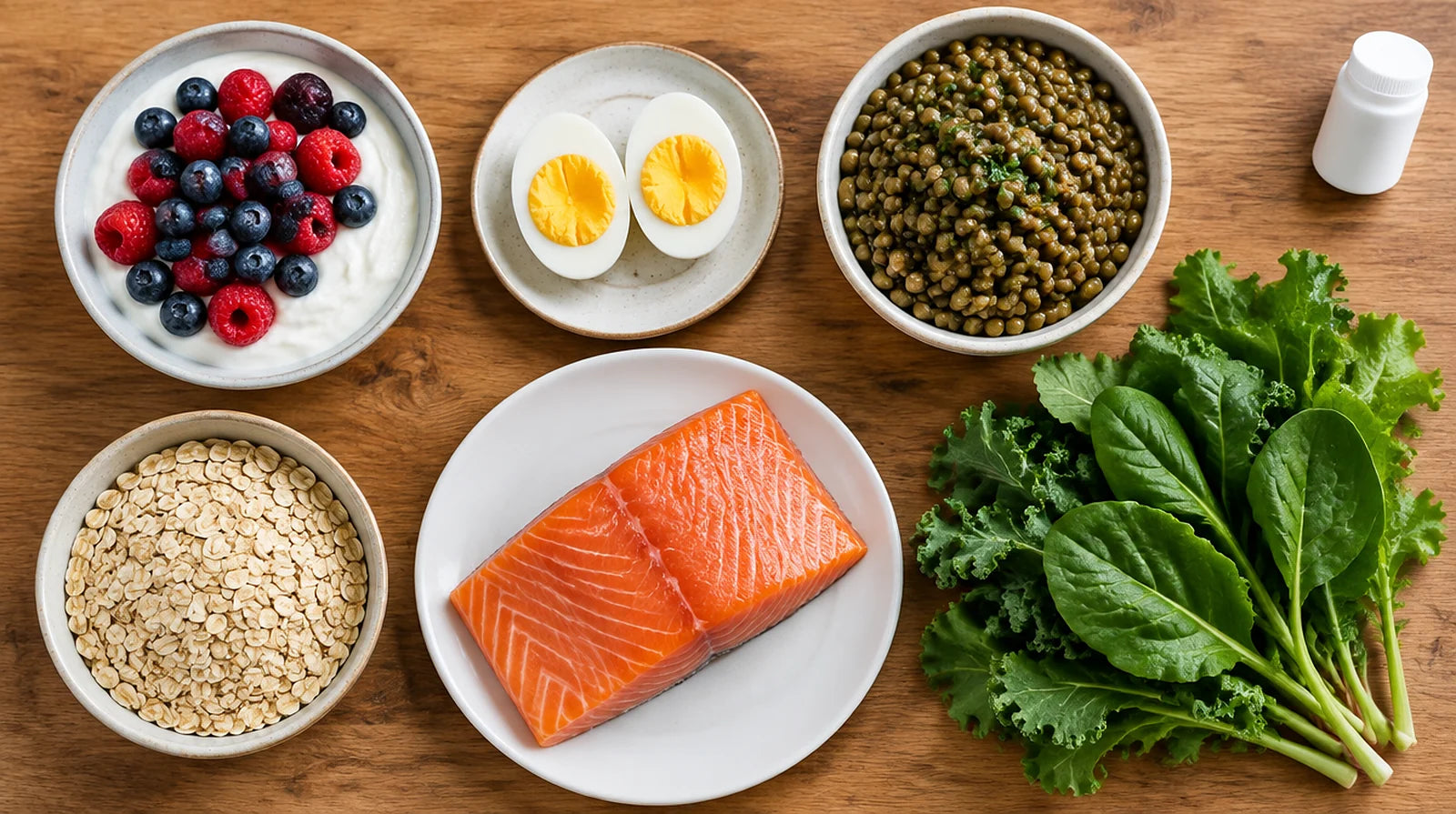
Our page on how much protein to eat on GLP-1 turns that range into daily numbers. The advisory also suggests eating protein foods first [26], which helps when a smaller appetite means you stop eating sooner. Beans, lentils, oats, berries, vegetables, and whole grains add fiber without a capsule, alongside enough fluids. Regular meals like these are also the first step in our article on how to quiet food noise.
A simple day:
- Breakfast: Greek yogurt with berries and oats (more GLP-1 breakfast ideas).
- Lunch: Lentil soup with a leafy green salad.
- Snack: Two boiled eggs or cottage cheese.
- Dinner: Salmon, roasted vegetables, and some whole grains.
For a full week, see our GLP-1 meal plan. If you want high-protein recipes and meal ideas sized for a smaller appetite, our guide collects them in one meal plan.
How to Read a GLP-1 Supplement Label
A GLP-1 supplement label tells you what the maker claims, not what FDA has checked, because FDA does not test supplements before sale [3].
Use this checklist:
- Find the FDA disclaimer: "This statement has not been evaluated by the Food and Drug Administration" [6].
- Watch for red flags. "FDA approved," "same as Ozempic," "no diet needed," or "clinically proven" without a published human trial should make you stop. FDA does not approve supplements, and the FTC generally expects randomized human trials behind health claims [3][7].
- Check for blends without amounts. You cannot compare them with studied amounts, and ODS notes that evidence may exist for only one ingredient, not for the combination [2].
- Compare with the evidence table above. Most ingredients show small or no weight effects.
- Search FDA's tainted weight-loss list. It lists products found with hidden drug ingredients, though only a fraction of them [9].
- Bring the bottle to your pharmacist to check each ingredient against your medicines.
Frequently Asked Questions
Is there an over-the-counter GLP-1 pill?
No. The Wegovy pill and Foundayo need a prescription, and as of September 29, 2026, no GLP-1 medicine in FDA's drug database has over-the-counter status.
What supplement is closest to GLP-1?
None works like a GLP-1 medicine. Fiber and berberine have the most human weight data, with small effects: about 0.8 kg and 2 kg more weight lost than control in pooled trials.
Do GLP-1 supplements actually work?
Human studies show small or no weight effects. In the few human studies we found that measured GLP-1, psyllium and pasteurized Akkermansia did not raise it.
Is berberine "nature's Ozempic"?
No. Berberine lowered weight by about 2 kg in a pooled analysis of 12 trials, and we found no human randomized trial that measured its effect on GLP-1.
Do GLP-1 probiotics or Akkermansia raise GLP-1?
Not in the human trials we found. Pasteurized Akkermansia did not significantly change plasma GLP-1 in a pilot trial, and a probiotic blend trial did not measure GLP-1 and found no weight effect.
Can I take GLP-1 supplements with Ozempic, Wegovy, or Zepbound?
Ask your prescriber and pharmacist first. Some ingredients interact with medicines, GLP-1 medicines slow stomach emptying and can change oral medicine absorption, and the Wegovy pill has a 30-minute rule before other oral medicines.
Are GLP-1 supplements safe?
Most ingredients mainly cause stomach and bowel side effects, but some interact with medicines, and FDA warns that some weight-loss products contain hidden drug ingredients. If you think a supplement harmed you, contact or see your health care provider immediately, then report it to FDA.
Why can supplement companies put "GLP-1" on the label?
FDA does not approve supplements or their labels before sale. Makers may use structure/function claims they can back up, with an FDA notice and FDA's disclaimer, but may not claim to treat a disease or replace a drug.
Key Takeaways
- There is no OTC GLP-1 medicine. Every GLP-1 medicine in Drugs@FDA is prescription or discontinued.
- GLP-1 supplements are not GLP-1 drugs. FDA does not approve them before sale.
- The evidence is thin. Fiber and berberine show about 0.8 to 2 kg of extra weight loss, and no human study we found showed higher GLP-1.
- Safety still matters. Some ingredients interact with medicines, and some products hide drug ingredients. If a supplement harms you, contact or see your health care provider immediately, then report it to FDA.
- Food comes first. Protein, fiber-rich foods, and regular meals are the best-supported basics.
References
- Drugs@FDA data via openFDA, one query per GLP-1 active ingredient (example: semaglutide), data updated September 29, 2026: U.S. Food and Drug Administration
- Dietary Supplements for Weight Loss: Fact Sheet for Health Professionals, updated May 18, 2022: NIH Office of Dietary Supplements
- Questions and Answers on Dietary Supplements, content current as of 08/27/2026: U.S. Food and Drug Administration
- Dietary Supplements, content current as of 10/01/2024: U.S. Food and Drug Administration
- Structure/Function Claims, content current as of 03/28/2024: U.S. Food and Drug Administration
- 21 CFR 101.93, Certain types of statements for dietary supplements, up to date as of 9/25/2026: eCFR
- Health Products Compliance Guidance, December 2022: Federal Trade Commission
- FDA Roundup, December 17, 2024: U.S. Food and Drug Administration
- Weight Loss Product Notifications (tainted weight-loss products), content current as of 09/04/2026: U.S. Food and Drug Administration
- Holst JJ. The physiology of glucagon-like peptide 1. Physiol Rev, 2007
- Wegovy (semaglutide) injection and tablets Prescribing Information, revised 06/2026: Novo Nordisk
- Zepbound (tirzepatide) Prescribing Information, revised 08/2026: Eli Lilly
- Zepbound Medication Guide, revised 08/2026: Eli Lilly
- Frost GS et al. The effects of fiber enrichment of pasta and fat content on gastric emptying, GLP-1, glucose, and insulin responses to a meal. Eur J Clin Nutr, 2003
- Karhunen LJ et al. A psyllium fiber-enriched meal strongly attenuates postprandial gastrointestinal peptide release in healthy young adults. J Nutr, 2010
- Jovanovski E et al. Effect of viscous fiber supplementation on obesity indicators in individuals consuming calorie-restricted diets: a systematic review and meta-analysis of randomized controlled trials. Eur J Nutr, 2021 (online 2020)
- Asbaghi O et al. The effect of berberine supplementation on obesity parameters, inflammation and liver function enzymes: a systematic review and meta-analysis of randomized controlled trials. Clin Nutr ESPEN, 2020
- Berberine and Weight Loss: What You Need To Know, November 2023: National Center for Complementary and Integrative Health
- Diabetes and Dietary Supplements: What You Need To Know, November 2023: National Center for Complementary and Integrative Health
- Dumitru CN et al. Berberine-Drug Interactions: Mechanisms, Clinical Relevance and Risk Stratification, A Narrative Review. Pharmaceuticals (Basel), 2026
- Depommier C et al. Supplementation with Akkermansia muciniphila in overweight and obese human volunteers: a proof-of-concept exploratory study. Nat Med, 2019
- Perraudeau F et al. Improvements to postprandial glucose control in subjects with type 2 diabetes: a multicenter, double blind, randomized placebo-controlled trial of a novel probiotic formulation. BMJ Open Diabetes Res Care, 2020
- Kim SY et al. Anti-obesity effects of Yerba Mate (Ilex paraguariensis): a randomized, double-blind, placebo-controlled clinical trial. BMC Complement Altern Med, 2015
- White CM, Tai Z, Nuzi K. Transdermal "Natural GLP-1" Dietary Supplements Violate Law and Place Patients at Risk. Ann Pharmacother, 2026
- Johnson BVB et al. Dietary supplement considerations during glucagon-like peptide-1 receptor agonist treatment: a narrative review. Obes Pillars, 2025
- Mozaffarian D et al. Nutritional priorities to support GLP-1 therapy for obesity: a joint advisory from ACLM, ASN, OMA, and TOS. Obes Pillars, 2025
- Butsch WS et al. Nutritional deficiencies and muscle loss in adults with type 2 diabetes using GLP-1 receptor agonists: a retrospective observational study. Obes Pillars, 2025
This article is for education only and is not medical advice. It summarizes FDA records, FDA drug labels, federal fact sheets, and published research, and it gives no personalized dosing advice. Talk to your prescriber or pharmacist before starting any supplement. Read our full medical disclaimer.