
Berberine Patches: Do They Work? Evidence, Safety, and FDA Status
Do berberine patches work? We found no human study of any berberine patch. What oral berberine trials show, whether berberine crosses the skin, FDA and FTC rules, drug interactions, and pregnancy cautions.


Berberine patches are adhesive skin patches sold online, often as a "natural GLP-1", and we found no published human study showing that any of them works for weight loss or blood sugar. Swallowed berberine has modest trial evidence of limited quality [4][11]. A skin patch has none that we could find, and FDA says a product that is not swallowed is not a dietary supplement [1].
Berberine can also interact with some prescription drugs [19][20], and NCCIH says it is likely unsafe for infants and may be unsafe in pregnancy and breastfeeding [4]. These patches are not FDA-approved GLP-1 medications.
In this guide you will learn:
- What berberine patches contain and what studies have tested
- Whether berberine can get through skin
- The FDA and FTC rules that apply
- Side effects, drug interactions, and pregnancy cautions
This page names no patch brands and gives no dosing advice.
Table of Contents
- What are berberine patches?
- Do berberine patches work?
- Can berberine get through your skin?
- What oral berberine studies show for weight and blood sugar
- Are berberine patches legal? FDA and FTC rules
- Are berberine patches safe? Side effects and drug interactions
- How to read a berberine patch ad
- What to do instead if you want help with weight or blood sugar
- Frequently asked questions
- Key takeaways
What Are Berberine Patches?
Berberine patches are stick-on patches marketed for weight, appetite, or blood sugar, and many sellers call them a "natural GLP-1". Berberine is a plant alkaloid [13], and no FDA drug application contains it [23].
A 2026 market survey by University of Connecticut pharmacy researchers found 24 patch products and 1 gel sold as "natural GLP-1" dietary supplements [6]. What they found [6]:
- Many ingredients. Products listed an average of 7 natural ingredients, most often berberine, glutamine or glutamate, cinnamon, and pomegranate.
- No lab proof. No product posted a certificate of analysis, so buyers cannot check how much berberine a patch holds.
- Missing disclaimers. Many products lacked the FDA disclaimer and used deceptive advertising.
Moringa and Berberine Patches
Moringa and berberine patches are a common search pairing, and the evidence gap is the same. Our PubMed search on September 29, 2026 found no human study of a moringa patch [26], and we found none of a berberine patch either.
Do Berberine Patches Work?
We found no human evidence that berberine patches work. In a womensglp1guide.com search on September 29, 2026, ClinicalTrials.gov listed 0 studies for "berberine transdermal" and 0 for "berberine topical", and the 3 hits for "berberine patch" all tested berberine taken by mouth [22].
A PubMed search for berberine plus skin delivery terms returned 54 records, mostly lab and animal topical work on wounds, psoriasis, arthritis, eczema, and vitiligo, plus reviews [25]. The few human trials in the set were heart studies, picked up because "percutaneous" also names a heart procedure. None tested a berberine patch or topical berberine in people, and none measured weight or blood sugar after skin use.
| Form of berberine | Tested in people? | What researchers measured | Sources |
|---|---|---|---|
| Oral berberine (swallowed) | Yes, in many randomized trials | Weight, BMI, blood sugar, HbA1c, blood lipids | [11][12][13][15] |
| Topical formulation on rat skin | No, rats only | Blood berberine levels, skin redness | [7] |
| Topical berberine for skin conditions | No, lab and animal work | Wound healing, psoriasis, other skin outcomes | [25] |
| Adhesive berberine patch | None found | Nothing published that we found | [22][25] |
What about berberine patches reviews? The 2026 survey noted 1 to 2 star reviews and consumer comments "suggesting lack of efficacy or adverse events" [6]. Star ratings are not verified reports, and good ratings would not prove that a patch works.
Can Berberine Get Through Your Skin?
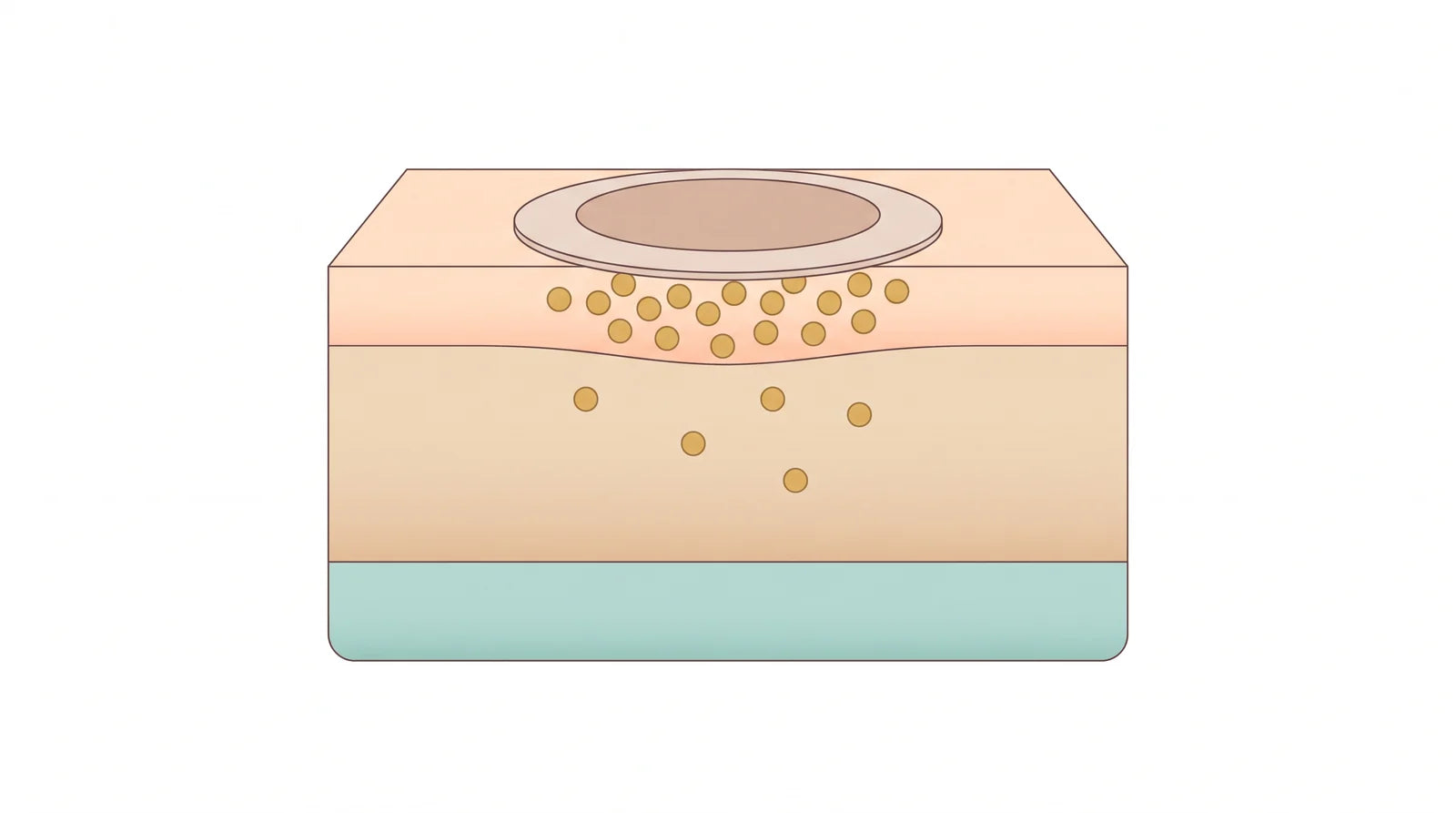
Berberine does not cross skin easily. It is a charged molecule, a quaternary ammonium alkaloid [10], and lab papers describe it as water-soluble with limited skin permeability [8][9]. To push it into skin, lab teams built nanodiamond carriers [9], an ion-paired berberine oleate complex tested on rat skin [8], and microneedle systems [25].
The Rat Study Behind "Better Than Oral" Claims
The only topical versus oral comparison we found is a 2018 rat study [7]. A 5% topical berberine formulation, spread on a shaved 2 by 2 inch area, gave higher blood berberine over 8 hours than the same dose (90 mg/kg) given by mouth. Its limits [7]:
- Rats, not people. The oral group had 3 rats and each topical group had 8.
- Not a patch. It tested a spread-on formulation in a commercial base, and measured blood levels and general safety signs, not weight loss or blood sugar.
- Conflict of interest. All authors worked for the company that makes the topical base, which held a pending patent on topical berberine formulations.
- Skin reactions. Mild skin redness appeared briefly in some animals in every topical group.
Skipping the gut and liver, which limit how much swallowed berberine reaches the blood [10], only helps if enough berberine crosses the skin. We found no human data showing that a patch delivers any (our reasoning, not a study result).
What Oral Berberine Studies Show for Weight and Blood Sugar
Oral berberine, the swallowed supplement, shows modest effects on weight and blood sugar in trials of limited quality. NCCIH says some studies suggest it might help with weight, "but the evidence is not conclusive" [4]. Berberine patches borrow this evidence, but none of it involves skin delivery.
| Study | Participants | What researchers gave | Main result | Caveat or side effects |
|---|---|---|---|---|
| Asbaghi 2020, meta-analysis [11] | 12 randomized trials | Oral berberine vs control | Weight down 2.07 kg on average | Earlier, smaller trial set |
| Elahi Vahed 2026, meta-analysis [12] | 23 trial reports | Oral berberine vs control | Weight down 0.88 kg on average | Weak blinding, randomization, and dose reporting |
| Zhang 2008 [13] | 116 people with type 2 diabetes and high blood lipids | 1.0 g daily vs placebo for 3 months | HbA1c 7.5% to 6.6% | Constipation in 5 people on berberine |
| Yin 2008, pilot [14] | 36 adults with new type 2 diabetes | Berberine or metformin, 0.5 g three times a day for 3 months | HbA1c 9.5% to 7.5% on berberine, similar to metformin | 20 patients (34.5%) had short-lived gut effects; the abstract does not say in which groups |
| Lan 2015, meta-analysis [15] | 27 randomized trials, 2,569 patients (diabetes, blood lipids, and blood pressure) | Berberine vs lifestyle, placebo, or oral diabetes drugs | Lower glucose markers vs lifestyle or placebo; no difference vs diabetes pills | Benefit supported only "to a limited degree" |
NCCIH adds that many weight studies had a high risk of bias, and most participants had health problems such as diabetes or fatty liver disease [4]. Weight effects appeared mainly above 1 gram a day for more than 8 weeks, a study fact, not a dose to take.
The newer, larger meta-analysis found a smaller average weight difference (0.88 kg vs 2.07 kg) [11][12]. The two used different search dates and trial sets, and neither explains the gap. An umbrella review says berberine's effects "need to be confirmed in high-quality RCTs" [16].
Berberine and PCOS
Berberine for PCOS has some hormone data but no solid fertility benefit, and no study we found tested a patch. A 2019 meta-analysis of 12 randomized trials found that oral berberine lowered total testosterone and the LH to FSH ratio compared with placebo or no treatment [17]. The authors found "no solid evidence" of better live birth rates. If you have PCOS, talk with the clinician who manages it before trying any berberine product.
Is Berberine a Natural GLP-1?
Berberine is not a GLP-1 medicine. In a 2015 lab study, it raised GLP-1 release from human gut cells in a dish by acting on bitter taste receptors [18]. That study used gut cells, not people, and not skin delivery. Some sites call berberine "nature's Ozempic", but no FDA drug application contains it [23]. For the real medicines, see our list of FDA-approved GLP-1 medications.
Are Berberine Patches Legal? FDA and FTC Rules
Berberine patches fall outside the legal definition of a dietary supplement. FDA says supplements "must be swallowed" and that topical products "are not supplements" [1]. The federal definition requires a product "intended for ingestion" [2].
- No approval before sale. FDA states that "by law, FDA does not approve dietary supplements or their labeling" [1].
- FDA has applied the rule to a patch. A June 6, 2018 FDA warning letter to a weight-control patch marketer said: "Topical patch products and other products that are not intended for ingestion are not dietary supplements" [24]. That product was not a berberine patch.
- Disease claims make a product a drug. Only a drug can legally claim to treat or prevent a disease [1]. FDA warning letters in 2020 and 2021 treated oral berberine products as unapproved drugs because of such claims; the May 27, 2021 letter quoted "lower blood sugar and cholesterol" and "natural support to women with PCOS" [24].
- No approved berberine drug. FDA's drug database returned no application with berberine on September 29, 2026 [23].
- The FTC rejects patch weight loss claims. The FTC says "Nothing you wear or apply to the skin can cause substantial weight loss." It adds that weight loss claims for patches are false [3].
The 2026 survey authors concluded that "all these products are illegal" because supplements must be swallowed [6]; that is their view, not an FDA ruling. As of September 29, 2026, we found no FDA warning specific to berberine patches. For how FDA treats unapproved copies of a real GLP-1 medicine, see compounded tirzepatide. This section is not legal advice.
Are Berberine Patches Safe? Side Effects and Drug Interactions
The safety of berberine patches in people is unknown. We found no patch-specific safety data, and without a certificate of analysis, buyers cannot confirm how much berberine a patch contains [6].
Skin. Any adhesive patch can irritate skin (general advice, not a berberine finding), and the rat study saw brief mild redness [7].
If berberine reaches the blood, oral studies show what it can do:
- Gut effects. Studies report nausea, abdominal pain, bloating, constipation, or diarrhea [4].
- Drug-processing enzymes. In healthy men, 2 weeks of oral berberine slowed three enzymes (CYP2D6, CYP2C9, and CYP3A4) that break down many drugs; exposure to the test drug midazolam rose 40% [19].
- Cyclosporine. NCCIH warns that berberine interacts with this transplant drug [4]. In 104 kidney transplant recipients, cyclosporine levels ended 29.3% higher with berberine [20].
- Metformin. Goldenseal, a herb that contains berberine, lowered metformin levels about 25% in healthy adults [5]. That result is for goldenseal, not purified berberine.
NCCIH advises anyone who takes medicine to talk with a health care provider before using berberine [4]. Given the findings above, that talk matters most if you take diabetes medicines, a GLP-1 medicine, transplant drugs, or several prescriptions (our reading of the studies, not an NCCIH list).
If you think a patch harmed you, take it off (general advice). FDA's advice for any harmful effect from a supplement is to "contact or see your health care provider immediately" [1]. Then you or your provider can report it through FDA's Safety Reporting Portal [27], "even if you are unsure the product caused the problem" [1].
Pregnancy and Breastfeeding
Berberine carries a specific warning for pregnancy, breastfeeding, and infants: NCCIH says berberine exposure "has been linked to a harmful buildup of bilirubin in infants, which can cause brain damage" [4]. It calls berberine "likely to be unsafe for infants" and says it "may also be unsafe for use during pregnancy or while breastfeeding" [4].
NCCIH's goldenseal page says women who are pregnant or breastfeeding should not use goldenseal [5]. A 1993 lab study found that berberine pushed bilirubin off its carrier protein about tenfold more strongly than a comparison drug [21]. If you are pregnant, trying to get pregnant, or breastfeeding, talk with your clinician before using any berberine product, patch or pill.
How to Read a Berberine Patch Ad
A berberine patch ad deserves doubt when it breaks FDA and FTC rules. The 2026 survey found missing disclaimers and deceptive advertising in many of these products [6]. Watch for:
- Drug names on a non-drug. "GLP-1" or "Ozempic" wording suggests a medicine, but no FDA drug application contains berberine [23].
- Big weight loss promises. The FTC says wearing a product cannot cause substantial weight loss [3].
- No berberine amount and no certificate of analysis. No product in the 2026 survey posted one [6].
- The word "supplement" on a patch. FDA says topical products are not dietary supplements [1].
- Disease claims. Claims to treat diabetes, PCOS, or another disease are drug claims [1].
The same checks help with swallowed products. For how to read the label of a swallowed "GLP-1" supplement, see GLP-1 supplements.
What to Do Instead if You Want Help With Weight or Blood Sugar
If berberine patches appeal to you because you want help with weight or blood sugar, a clinician can review approved treatments, including needle-free ones. FDA has approved two GLP-1 tablets for weight loss, the Wegovy pill and Foundayo, each taken once daily [29][30]. See how to take the Wegovy pill.
Eating habits help with or without medicine. For people on GLP-1 treatment, a 2025 joint nutrition advisory notes that protein targets of 1.2 to 1.6 grams per kilogram of body weight per day have been proposed during active weight loss, and it stresses resistance training to help keep muscle [28]. Read how much protein you need on a GLP-1.
Simple habits to start with:
- Build each meal around a protein food, such as eggs, Greek yogurt, fish, chicken, tofu, or beans.
- Add fiber from vegetables, fruit, beans, and whole grains.
- Plan the week's meals ahead, as in our sample GLP-1 meal plan.
If you want high-protein recipes and meal ideas that make planning easier, see our guide.

Frequently Asked Questions
Do berberine patches work for weight loss?
We found no published human study showing that any berberine patch causes weight loss. The FTC says weight loss claims for patches are false.
How long do berberine patches take to work?
There is no evidence-based timeline, because we found no human data on berberine patches. We also found no tested dose, placement, or wearing schedule.
Are berberine patches safe?
Their safety is unknown. We found no patch-specific safety data in people, and swallowed berberine can upset the stomach and interact with some prescription drugs.
Are berberine patches FDA approved or legit?
No. FDA does not approve dietary supplements, no FDA drug application contains berberine, and FDA says products that are not swallowed are not dietary supplements.
Can you use berberine patches with Mounjaro, Zepbound, or another GLP-1 medicine?
Ask your prescriber first. Oral berberine lowered blood sugar in trials and slowed drug-processing enzymes in healthy volunteers, but we found no study of berberine with tirzepatide or semaglutide.
Can I use a berberine patch while pregnant or breastfeeding?
NCCIH says berberine is likely unsafe for infants and may be unsafe during pregnancy or breastfeeding. Talk with your clinician before using any berberine product.
Is a berberine patch the same as a GLP-1 patch?
No. Neither is a GLP-1 medicine: every FDA-approved GLP-1 drug is an injection or a tablet, and no FDA drug application contains berberine. For the wider product category, see GLP-1 patches.
Why are doctors cautious about berberine?
NCCIH calls the weight evidence not conclusive, notes a high risk of bias in many studies, and warns that berberine may interact with medicines such as cyclosporine.
Do moringa and berberine patches work better?
We found no human study of a moringa patch or a berberine patch, so there is no evidence that combining them works better.
Key Takeaways
- No human evidence. We found no human study of any berberine patch, so there is no proven effect and no timeline for results.
- Oral evidence is modest. Swallowed berberine changed weight and blood sugar modestly in trials of limited quality.
- Not a supplement under FDA rules. FDA says products that are not swallowed are not dietary supplements, and the FTC says patch weight loss claims are false.
- Interactions and harm. Talk to your prescriber or pharmacist first if you take any medicine. If you think a patch harmed you, take it off, "contact or see your health care provider immediately", and then report it to FDA.
- Pregnancy and infants. NCCIH says berberine is likely unsafe for infants and may be unsafe during pregnancy or breastfeeding; talk with your clinician first.
This page reflects FDA, FTC, NCCIH, registry, and PubMed records as of September 29, 2026. It is for education only, is not medical or legal advice, and gives no personalized dosing advice. Read our full medical disclaimer.
References
- Questions and answers on dietary supplements, content current as of 08/27/2026: U.S. Food and Drug Administration
- 21 U.S.C. 321(ff), definition of dietary supplement: Legal Information Institute, Cornell Law School
- Gut Check: a reference guide for media on spotting false weight loss claims, January 2014: Federal Trade Commission
- Berberine and weight loss: what you need to know, last updated November 2023: National Center for Complementary and Integrative Health
- Goldenseal, last updated February 2025: National Center for Complementary and Integrative Health
- White CM, Tai Z, Nuzi K. Transdermal "natural GLP-1" dietary supplements violate law and place patients at risk. Ann Pharmacother, 2026;60(8):813-816
- Buchanan B et al. Comparative pharmacokinetics and safety assessment of transdermal berberine and dihydroberberine. PLoS One, 2018;13(3):e0194979
- Torky AS et al. Novel skin penetrating berberine oleate complex capitalizing on hydrophobic ion pairing approach. Int J Pharm, 2018;549(1-2):76-86
- Kulkarni S, Prabhakar B, Shende P. Nanodiamond-based berberine aquasomes for enhancing penetration across epidermis to treat psoriasis. Int J Pharm, 2024;656:124051
- Murakami T, Bodor E, Bodor N. Approaching strategy to increase the oral bioavailability of berberine, part 1. Expert Opin Drug Metab Toxicol, 2023;19(3):129-137
- Asbaghi O et al. The effect of berberine supplementation on obesity parameters, inflammation and liver function enzymes: a systematic review and meta-analysis of randomized controlled trials. Clin Nutr ESPEN, 2020;38:43-49
- Elahi Vahed I et al. The effect of berberine on obesity indices: a systematic review and meta-analysis. Int J Obes, 2026;50(1):53-73
- Zhang Y et al. Treatment of type 2 diabetes and dyslipidemia with the natural plant alkaloid berberine. J Clin Endocrinol Metab, 2008;93(7):2559-2565
- Yin J, Xing H, Ye J. Efficacy of berberine in patients with type 2 diabetes mellitus. Metabolism, 2008;57(5):712-717
- Lan J et al. Meta-analysis of the effect and safety of berberine in the treatment of type 2 diabetes mellitus, hyperlipemia and hypertension. J Ethnopharmacol, 2015;161:69-81
- Li Z et al. Berberine and health outcomes: an umbrella review. Phytother Res, 2023;37(5):2051-2066
- Xie L et al. The effect of berberine on reproduction and metabolism in women with polycystic ovary syndrome: a systematic review and meta-analysis of randomized control trials. Evid Based Complement Alternat Med, 2019;2019:7918631
- Yu Y et al. Berberine induces GLP-1 secretion through activation of bitter taste receptor pathways. Biochem Pharmacol, 2015;97(2):173-177
- Guo Y et al. Repeated administration of berberine inhibits cytochromes P450 in humans. Eur J Clin Pharmacol, 2012;68(2):213-217
- Wu X et al. Effects of berberine on the blood concentration of cyclosporin A in renal transplanted recipients. Eur J Clin Pharmacol, 2005;61(8):567-572
- Chan E. Displacement of bilirubin from albumin by berberine. Biol Neonate, 1993;63(4):201-208
- ClinicalTrials.gov searches for berberine transdermal, berberine topical, and berberine patch, September 29, 2026: U.S. National Library of Medicine
- openFDA Drugs@FDA endpoint, searched for berberine as generic name and as active ingredient on September 29, 2026 (no matches): U.S. Food and Drug Administration
- FDA warning letters MARCS-CMS 547614 (June 6, 2018), MARCS-CMS 605076 (June 18, 2020), and MARCS-CMS 612984 (May 27, 2021, in FDA's warning letter database): U.S. Food and Drug Administration
- PubMed search for berberine and transdermal, skin permeation, percutaneous, microneedle, or dermal delivery, September 29, 2026: U.S. National Library of Medicine
- PubMed search for moringa patches and weight, obesity, or glucose, September 29, 2026: U.S. National Library of Medicine
- Safety Reporting Portal: U.S. Department of Health and Human Services and U.S. Food and Drug Administration
- Nutritional priorities to support GLP-1 therapy for obesity: joint advisory from ACLM, ASN, OMA, and TOS, 2025
- Wegovy (semaglutide) injection and tablets Prescribing Information, revised 06/2026
- Foundayo (orforglipron) Prescribing Information, revised 07/2026