
GLP-1 Patches: Do They Work? What the Evidence and the FDA Say
Do GLP-1 patches work? What these stick-on products contain, why no GLP-1 patch is FDA approved, what FDA and FTC actions say, the safety questions, and how they compare with prescription GLP-1 medicines.


GLP-1 patches are adhesive stickers sold online that list herbal ingredients such as berberine, not a GLP-1 drug like semaglutide or tirzepatide. No GLP-1 patch is FDA approved, and we found no human trial showing that these products cause weight loss.
A real drug patch does exist in research. A microneedle patch that delivers semaglutide started its first-in-human trial in June 2026, and it is not available [10].
In this guide you will learn:
- What GLP-1 patches contain and whether skin can absorb a GLP-1 drug
- Why no patch is FDA approved as a GLP-1 medicine, and why a patch is not a supplement
- What the FDA and FTC have done about weight-loss patches
- How to handle side effects, reports, and subscriptions
This page reviews the evidence and names no products.
Table of Contents
- What are GLP-1 patches?
- Do GLP-1 patches work? What the evidence shows
- What is in GLP-1 patches?
- Can GLP-1 medicine pass through the skin?
- Are GLP-1 patches FDA approved?
- FDA and FTC actions on weight-loss and GLP-1 patches
- Are GLP-1 patches safe? Side effects and what to do
- Stuck in a GLP-1 patch subscription? How to cancel and dispute charges
- Real GLP-1 patches in development
- GLP-1 patches vs prescription GLP-1 medications
- Eating well while you weigh your options
- Frequently asked questions
- Key takeaways
What Are GLP-1 Patches?
GLP-1 patches are stick-on products marketed for appetite control and weight loss, often as "natural GLP-1" products. They list plant and nutrient ingredients, not semaglutide, tirzepatide, or any other GLP-1 medicine [3].
A 2026 editorial by University of Connecticut pharmacy researchers surveyed this market. The team identified 24 "natural GLP-1" skin patches and 1 gel, with an average of 7 ± 4 ingredients each [3]. It is a product survey, not a clinical trial.
The name borrows from real medicines. GLP-1 drugs such as Wegovy and Zepbound act on the GLP-1 hormone pathway, and every approved one is a tablet or an injection.
A GLP-1 patch is also not the same as a microneedle drug patch. A microneedle patch uses tiny needles to deliver the real prescription drug through the skin, and it is being tested in a regulated trial, as explained further down [10]. Swallowed products sold as "GLP-1 boosters" are a separate category; see GLP-1 supplements.
Do GLP-1 Patches Work? What the Evidence Shows
We found no randomized human trial showing that any GLP-1 patch causes weight loss. Our PubMed searches on September 29, 2026 turned up no randomized trial of an over-the-counter "GLP-1 patch".
The FTC's position is blunt. Its consumer advice says, "Nothing you can wear or apply to your skin will cause you to lose weight. Period." [7]. Its 2014 guide for media lists "causes substantial weight loss by wearing a product on the body or rubbing it into the skin" among seven claims that experts say simply cannot be true [6].
Many people search for GLP-1 patch reviews. The UConn team read them too: several products had 1 to 2 star ratings, with comments suggesting "lack of efficacy or adverse events" [3]. Online reviews are not evidence of results either way, so this page does not rate products.
What would count as proof? A randomized trial that compares a patch with a placebo patch and measures weight over months. That is how the approved GLP-1 medicines were tested, and none of the patches sold online has published such a trial that we could find.
What Is in GLP-1 Patches?
GLP-1 patches list herbal and nutrient ingredients, most often berberine, glutamine or glutamate, cinnamon, and pomegranate, according to the UConn survey of 24 products [3]. None of these is a GLP-1 medicine, and we found no human study showing that any of them passes through the skin in useful amounts.
Label transparency is poor. The UConn team found no certificates of analysis, many products without the FDA disclaimer, and many with deceptive advertising [3].
| Ingredient | How often it appears | Evidence when swallowed | Weight evidence through the skin |
|---|---|---|---|
| Berberine | Among the most listed | Small weight change in trials; NCCIH calls the evidence "not conclusive" | We found no human study |
| Glutamine or glutamate | Among the most listed | Not reviewed here for weight loss | We found no human study |
| Cinnamon | Among the most listed | Not reviewed here for weight loss | We found no human study |
| Pomegranate | Among the most listed | Not reviewed here for weight loss | We found no human study |
| Caffeine, green tea extract | Named as claims in one listing FDA cited in 2026; no source counts how often they appear | Not reviewed here | We found no human study in a GLP-1 patch |
Sources: White 2026 editorial, NCCIH, FDA warning letter MARCS-CMS 722215 [3][8][11].
Berberine, the Most Listed Ingredient
Berberine is a plant compound, and all of its weight data come from people who swallowed it. NCCIH says it "might" help, "but the evidence is not conclusive," with effects seen mainly above 1 gram per day for more than 8 weeks [8]. A meta-analysis of 23 trial reports, published online in November 2025, found that people taking oral berberine lost an average of 0.88 kg (about 2 pounds) more than comparison groups [9].
We found no human study that measured berberine in the blood or weight change after a skin patch. NCCIH also notes digestive side effects, possible drug interactions, and possible harm in pregnancy or breastfeeding for oral berberine [8]. The evidence on these products is covered in berberine patches.
Can GLP-1 Medicine Pass Through the Skin?
Not through a flat sticker like the GLP-1 patches sold online, based on the evidence we reviewed. GLP-1 medicines are far larger than the molecules that a widely cited review says can pass through intact skin. Semaglutide weighs 4113.58 g/mol and tirzepatide 4813.53 Da, according to their FDA labels [12][13].
That review's rule of thumb puts the limit for skin absorption near 500 Dalton. Its authors wrote that "all known topical drugs used in transdermal drug-delivery systems are under 500 Dalton" [14]. That puts semaglutide at about 8 times the threshold and tirzepatide at about 10 times.
Even the stomach is a hard route. The Wegovy tablet needs an absorption enhancer called SNAC, and the label estimates absolute bioavailability of only about 1% to 2% [12]. Every GLP-1 product in FDA's drug database is an injection or a tablet [15].
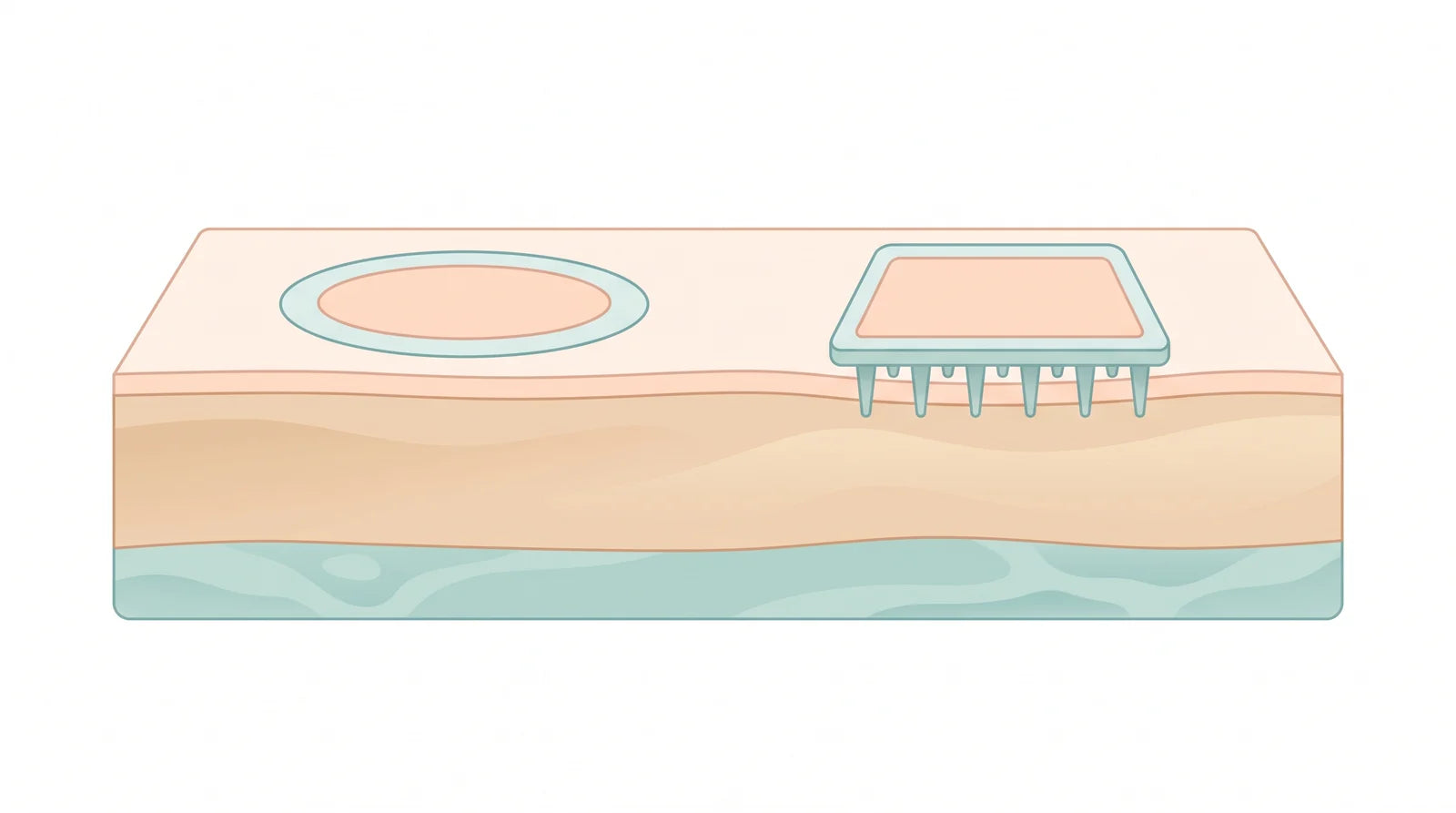
Microneedles are the workaround researchers are testing. They pierce the outer layer of skin so the drug can get past it, which a flat sticker cannot do.
Are GLP-1 Patches FDA Approved?
No, GLP-1 patches are not FDA approved. A womensglp1guide.com analysis of Drugs@FDA on September 29, 2026 found 32 applications for GLP-1 drugs, and every product in them is a tablet or an injection [15].
| Active ingredient | Applications | Routes listed |
|---|---|---|
| Liraglutide | 14 | Injection under the skin |
| Semaglutide | 6 | Tablet (3), injection (3) |
| Exenatide | 5 | Injection under the skin |
| Tirzepatide | 2 | Injection under the skin |
| Lixisenatide | 2 | Injection under the skin |
| Dulaglutide | 1 | Injection |
| Orforglipron | 1 | Tablet |
| Albiglutide (discontinued) | 1 | Injection |
| Total | 32 | Transdermal or topical: 0 |
Method: one openFDA drugsfda query per active ingredient. Drugs@FDA covers FDA applications, including discontinued products, and does not list unapproved products [15].
For every approved GLP-1 product and its form, see our GLP-1 medications list.
A patch cannot be a dietary supplement either. Federal law defines a supplement as a product "intended for ingestion," and FDA says supplements "must be swallowed," so "topical or inhaled products are not supplements" [1][2]. In 2018, FDA told a weight-control patch marketer that "topical patch products and other products that are not intended for ingestion are not dietary supplements," and treated its patch as an unapproved new drug [5].
That matters because FDA does not approve supplements before they are sold [1], so the supplement label would not mean FDA checked a patch. In the 2018 letter, FDA called the patch a drug because it was intended to affect the structure or function of the body, and said a new drug may not be shipped across state lines unless an FDA-approved application is in effect for it [5].
FDA and FTC Actions on Weight-Loss and GLP-1 Patches
The FDA and the FTC have acted against weight-loss patches since at least 2007, and FDA sent a warning letter about a GLP-1 style microneedle patch in March 2026. We found no case titled for "GLP-1 patches" as of September 29, 2026.
| Date | Agency | Action |
|---|---|---|
| August 2007 | FTC | A weight-loss patch seller and its owner were banned from selling weight-loss patches and agreed to pay $180,000, in a settlement without admission of a violation. The FTC headline: products worn or rubbed on the skin do not cause weight loss |
| January 2014 | FTC | Gut Check guide for media: "Nothing you wear or apply to the skin can cause substantial weight loss" |
| June 2018 | FDA | Warning letter: a weight-control patch is not a dietary supplement and is an unapproved new drug |
| February 2025 | FTC | Consumer advice: "Lose weight with this patch or cream. (You can't.)" |
| March 2026 | FDA | Warning letter to an online marketplace seller of a "nano microneedle patch" with GLP-1 style naming, listed for type 2 diabetes treatment and weight loss. FDA judged it an unapproved new drug from its listing claims |
Sources: FTC release (2007), FTC Gut Check (2014), FDA warning letters MARCS-CMS 547614 and 722215, FTC consumer advice (2025) [4][5][6][7][11].
FDA based the March 2026 letter on the product listing and did not report testing what the patch contained [11]. The letter gave the seller 15 working days to respond and warned of possible regulatory or legal action, including seizure and injunction [11].
Patches are not the only unapproved GLP-1 products FDA watches. Our page on compounded tirzepatide covers pharmacy-made and fake injectable products.
Are GLP-1 Patches Safe? Side Effects and What to Do
GLP-1 patches have no proven safety record, because we found no published testing of their contents or doses. No certificates of analysis were posted for the products in the UConn survey, and consumer comments on several products suggested adverse events [3].
Those reviews are complaints, not measured rates. The editorial abstract does not say which adverse events people described [3].
What is known applies to ingredients taken by mouth. NCCIH says berberine may interact with medicines, is likely unsafe for infants, and may be unsafe in pregnancy or breastfeeding [8].
If you take a prescribed GLP-1. A patch is not a substitute for Zepbound, Wegovy, or another prescribed GLP-1, and it does not change your dose plan. Tell your prescriber about any patch or supplement you use.
If you have a harmful effect. FDA's advice for a harmful effect from a dietary supplement, the closest consumer guidance, is to "contact or see your health care provider immediately" first, then report [1]. General advice, not from any label: take off a patch that irritates your skin. These products have no FDA-reviewed label or Medication Guide to follow.
How to report a problem:
- FDA MedWatch for drug-type problems, online or with a form sent by fax [16]
- FDA Safety Reporting Portal, which FDA wants used "even if you are unsure the product caused the problem" [1]
- ReportFraud.ftc.gov or your state attorney general for false weight-loss claims [7]
Stuck in a GLP-1 Patch Subscription? How to Cancel and Dispute Charges
If a GLP-1 patch order turned into a subscription, the FTC's steps are to follow the company's cancellation process, keep records, watch your statements, and dispute charges you did not authorize. The FTC's September 2024 advice names supplements among common subscription offers [17].
- Follow the company's cancellation steps. Keep a copy of your request and notes on every conversation [17].
- If you cannot cancel, call your card company. The FTC says, "If you can't cancel, call your credit card company, and ask them to stop the payments." [17]
- Check every statement. Look for charges after you canceled [17].
- Dispute charges you did not authorize. Use your card's online account or the phone number on the back, then follow up in writing [17].
- Save your records and report problems. Report to ReportFraud.ftc.gov or your state attorney general [17].
Real GLP-1 Patches in Development
A real GLP-1 patch is in early testing: VX-201, a microneedle array patch that delivers semaglutide, entered a first-in-human phase 1 trial in June 2026. It is not approved or available [10].
The trial (NCT07673900) compares the patch with semaglutide injected under the skin in adults with overweight or obesity and without diabetes. It plans to enroll 62 adults, and its main outcome is safety, including skin sensitivity at the application site [10].
Expected primary completion is February 2027, an estimate on the registry. Phase 1 trials test safety and how the body handles a drug; they do not show whether it works as well as an injection. The sponsor is a drug developer, not a patch seller, and the full record is on ClinicalTrials.gov [10].
GLP-1 Patches vs Prescription GLP-1 Medications
GLP-1 patches and prescription GLP-1 medications differ at every step, from FDA approval to trial evidence. Approved GLP-1 medicines have published trial results and an FDA-reviewed label, while the patches have neither [12][13][15].
| Feature | GLP-1 patches sold online | Prescription GLP-1 medications |
|---|---|---|
| FDA approval | None | Approved, for example Zepbound, Wegovy, and Foundayo |
| Active drug | No GLP-1 drug listed; herbal ingredients such as berberine | Semaglutide, tirzepatide, orforglipron, and others |
| Route | Stuck on the skin | Injection under the skin or tablet |
| Trial evidence | We found no randomized human trial | Zepbound SURMOUNT-1: 20.9% average weight loss at 15 mg vs 3.1% with placebo at 72 weeks. Wegovy STEP 1: 14.9% vs 2.4% at 68 weeks |
| Label and Medication Guide | None reviewed by FDA | FDA-reviewed label and Medication Guide |
| Prescription | Sold online without one | Required |
| Where to report problems | FDA MedWatch or Safety Reporting Portal; FTC for false claims | FDA MedWatch |
Sources: Zepbound label (revised 08/2026) section 14.1; Wegovy label (revised 06/2026) section 14.2, Table 8; Drugs@FDA [12][13][15][16].
Approved weight-management labels call for use together with a reduced-calorie diet and increased physical activity [12][13]. If needles are the reason you looked at patches, approved tablets exist: the Wegovy pill and Foundayo. See how to take the Wegovy pill and our GLP-1 medications list.
Approved drugs have real side effects, too. Our page on Zepbound side effects covers what the trials and the label report.
Eating Well While You Weigh Your Options
GLP-1 patches aside, the nutrition basics experts stress for people on GLP-1 medications are eating enough protein and training for strength, and they are sensible habits while you weigh your options. A 2025 joint advisory from four lifestyle medicine, nutrition, and obesity groups notes that targets of 1.2 to 1.6 grams of protein per kilogram of body weight per day have been proposed during active weight loss [18].
The advisory adds caveats. The right body weight for that calculation is unsettled, and strength training at least 3 times a week is also needed to help protect muscle [18]. Our page on how much protein to eat on a GLP-1 explains the numbers.
Simple habits help:
- Eat the protein part of each meal first.
- Plan smaller meals and snacks built around protein foods.
- Add resistance exercise through the week, as your clinician advises.
A sample week is in our GLP-1 meal plan. If you want high-protein recipes and meal ideas sized for a smaller appetite, see our guide to GLP-1 meal planning.
Frequently Asked Questions
Do GLP-1 patches really work?
We found no randomized human trial showing that any GLP-1 patch sold online causes weight loss. The FTC says nothing you wear or apply to your skin will cause you to lose weight.
Are GLP-1 patches FDA approved?
No. A womensglp1guide.com analysis of Drugs@FDA found 32 applications for GLP-1 drugs, and every product in them is a tablet or an injection. None is a skin patch.
Do GLP-1 patches contain semaglutide or tirzepatide?
The patches sold online list herbal ingredients such as berberine, glutamine, cinnamon, and pomegranate, not a GLP-1 drug. The only semaglutide patch we found is an experimental microneedle patch in a phase 1 trial.
Is there an Ozempic or semaglutide patch?
Not an approved one. Every FDA-approved semaglutide product is an injection or a tablet. A microneedle patch that delivers semaglutide, VX-201, is only in a first-in-human phase 1 trial.
Can I use a GLP-1 patch with Zepbound, Wegovy or Mounjaro?
We found no evidence that a patch adds any benefit, and berberine, the most listed patch ingredient, may interact with medicines according to NCCIH. A patch is not a substitute for a prescribed GLP-1, so talk to your prescriber before adding one or changing anything about your treatment.
Are GLP-1 patches safe during pregnancy or breastfeeding?
We found no evidence that they are. NCCIH says berberine taken by mouth may be unsafe during pregnancy or breastfeeding, and the patches do not publish tested contents, so talk to your clinician before using one.
Where do you put a GLP-1 patch, and does placement matter?
We found no study showing that placement or wear time changes anything, because we found no human trial showing these patches work at all.
How do I cancel a GLP-1 patch subscription?
Follow the company's cancellation steps and keep a copy of your request. If you cannot cancel, the FTC says to ask your credit card company to stop the payments, and to dispute charges you did not authorize.
Key Takeaways
- No GLP-1 drug listed. GLP-1 patches sold online list herbal ingredients such as berberine, not semaglutide or tirzepatide.
- No proof they work. We found no randomized human trial, and the FTC says nothing worn on the skin causes weight loss.
- Not FDA approved, not a supplement. All 32 GLP-1 drug applications in Drugs@FDA are tablets or injections, and FDA says topical products are not dietary supplements.
- Safety is unknown. No test results for contents were posted, and berberine may interact with medicines. If you have a harmful effect, contact your health care provider immediately, then report it to FDA.
- The real patch is still experimental. A microneedle semaglutide patch entered a phase 1 trial in June 2026 and is not available.
GLP-1 patches remain an unproven product, and this page reflects FDA, FTC, and research records as of September 29, 2026.
This article is for education only and is not medical or legal advice. It summarizes FDA and FTC records, FDA labels, and published research, and it gives no personalized dosing advice. Talk to your clinician about your treatment. Read our full medical disclaimer.
References
- Questions and answers on dietary supplements, content current as of 08/27/2026: U.S. Food and Drug Administration
- 21 U.S.C. 321(ff), definition of dietary supplement: Legal Information Institute, Cornell Law School
- White CM, Tai Z, Nuzi K. Transdermal "natural GLP-1" dietary supplements violate law and place patients at risk. Ann Pharmacother. 2026;60(8):813-816 (editorial)
- Weight-loss patch manufacturer banned from selling weight-loss patches; will pay $180,000, August 20, 2007: Federal Trade Commission
- FDA warning letter MARCS-CMS 547614 to a weight-control patch marketer, June 6, 2018: U.S. Food and Drug Administration
- Gut Check: a reference guide for media on spotting false weight loss claims, January 2014: Federal Trade Commission
- The truth behind weight loss ads, February 2025: Federal Trade Commission consumer advice
- Berberine and weight loss: what you need to know, last updated November 2023: National Center for Complementary and Integrative Health
- Elahi Vahed I et al. The effect of berberine on obesity indices: a systematic review and meta-analysis. Int J Obes. 2026;50(1):53-73 (published online November 2025)
- NCT07673900: Semaglutide delivered epi-intradermally by microarray patch (VX-201) versus subcutaneous administration, record fetched September 29, 2026: ClinicalTrials.gov
- FDA warning letter MARCS-CMS 722215, March 31, 2026 (search the letter number in FDA's warning letter database): U.S. Food and Drug Administration
- Wegovy (semaglutide) injection and tablets Prescribing Information, revised 06/2026: Novo Nordisk
- Zepbound (tirzepatide) Prescribing Information, revised 08/2026: Eli Lilly
- Bos JD, Meinardi MM. The 500 Dalton rule for the skin penetration of chemical compounds and drugs. Exp Dermatol. 2000;9(3):165-169
- Drugs@FDA data via the openFDA drugsfda endpoint, last updated September 29, 2026: U.S. Food and Drug Administration
- FDA's concerns with unapproved GLP-1 drugs used for weight loss, content current as of 09/01/2026: U.S. Food and Drug Administration
- Getting in and out of free trials, auto-renewals, and negative option subscriptions, September 2024: Federal Trade Commission consumer advice
- Nutritional priorities to support GLP-1 therapy for obesity: joint advisory from ACLM, ASN, OMA, and TOS, 2025