
Retatrutide Side Effects: What the Trials Show So Far
What the retatrutide trials report so far: nausea, diarrhea, skin sensations (dysesthesia), heart rate, and UTIs, with rates vs placebo and trial limits, plus its FDA status and FDA warnings about research-grade products.


Retatrutide side effects in clinical trials are mostly digestive: nausea, diarrhea, constipation, and vomiting, usually mild to moderate. The one that stands out is dysesthesia, an unusual skin sensation such as tingling or burning. It affected up to 20.9% of people in one phase 3 trial, compared with 0.7% on placebo.
Retatrutide is not FDA approved. Everything known about its safety comes from Eli Lilly's trials, not from a drug label. If you are comparing it with an approved medicine, our article on Zepbound side effects covers tirzepatide's label data.
Key takeaways:
- Digestive effects lead. Nausea affected 13.7% to 43.2% of people on retatrutide across five phase 3 trials, vs 3.7% to 14.8% on placebo.
- Skin sensations stand out. Dysesthesia reached 2.3% to 20.9% on retatrutide, vs 0% to 1.3% on placebo.
- Not approved. Lilly plans to submit retatrutide to the FDA in the first quarter of 2027. Our GLP-1 medications list shows the medicines that are approved today.
- "Research" products are a separate risk. The FDA says they are illegal, unapproved, and of unknown quality.
This guide covers every published safety result, from the 2023 phase 2 trial to the five phase 3 readouts in 2025 and 2026. It gives no dosing information, because retatrutide has no approved dose.
Table of Contents
- Retatrutide side effects at a glance
- Is retatrutide FDA approved?
- FDA warnings about "research" retatrutide
- Side effects in the phase 3 trials
- What the phase 2 NEJM trial showed
- Dysesthesia: the skin sensation side effect
- Heart rate and heart safety
- Other side effects reported
- How long do retatrutide side effects last?
- Retatrutide vs Zepbound side effects
- Eating to ease digestive side effects
- What the trials cannot tell you yet
- When to get medical help
- Frequently asked questions
Retatrutide Side Effects at a Glance
The most common retatrutide side effects in the phase 3 trials were nausea, diarrhea, constipation, vomiting, and decreased appetite. Dysesthesia and urinary tract infections (UTIs) were less common, but both occurred more often than on placebo.
Retatrutide is an investigational once-weekly medicine that activates three hormone receptors: GIP, GLP-1, and glucagon. Some people call it "GLP-3," but that is a nickname, not an official name. Lilly describes the side effects as "generally consistent with trials of other incretin-based therapies."
| Side effect | On retatrutide | On placebo | Trials reporting it |
|---|---|---|---|
| Nausea | 13.7% to 43.2% | 3.7% to 14.8% | 5 of 5 |
| Diarrhea | 18.7% to 34.7% | 4.5% to 13.5% | 5 of 5 |
| Constipation | 14.0% to 26.1% | 7.1% to 10.9% | 4 of 5 |
| Vomiting | 5.5% to 25.3% | 0% to 4.8% | 4 of 5 |
| Decreased appetite | 5.8% to 19.0% | 3.0% to 9.4% | 4 of 5 |
| Dysesthesia (skin sensations) | 2.3% to 20.9% | 0% to 1.3% | 5 of 5 |
| Urinary tract infection | 0.7% to 8.8% | 0% to 6.6% | 4 of 5 |
| Stopped treatment due to side effects | 2.2% to 18.2% | 0% to 4.9% | 5 of 5 |
Ranges cover every retatrutide dose group in TRIUMPH-1 to TRIUMPH-4 and TRANSCEND-T2D-1. "Trials reporting it" counts the trials whose public summary gave that rate.
Most digestive events were mild to moderate. Lilly reports that most dysesthesia and UTI events resolved during treatment, and most people kept taking the drug.
Is Retatrutide FDA Approved?
No. As of September 2026, retatrutide is not approved by the FDA for any use, and it has no prescribing information or Medication Guide. Lilly states that it "cannot be legally sold or marketed for human use" and is "legally available only to participants in Lilly's clinical trials," apart from the narrow expanded access program described below.
Here is where things stand:
- Filing plan: Lilly plans to submit retatrutide to the FDA in the first quarter of 2027, after it completes the manufacturing and quality data package the application requires (Lilly, July 23, 2026).
- Uses Lilly will seek: obesity, knee osteoarthritis pain, and obstructive sleep apnea, based on five positive phase 3 studies.
- No approval date: neither Lilly nor the FDA has given one, and we do not guess.
- Database listings are not approvals. An openFDA search on September 24, 2026 found no FDA application for retatrutide. The listings that do appear have no application number, and most are marked "export only" on DailyMed.
- Expanded access is narrow. Lilly lists a single-patient expanded access program on ClinicalTrials.gov (NCT07629401). The treating physician must request it, and it covers only adults with a BMI of 35 or higher despite the highest available dose of an approved weight-management treatment, with at least two serious or life-threatening obesity-related complications, who cannot join a trial.
Lilly presented the phase 3 TRIUMPH-2 results at the EASD meeting, and The Lancet published the trial on September 29, 2026, so more safety detail may follow as the other phase 3 trials are published.
FDA Warnings About "Research" Retatrutide
The FDA says retatrutide cannot be used in compounding under federal law, and that products sold "for research purposes" or "not for human consumption" are illegal unapproved drugs. The agency urges consumers not to buy them. Our page on compounded tirzepatide explains FDA's current compounding rules.
The FDA's page on unapproved GLP-1 drugs, current as of September 1, 2026, makes five points:
- "Retatrutide and cagrilintide cannot be used in compounding under federal law."
- These ingredients "have not been found safe and effective for any condition."
- The FDA has warned companies selling retatrutide and other GLP-1 drugs falsely labeled "for research purposes" or "not for human consumption."
- Those products "have been sold directly to consumers for human use with dosing instructions."
- "The agency urges consumers not to purchase these products which are of unknown quality and may be harmful to their health."
The FDA has also warned ingredient distributors that sold retatrutide to compounders, outsourcing facilities that repackaged it, and telehealth companies that marketed it. In a March 2026 warning letter, the agency said a "Research Use Only" label did not change the facts: "these products are unapproved new drugs under section 505(a)" of federal drug law. The same letter warns that injectable drugs "bypass some of the body's key defenses against toxins and microorganisms." An August 2026 letter repeated that warning.
Why this matters for side effects: every rate in this article describes Lilly's trial drug, given under medical supervision. None of it tells you what is in an unapproved product or how that product affects the body. A 2026 case report describes a man with type 1 diabetes who was hospitalized with severe vomiting, diarrhea, high ketones, and kidney injury shortly after using a product bought online and marketed as retatrutide; a gut infection was also found, so the authors could not establish cause (Branine 2026). If you have a problem after using one, get medical care and report it to FDA MedWatch online, by phone at 1-800-FDA-1088, or by fax at 1-800-FDA-0178.
Side Effects in the Phase 3 Trials
Retatrutide has five completed phase 3 trials, and all five found mostly digestive side effects that were mild to moderate. Two are peer reviewed so far: TRANSCEND-T2D-1 and TRIUMPH-2, which was published in The Lancet on September 29, 2026, and presented at the EASD meeting. The other three TRIUMPH results come from Lilly press releases and congress slides.
| Trial (who, length, size) | Nausea | Diarrhea | Vomiting | Constipation | Dysesthesia | Stopped due to side effects |
|---|---|---|---|---|---|---|
| TRIUMPH-1: obesity or overweight with a weight-related condition, no diabetes; 80 weeks; 2,339 | 28.6% to 42.4% (14.8%) | 25.2% to 34.1% (13.5%) | 10.6% to 25.3% (4.8%) | 23.8% to 26.1% (10.9%) | 5.1% to 12.5% (0.9%) | 4.1% to 11.3% (4.9%) |
| TRIUMPH-2: obesity or overweight with type 2 diabetes; 80 weeks; 1,152 | 13.7% to 28.0% (8.0%) | 27.4% to 33.6% (13.2%) | 5.5% to 15.7% (4.2%) | 14.0% to 16.8% (9.4%) | 4.5% to 7.3% (0.7%) | 3.8% to 11.6% (4.9%) |
| TRIUMPH-3: BMI 35 or higher with heart disease; 80 weeks; 1,949 | 21.7% to 22.4% (5.8%) | 24.4% to 30.1% (8.7%) | Not reported | 15.7% to 18.0% (7.1%) | 6.4% (1.3%) | 9.8% to 13.5% (4.8%) |
| TRIUMPH-4: obesity or overweight with knee osteoarthritis; 68 weeks; 445 | 38.1% to 43.2% (10.7%) | 33.1% to 34.7% (13.4%) | 20.4% to 20.9% (0.0%) | 21.8% to 25.0% (8.7%) | 8.8% to 20.9% (0.7%) | 12.2% to 18.2% (4.0%) |
| TRANSCEND-T2D-1: type 2 diabetes; 40 weeks; 537 | 16.4% to 26.5% (3.7%) | 18.7% to 26.3% (4.5%) | 15.0% to 17.6% (2.2%) | Not reported | 2.3% to 4.5% (0.0%) | 2.2% to 5.1% (0.0%) |
Sources: Lilly releases of December 11, 2025, May 21, June 6, and July 23, 2026; Bajaj et al., Lancet 2026. TRANSCEND-T2D-1 arm rates are Lilly-reported.
What stands out:
- Nausea was higher at higher doses. That held in all five trials, although the TRIUMPH-3 gap was small (21.7% vs 22.4%).
- Not every effect followed dose. In TRIUMPH-3, diarrhea affected 30.1% at 9 mg but 24.4% at 12 mg.
- Stopping was tied to starting weight. In TRIUMPH-4, stopping due to side effects was "highly correlated with baseline BMI" and included stops for "perceived excessive weight loss." In people with a BMI of 35 or higher, the rates were 8.8% to 12.1% vs 4.8% on placebo, lower than the 12.2% to 18.2% overall, so people with a lower starting BMI stopped more often.
- High blood sugar fell. In TRIUMPH-3, hyperglycemia affected 3.1% to 3.9% on retatrutide vs 13.4% on placebo.
The peer-reviewed TRANSCEND-T2D-1 paper describes "mild to moderate gastrointestinal events, which subsided over time," with no severe low blood sugar. Stopping due to side effects was 2% to 5% on retatrutide vs 0% on placebo.
What the Phase 2 NEJM Trial Showed
The 2023 phase 2 trial in the New England Journal of Medicine found that retatrutide side effects were mainly digestive, rose with dose, and were mostly mild to moderate. It enrolled 338 adults with obesity or overweight for 48 weeks.
The authors reported two key findings:
- A gentler start helped. Digestive events were "partially mitigated with a lower starting dose."
- Heart rate rose, then fell. Increases were dose-dependent, "peaked at 24 weeks and declined thereafter."
The trial's posted results on ClinicalTrials.gov (NCT04881760) give the counts behind these findings.
| Side effect | Placebo (70 people) | Highest dose group, 12 mg (62 people) |
|---|---|---|
| Nausea | 11.4% | 45.2% |
| Decreased appetite | 8.6% | 29.0% |
| Vomiting | 1.4% | 19.4% |
| Constipation | 2.9% | 16.1% |
| Diarrhea | 11.4% | 14.5% |
| Fatigue | 4.3% | 9.7% |
| Dizziness | 2.9% | 8.1% |
| Allodynia (pain from light touch) | 0% | 6.5% |
The registry lists non-serious events that reached 5% in any group, over up to 52 weeks.
Nausea reached 60.0% in one group that began at a higher starting dose. Serious adverse events affected 3.7% of all people on retatrutide vs 4.3% on placebo. Skin-sensation terms such as allodynia, hyperaesthesia, and sensitive skin already appeared in phase 2, so dysesthesia was not a brand-new signal in phase 3.
A second phase 2 trial in type 2 diabetes (Lancet 2023) found mild to moderate digestive events in 35% of people on retatrutide, 13% on placebo, and 35% on dulaglutide.
Dysesthesia: The Skin Sensation Side Effect
Dysesthesia is the retatrutide side effect that stands out most against approved drug labels such as Zepbound's. It means an abnormal skin sensation, such as tingling, burning, prickling, or discomfort from light touch.
Rates in each phase 3 trial:
- TRIUMPH-4: 8.8% and 20.9% vs 0.7% on placebo
- TRIUMPH-1: 5.1% to 12.5% vs 0.9%
- TRIUMPH-3: 6.4% in both dose groups vs 1.3%
- TRIUMPH-2: 4.5% to 7.3% vs 0.7%
- TRANSCEND-T2D-1: 2.3% to 4.5% vs 0.0%
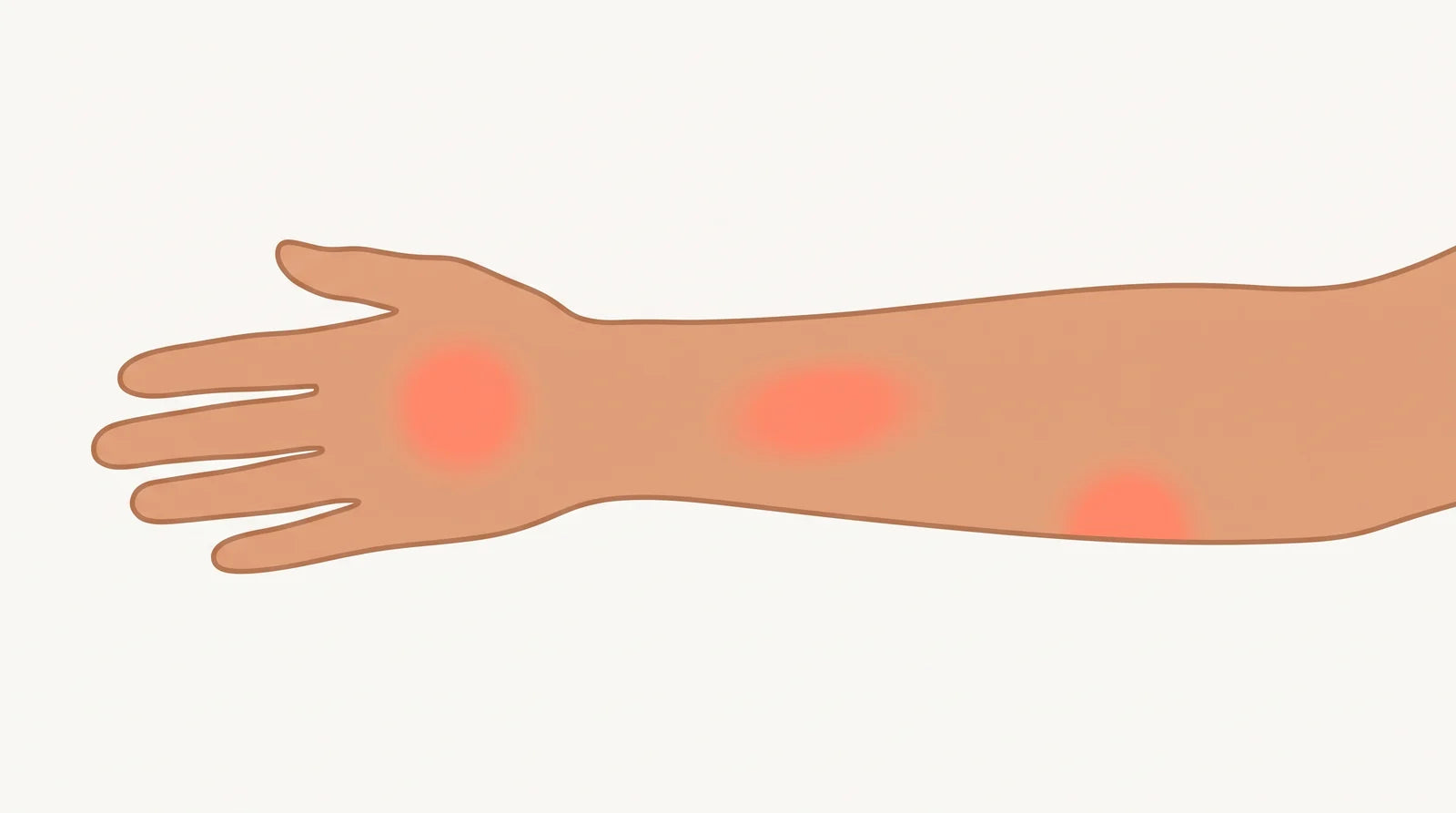
For context, the Zepbound label reports dysesthesia in 0.2% to 0.4% of people on tirzepatide vs 0.1% on placebo. That comparison crosses trials, but the gap is large.
What Lilly says about severity:
- In TRIUMPH-4, the events were "generally mild and rarely led to treatment discontinuation."
- In TRIUMPH-1 to TRIUMPH-3, they were "generally mild to moderate, and the majority resolved during treatment."
- In TRANSCEND-T2D-1, they were "generally mild, with a majority resolving during treatment."
We found no published explanation of what causes it. Lilly has also not reported how long episodes lasted. Approved drugs show a related pattern: a 2026 review of international and French drug safety reports linked skin-sensation problems to semaglutide and tirzepatide (and burning skin to semaglutide), more often at higher doses, and many cases improved after the drug was stopped (Laroche 2026). Those are spontaneous reports, not trial data. If you are in a trial and notice new skin sensations, tell the trial team.
Heart Rate and Heart Safety
Retatrutide raised heart rate in the phase 2 trial, and the phase 3 heart data so far are too sparse to show benefit or harm. A dedicated heart outcomes trial with about 10,000 people is still running.
What the data show:
- Heart rate: in phase 2, increases rose with dose, peaked at week 24, and then declined. The published summary does not give the size of the increase.
- TRIUMPH-1 heart data: severe or serious heart rhythm problems affected 0.2% to 0.9% of people on retatrutide vs 0.9% on placebo, and confirmed major heart events 0.2% to 0.5% vs 0.2% (ADA 2026 presentation). There were too few events to draw a conclusion.
- Heart events: TRIUMPH-3 enrolled 1,949 people with a BMI of 35 or higher and established heart disease. Major heart events "occurred less frequently than anticipated" in both groups.
- Three-part measure: heart-related death, heart attack, or stroke occurred in 27 people on retatrutide vs 23 on placebo, a hazard ratio of 1.12 (95% CI 0.64 to 1.96).
- Five-part measure: adding death from any cause, heart failure events, and procedures to reopen heart arteries gave 44 vs 52 events, a hazard ratio of 0.82 (0.55 to 1.22).
Both confidence intervals include 1.0. That means the results fit with benefit, harm, or no difference, so they settle nothing.
The answer should come from TRIUMPH-Outcomes (NCT06383390), which tracks heart and kidney events. Its estimated primary completion date is February 2029. For comparison, the Zepbound label reports a mean heart rate increase of 1 to 3 beats per minute vs no increase on placebo.
Other Side Effects Reported
Beyond digestive effects and dysesthesia, other retatrutide side effects in the trials included UTIs, low blood pressure, fatigue, and a small number of serious events. Hair loss did not appear among the common events.
Urinary tract infections
UTIs affected 7.5% to 8.8% of people on retatrutide in TRIUMPH-1, vs 5.3% on placebo (Lilly release). In Lilly's ADA 2026 presentation, which reported UTIs in 6.8% to 8.1% on retatrutide vs 4.8% on placebo, 92% of UTIs were in female participants, and none led to stopping treatment. The summaries we reviewed give no rate by sex, so that figure alone does not show how much higher the risk was for women.
The pattern varied by trial. In TRIUMPH-2, UTIs affected 3.8% to 8.0% on retatrutide vs 6.6% on placebo, so the two lower dose groups had rates at or below placebo. Lilly says most UTIs were mild to moderate and resolved during treatment.
Low blood pressure
Low blood pressure (hypotension) was an adverse event of special interest in TRIUMPH-1. It was reported in 2.7%, 5.3%, and 8.8% of people on retatrutide 4, 9, and 12 mg vs 0.9% on placebo (low blood pressure, low blood pressure on standing, and decreased blood pressure combined), so it rose with dose. It was more common in people taking blood pressure medicines, according to the ADA presentation. Dizziness affected 5.0% to 12.0% on retatrutide vs 3.1% on placebo. For context, the Zepbound label lists hypotension in 1% to 2% of people vs 0% on placebo. In the phase 2 registry, 6 of 267 people on retatrutide reported it, vs 0 of 70 on placebo.
Does retatrutide cause hair loss?
We found no evidence that it does, but the data are incomplete. Hair loss did not appear in TRIUMPH-1's table of side effects reported by 5% or more of any group, and it is not in the phase 2 registry tables, which also use a 5% cutoff. Rarer hair loss would not show in either table, and the other phase 3 trials have not released full tables. By contrast, the Zepbound label lists hair loss in 4% to 5% of people vs 1% on placebo, and it was far more common in women than in men on Zepbound (7.1% vs 0.5%). Our page on Zepbound hair loss covers timing and regrowth.
Does retatrutide make you tired?
Yes, fatigue was more common than on placebo. In TRIUMPH-1, 7.4% to 10.6% of people on retatrutide reported fatigue vs 3.6% on placebo (Lilly ADA 2026 presentation). In phase 2, fatigue affected 9.7% of the highest dose group vs 4.3% on placebo, with 2.9% to 12.1% across dose groups. For context, the Zepbound label lists fatigue in 5% to 7% of people vs 3% on placebo.
Serious adverse events
Serious retatrutide side effects (serious adverse events) affected 7.7% to 10.5% of people on retatrutide in TRIUMPH-1, vs 5.5% on placebo (ADA slides). In phase 2 they affected 3.7% vs 4.3%. The phase 2 registry lists one case each of acute pancreatitis, gallbladder inflammation, and acute kidney injury. Single cases in a small trial cannot show whether the drug caused them.
TRIUMPH-1 gives larger numbers, but they are still small (ADA 2026 presentation):
- Pancreatitis (confirmed by a review committee): 0.2% to 0.7% on retatrutide vs 0.3% on placebo, higher at higher doses but only 1 to 4 people per group.
- Severe or serious gallbladder problems: 0.7% to 1.7% vs 0.7%.
- Deaths: 0 to 0.5% vs 0.3%.
These counts are too small to show benefit or harm either way. In TRANSCEND-T2D-1, two people died, both in the 4 mg group, and the published paper judged both deaths unrelated to the drug.
How Long Do Retatrutide Side Effects Last?
Digestive retatrutide side effects eased over time in the trials, but we found no study that published an exact timeline. The TRANSCEND-T2D-1 paper says the digestive events "subsided over time."
What else the trials say:
- Mostly early on: Lilly's TRANSCEND-T2D-1 topline release (March 19, 2026) says digestive events "occurred primarily during dose escalation," that is, mostly in the early months while the dose was being raised. This is sponsor data.
- Dysesthesia and UTIs: Lilly says the majority resolved during treatment.
- No week-by-week data: the TRIUMPH press releases do not say when side effects started or stopped.
- A gentler start: the phase 2 trial showed that a lower starting dose partly reduced digestive effects.
What happens when you stop retatrutide?
We found no published results yet. TRIUMPH-6 (NCT06859268) is testing this directly: after 80 weeks on retatrutide, some participants switch to placebo for 36 weeks. Its estimated primary completion date is April 2028, so results are not expected before then.
Retatrutide vs Zepbound Side Effects
Retatrutide side effects were more frequent than Zepbound's in their separate trials, with more digestive events and far more dysesthesia. No head-to-head result exists yet, so treat this comparison with caution.
| Side effect | Retatrutide 12 mg | TRIUMPH-1 placebo | Zepbound 15 mg | Zepbound label placebo |
|---|---|---|---|---|
| Nausea | 42.4% | 14.8% | 28% | 8% |
| Diarrhea | 32.0% | 13.5% | 23% | 8% |
| Vomiting | 25.3% | 4.8% | 13% | 2% |
| Constipation | 26.1% | 10.9% | 11% | 5% |
| Dysesthesia | 12.5% | 0.9% | 0.4% | 0.1% |
Sources: Lilly TRIUMPH-1 release, May 21, 2026; Zepbound Prescribing Information, revised 08/2026.
Placebo rates were also higher in TRIUMPH-1 (nausea 14.8% vs 8%). The trials differ in population, length, and design, so compare each drug with its own placebo rather than the raw numbers side by side.
Two head-to-head trials will answer this better. TRIUMPH-5 compares retatrutide with tirzepatide in about 800 people, with an estimated primary completion in November 2026. TRANSCEND-T2D-2 compares it with semaglutide in type 2 diabetes and has no results yet. For weight loss results and the full comparison, read retatrutide vs tirzepatide.
For the full tirzepatide picture, read our Zepbound side effects guide. Injection site reactions affected 5.5% to 12.2% of people on retatrutide in TRIUMPH-1 vs 3.8% on placebo (Lilly ADA 2026 presentation). The Zepbound label reports 6% to 8% vs 2% on placebo, from different trials. For site rotation on an approved drug, see Zepbound injection sites.
Eating to Ease Digestive Side Effects
Retatrutide is available only in trials and a narrow expanded access program, but its most common side effects are the same digestive ones seen with approved GLP-1 medicines. The eating habits that help with those medicines are a sensible starting point for anyone on one today.
A 2025 joint advisory from four nutrition and obesity societies (ACLM, ASN, OMA, and TOS) offers practical guidance:
- Eat smaller, more frequent meals while nausea settles, and go easy on fatty or high-fiber foods in the first days of treatment.
- Prioritize protein. The advisory reports proposed intakes of 1.2 to 1.6 grams per kilogram of body weight per day during active weight loss.
- Avoid large or high-fat meals if you have diarrhea.
- Pair fluids with fiber from foods if you get constipated.
- Lift weights. The advisory recommends strength training at least 3 times a week to help protect muscle.

Hitting a protein target with a small appetite takes planning. Greek yogurt, eggs, fish, chicken, tofu, and cottage cheese pack more protein per bite. If you want high-protein recipes and meal ideas sized for a smaller appetite, see our guide.
What the Trials Cannot Tell You Yet
The trials describe common retatrutide side effects well, but they leave rare, long-term, and group-specific risks open. Keep these limits in mind when you read any claim about its safety.
- Most data are not peer reviewed. Three of the four TRIUMPH results are sponsor summaries; TRANSCEND-T2D-1 and TRIUMPH-2 have journal papers. ClinicalTrials.gov shows no posted TRIUMPH results.
- Short follow-up. The trials ran 40 to 80 weeks, with 104 weeks in a TRIUMPH-1 extension of 532 people.
- Specific populations. Average BMI was 40.0 in TRIUMPH-1, 38.2 in TRIUMPH-2, 40.4 in TRIUMPH-3 (where everyone had a BMI of 35 or higher), and 35.8 in TRANSCEND-T2D-1. In TRIUMPH-4, 84% had a BMI of 35 or higher.
- Some people were excluded. TRIUMPH-1 left out people with prior pancreatitis or a personal or family history of medullary thyroid cancer or MEN-2.
- No pregnancy data. We found no published data on retatrutide in pregnancy.
- Cancer questions stay open. In TRIUMPH-1, cancers were reported in 0.9% to 2.1% of people on retatrutide vs 1.0% on placebo, with no pattern by dose; counts were small and 80 weeks is far too short to judge cancer risk. Retatrutide has no label yet, so no boxed warning has been set. Zepbound's label carries a boxed warning for thyroid C-cell tumors seen in rats, and it states that the risk in humans is unknown.
- Stopping numbers mix reasons. Some people stopped because of side effects, and some because they felt they lost too much weight.
When to Get Medical Help
Most retatrutide side effects in the trials were mild to moderate, but get medical help right away for severe stomach pain that will not go away, signs of a serious allergic reaction, or nausea, vomiting, or diarrhea that does not go away. Retatrutide has no Medication Guide, so no official warning list exists for it. The signs in the first table come from the Zepbound Medication Guide, an approved medicine in the same family, and apply to anyone in a trial or on an approved GLP-1 medicine.
| Sign | What to do |
|---|---|
| Severe stomach pain that will not go away, with or without nausea or vomiting, possibly spreading to your back | On Zepbound, stop it and call your healthcare provider right away. In a trial, call the trial team right away |
| Signs of a serious allergic reaction: swelling of your face, lips, tongue, or throat, or problems breathing or swallowing | Get medical help right away. On Zepbound, stop it |
| Other signs of a serious allergic reaction: severe rash or itching, fainting or feeling dizzy, or a very rapid heartbeat | Get medical help right away. On Zepbound, stop it |
| Upper stomach pain, fever, yellow skin or eyes, or clay-colored stools | Call your healthcare provider or trial team right away |
| Nausea, vomiting, or diarrhea that does not go away | Call your healthcare provider or trial team right away. Loss of fluids (dehydration) may cause kidney problems |
| Signs of low blood sugar, such as dizziness, shakiness, sweating, confusion, or a fast heartbeat, especially if you also take insulin or a sulfonylurea | Follow the low blood sugar plan you agreed with your healthcare provider, and tell your healthcare provider or trial team. (The Medication Guide lists these signs but gives no step for them; this action is general advice.) |
The second table is general advice based on the retatrutide trial data. These rows are not in the Zepbound Medication Guide.
| Sign | What to do |
|---|---|
| Dark urine or passing little urine | Call your healthcare provider or trial team; these can be signs of dehydration |
| Feeling lightheaded when you stand, especially on blood pressure medicines | Tell your healthcare provider or trial team; low blood pressure was more common on retatrutide in TRIUMPH-1 |
| New skin tingling or burning that is severe or does not fade | Tell your healthcare provider or trial team |
| Any problem after using an unapproved "research" product | Get medical care, bring the product with you, and report it to FDA MedWatch (1-800-FDA-1088) |
If you are in a trial, the trial team is your first contact for any new symptom.
Key Takeaways
- Digestive effects are the most common. Nausea, diarrhea, constipation, and vomiting led the list in the phase 3 trials.
- Dysesthesia is the distinctive one. Skin sensations reached up to 20.9%, far above the 0.4% in the Zepbound label.
- Heart data are unsettled. TRIUMPH-3 found few events, and an outcomes trial runs to 2029.
- It is not approved. Lilly plans to file in early 2027, and the FDA warns against "research" products.
Retatrutide side effects look familiar for this drug class, with one new skin signal and several open questions. The full picture will come from peer-reviewed papers, the head-to-head trials, and an FDA review.
Frequently Asked Questions
Is retatrutide safe?
Its safety is still being studied. In five phase 3 trials most side effects were digestive and mild to moderate, but serious adverse events were more common than on placebo in TRIUMPH-1, long-term data do not exist yet, and the FDA has not approved it.
What are the most common side effects of retatrutide?
Nausea, diarrhea, constipation, vomiting, and decreased appetite. Skin sensations (dysesthesia) and urinary tract infections were less common but still more frequent than on placebo.
Does retatrutide cause hair loss?
We found no evidence that it does, but the data are incomplete. Hair loss did not appear in TRIUMPH-1's table of side effects reported by 5% or more of any group, or in the phase 2 registry tables, which use the same cutoff. Rarer hair loss would not show in either table, and the other phase 3 trials have not released full tables.
Does retatrutide make you tired?
Fatigue was more common than on placebo: 7.4% to 10.6% on retatrutide vs 3.6% on placebo in TRIUMPH-1, and 9.7% in the highest phase 2 dose group vs 4.3% on placebo.
Is dysesthesia from retatrutide permanent?
Lilly reports that most cases were mild to moderate and that the majority resolved during treatment. It has not published how long episodes lasted or what happened after people stopped.
Can retatrutide cause cancer?
The trials cannot answer this yet. In TRIUMPH-1, cancers were reported in 0.9% to 2.1% of people on retatrutide vs 1.0% on placebo, with no pattern by dose. Counts were small and follow-up lasted 80 weeks, far too short to judge cancer risk. Retatrutide has no FDA label yet, so no cancer warning has been set either way.
Are reta peptide side effects the same as in the trials?
We found no data on this. The FDA calls products sold for research use illegal unapproved drugs of unknown quality, and the trial data describe only Lilly's trial drug given under medical supervision.
When will retatrutide be approved?
No approval date exists. Lilly plans to submit retatrutide to the FDA in the first quarter of 2027, and the FDA then has to review it.
Is retatrutide worse than Zepbound for side effects?
Digestive side effects and skin sensations were more common in retatrutide trials than in the Zepbound label trials, but those are different studies. The head-to-head TRIUMPH-5 trial has not reported yet.
References
- FDA's Concerns with Unapproved GLP-1 Drugs Used for Weight Loss, content current as of 09/01/2026: U.S. Food and Drug Administration
- FDA warning letter MARCS-CMS 721806 (CDER), March 31, 2026: U.S. Food and Drug Administration, Warning Letters database
- FDA warning letter MARCS-CMS 734884 (CDER), August 24, 2026: U.S. Food and Drug Administration, Warning Letters database
- MedWatch: FDA Safety Information and Adverse Event Reporting Program: U.S. Food and Drug Administration
- openFDA drugsfda query for generic name retatrutide, September 24, 2026: no match
- TRIUMPH-4 topline results, December 11, 2025: Eli Lilly
- TRANSCEND-T2D-1 topline results, March 19, 2026: Eli Lilly via PR Newswire
- TRIUMPH-1 topline results, May 21, 2026: Eli Lilly
- TRIUMPH-1 and TRANSCEND-T2D-1 results at ADA, June 6, 2026: Eli Lilly
- TRIUMPH-1 presentation, ADA Scientific Sessions 2026: Lilly Medical
- TRIUMPH-2 and TRIUMPH-3 topline results and US submission plan, July 23, 2026: Eli Lilly
- Lilly to present new data at EASD 2026, September 15, 2026: Eli Lilly via PR Newswire
- Jastreboff AM et al. Triple-Hormone-Receptor Agonist Retatrutide for Obesity: A Phase 2 Trial. N Engl J Med, 2023
- Phase 2 retatrutide obesity trial results, NCT04881760: ClinicalTrials.gov
- Rosenstock J et al. Retatrutide, a GIP, GLP-1 and glucagon receptor agonist, for people with type 2 diabetes: a randomised, double-blind, placebo and active-controlled, parallel-group, phase 2 trial conducted in the USA. Lancet, 2023;402:529-544
- Bajaj HS et al. Efficacy and safety of retatrutide, a GIP, GLP-1, and glucagon receptor agonist, in people with type 2 diabetes and inadequate glycaemic control with diet and exercise (TRANSCEND-T2D-1): a double-blind, randomised, phase 3 trial. Lancet, 2026;407:2402-2413
- TRIUMPH-1, NCT05929066: ClinicalTrials.gov
- TRIUMPH-4, NCT05931367: ClinicalTrials.gov
- TRIUMPH-5 (retatrutide vs tirzepatide), NCT06662383: ClinicalTrials.gov
- TRIUMPH-6 (maintenance after switching to placebo), NCT06859268: ClinicalTrials.gov
- TRIUMPH-Outcomes, NCT06383390: ClinicalTrials.gov
- TRANSCEND-T2D-2 (retatrutide vs semaglutide), NCT06260722: ClinicalTrials.gov
- Pre-approval expanded access of retatrutide, NCT07629401: ClinicalTrials.gov
- Zepbound (tirzepatide) Prescribing Information, revised 08/2026: Eli Lilly
- Zepbound Medication Guide, revised 08/2026: Eli Lilly
- Nutritional priorities to support GLP-1 therapy for obesity: joint advisory from ACLM, ASN, OMA, and TOS, 2025
- Laroche ML et al. Dysesthesia associated with GLP-1 agonist therapies: data-mining analysis and literature review. Eur J Clin Pharmacol, 2026;82(6)
- Branine N. Online-sourced retatrutide complicating impending diabetic ketoacidosis in a patient with type 1 diabetes and concurrent Shigella gastroenteritis. Cureus, 2026;18(8):e115260
- Bellido V et al. Retatrutide in adults with obesity and type 2 diabetes (TRIUMPH-2): a double-blind, parallel-group, randomised, placebo-controlled, phase 3 trial. Lancet, 2026, online September 29 (PMID 42810372)
This article is for education only and is not medical advice. It summarizes published trial results, FDA statements, and the Zepbound label, and it gives no dosing advice. Retatrutide is not FDA approved; talk to your healthcare provider about your treatment options. Read our full medical disclaimer.